Our system will evaluate the answer based on this AI-generated description.
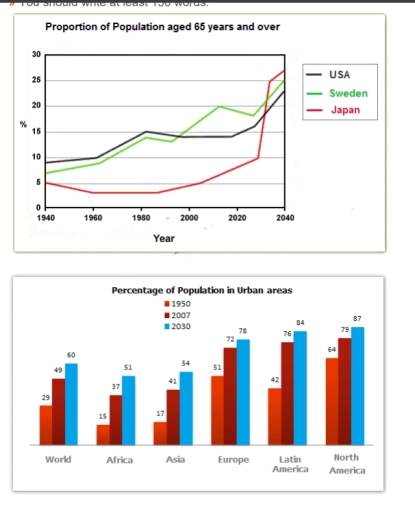
The image features two visuals: a line graph and a bar chart. The line graph depicts the proportion of the population aged 65 years and over from 1940 to 2040 for three countries. For the USA, figures are approximately 9% in 1940, 10% in 1960, 12% in 1980, 13% in 2000, 20% in 2020, 22% projected in 2020, and 23% by 2040. Sweden shows about 7% in 1940, 10% in 1960, 17% in 1980, 17% in 2000, 18% in 2020, projected at 19% in 2020, and 25% by 2040. Japan starts with around 5% in 1940, 8% in 1960, 10% in 1980, 17% in 2000, elevating to 27% by 2020-2040. The bar chart highlights the percentage of the population in urban areas across different regions for 1950, 2007, and 2030. Globally, urban population percentage is 29% in 1950, 49% in 2007, 60% in 2030. In Africa, it's 15% in 1950, 37% in 2007, 51% in 2030. For Asia, 17% in 1950, 41% in 2007, 55% in 2030. Europe's values are 51% in 1950, 72% in 2007, 78% in 2030. Latin America is at 42% in 1950, 76% in 2007, 84% in 2030. In North America, values are 64% in 1950, 79% in 2007, 87% in 2030.
Given the complexity of the image, the above description may not be entirely accurate.
Skyrocket your IELTS band score by 1-2 points in under a month with our premium plan!
Note: Both the topic and the answer were created by one of our users.
The line chart illustrates the proportion of population aged 65 years and older in three countries (the USA, Sweden and Japan) from 1940 and its predictions until 2040 while the bar chart indicates the percentage of population in urban areas in the world, Africa, Asia, Europe, Latin America and North America between 1950 and its anticipations until 2030.
Overall, an upward trend will be recorded in all countries with the striking changes in Japan. As can be clearly seen, Africa will account for the lowest figure in all years.
In detail, Japan will witness a gradual decrease from 5% to 4% between 1940 and 1960, followed by no change until 1990 and a dramatic increase to 26% in 2040. Like wise, China’s and Sweden’s population aged 65 years and older will significantly rise by 14% and 18% to 24% and 25% in 100 years.
Regarding, 64% of North American people lived in urban areas at the beginning, which indicated a disparity of 13%, 22%, 35% and over 48% in Europe, Latin America, the world, Asia and Africa. After that, there will be a marked growth to 87% and 78% in North America and Europe as opposed to a remarkable by 42%, 31%, 35% and 37% in Latin America, the world, Asia and Africa respectively in the final year.
Word Count: 218
