Our system will evaluate the answer based on this AI-generated description.
The image contains two graphs: the first graph displays world population growth from 1800 to 2100, showing population values of 1 billion in 1800, increasing to roughly 2.5 billion in 1950, then up to 6 billion by 2000, peaking at around 10 billion between 2050-2100; the second graph illustrates urban population projections from 2015 to 2040, wherein 2015 urban population stood at under 3 billion in developing regions and over 1 billion in developed regions, rising steadily over the years; by 2020, populations reached approximately 2.8 billion and 1.2 billion respectively; in 2025, near 3 billion and over 1.2 billion; 2030 data estimates around 3.5 billion for developing regions and 1.5 billion for developed regions; 2035 projection shows developing regions approaching 3.7 billion and developed regions hitting near 1.7 billion; by 2040, developing regions are expected to surpass 4 billion while developed regions stay close to 1.8 billion.
Given the complexity of the image, the above description may not be entirely accurate.
Skyrocket your IELTS band score by 1-2 points in under a month with our premium plan!
Note: Both the topic and the answer were created by one of our users.
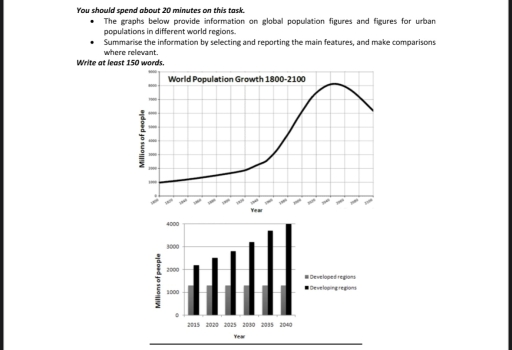
The graph describes world urban population change from 1800 to 2100. The bar chart illustrates different populations of developed areas and developing areas.
In the graph, there is a significant increase of human being during 20c. Over 60 million of peoples are born within 30 years, which is such a skyrocket growth. Notably, there is no deduction of population until 2020. But from 2040, the whole amount of population seems to getting decrease. Following the graph, this is first time that the population is recorded decrease, which is significantly change.
When it comes to bar chart, the most outstanding result is steady increase of population in developing areas. In 2015, the number of people who living in developing regions are around 2000 millions. The figures of populations increase steadily and eventually record 4000 millions in 2040, which is almost double growth compares with 2015. In contrast, the population in developed areas contain not much change. Of course, little chanes are exist but it is ignoable.
Word Count: 165
