🔥 Today Only: Save 30% on Premium — Offer Ends Soon! - Upgrade Now!
Line Graph

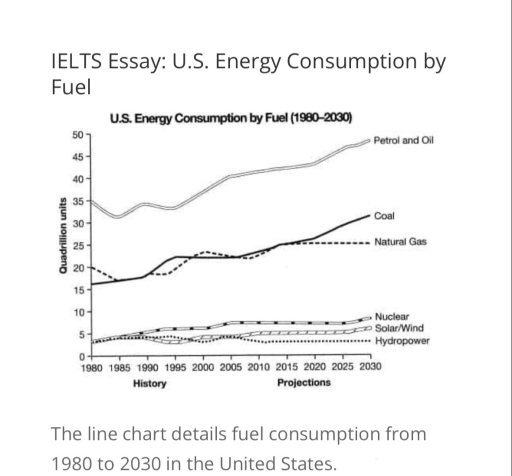
Band 6+: The line chart details fuel consumption from 1980 to 2030 in the United States.

Image for topic: The line chart details fuel consumption from 1980 to 2030 in the United States.
Our system will evaluate the answer based on this AI-generated description.
The image depicts a line chart titled "U.S. Energy Consumption by Fuel (1980-2030)" with six labeled lines representing "Petrol and Oil," "Coal," "Natural Gas," "Nuclear," "Solar/Wind," and "Hydropower." The chart's X-axis spans from 1980 to 2030, with the years 1985, 1995, 2005, 2010, 2015, 2020, and 2025 marked. The Y-axis measures quadrillion units from 0 to 50, in increments of 5. "Petrol and Oil" begins at approximately 30 quadrillion units in 1980, peaking near 45 in 2010 and projected to rise slightly above that by 2030. "Coal" starts near 15, peaks at 25 around 2005, and is projected to decline to just above 20. "Natural Gas" begins below 15, surpasses "Coal" near 2010 just under 25, and is expected to reach 30 by 2030. "Nuclear" maintains a steady rise from 5 in 1980 to a projected 10 in 2030. "Solar/Wind" starts at 0, shows a sharp increase after 2010, and is projected to surpass "Nuclear" by 2030, reaching approximately 15. "Hydropower" hovers consistently around 5 quadrillion units throughout the timeline.
Given the complexity of the image, the above description may not be entirely accurate.
Note: Both the topic and the answer were created by one of our users.

The chart illustrates data about energy use in USA from 1980 to 2030.

Overall, the amount of petrol, oil and coal energy used predicted to grow significantly. In contrast, it is predicted that nuclear and hydropower energy consumption will remain relatively stable.

To begin, between 1980 and 1995 pertol and oil energy consumption fluctuated between 30 and 35 quadrilion, after 5 years it’s figure increased sharply to 40 quadrilion units. Pertol and oil value set to increase consistently and reach a peak of around 48 quadrilion. While the amount of coal energy consumed was just over 16 quadrilion at the beginning of the period, and figure for this projected to rise steadily to 30 quadrilion.

As for natural gas, it’s usage predicted to witness an upward trend after hovering between 15 and 25 quadrlions, moreover, it is projected that it’s figure will remain relatively unchanged from 2015 and 2030. Turning to nuclear, solar/wind and hydropower energy, it is projected that it’s value will remain relatively stable with some fluctuation throughout the period.

Word Count: 172

Answers On The Same Topic:

The line chart details fuel consumption from 1980 to 2030 in the United States.

The provided chart gives the detail of US energy utilization by petroleum products from 1980 to 2030. Overall, except hydro power all sectors of petroleum experienced an upward trend, along with coal, natural gas,petrol and oil having significant use as well nuclear and solar/wind have minor rise of consumption. As the Graph shows that the […]

The line chart details fuel consumption from 1980 to 2030 in the United States.

The line graph demonstrates the consumption of fuel between 1980 to 2030 in the United States Overall, it can be observed that the pertrol and oil have the most dominant number of fuel consumption, while the opposite was true for hydropower. In addition To begin with, In 1980, 35 Quadrillion units were generated using Petrol […]

The line chart details fuel consumption from 1980 to 2030 in the United States.

The line graph provides data from a 2008 report about usage of energy in the United States of America from 1980 with predictions up to 2030, measured in quadrillion units. Overall, it is clear that America mostly relied on fossil fuels, which will continue in the future. Petrol and Oil was the highest amount in […]

The line chart details fuel consumption from 1980 to 2030 in the United States.

The graph illustrates the data from an Annual energy outlook regarding the daily consumption of six different energies in the USA for the fifty year period from the year 1980 to 2030. The energy consumption is measured in quadrillion units. Overall, petrol and oil was the most consumed fuel across the time period. The least […]

See All

Other Topics:

Task 1: The line graph shows the percentages of Australian exports with four countries.

The line chart illustrates how the proportion of Austrialin exponts changed in four different countries over a period 22 years, starting from years. were Overall, it can be seen that there were upwared trends in the China, US and India wheras the Japan was showed a downwand trend over a perciod. According to the chant, […]

The line graph provides data on the quantity of parcels delivered by two major mail service companies, FedEx and TNT, between 1920 and 2000.

The line graph illustrates how many parcels were transported by FedEx and TNT mail services companies over the 80 years between 1920 and 2000. Overall, TNT company deliveries showed a significant increase over the period shown until being more popular. Although the number of items delivered by FedEx fluctuated, this figure remained dominant for most […]

The chart below gives information about car ownership in households in the UK between 1951 and 2007.

The line graph illustrates car ownership in Britain from 1951 to 2007. Overall, almost all figures, namely, people who owned one car, two cars and, three or more cars followed an upward trend. The reverse was true for no car ownership, despite being the most common option to at the beginning of the period. As […]

Task 1: The graph below shows the average time spent by four car manufacturers to produce vehicles at their US factories.

The line graph compares the average number of hours required to manufacture vehicles in the US by four car companies – General Motor, Ford, Toyota and Honda – between 1998 and 2005. Overall, the time needed to produce cars generally declined over the period, especially for General Motor and Ford. Japanese manufacturers, Toyota and Honda, […]

The graph below shows the percentage of people by age group visiting the cinema at least once per month in one particular country between 1978 and 2008. Summarise the information by selecting and reporting the main features, and make comparisons where relevant.

The line graph illustrates the proportion of people by age bracket who visited the cinema at least once a month in a specific nation from 1978 to 2008. Overall, it is clear that there were some minor fluctuations in the rates of people of all ages going to the cinema. Additionally, young adults aged 14-24 […]

the graph shows the average trip length(in miles) in US children aged 5 to 15 years old.

The provided chart illustrates the average length of trip (in miles) among teenagers in the United States for twenty years old). Overall, It can be seen that there is a difference between the standard of long travels in the United States in which the bus becomes the highest trend and walking is the lowest one. […]

See All
We have detected unusual activity on your device.
Please verify your identity to continue.
Note: This verification step won't sign you in. If you have a premium account, please log in to access the service as usual.
Google/Gmail Verification
Or verify using Email/Code
We've sent a verification code to:
youremail@gmail.com (Not your email?)
Enter it below to complete the verification process.
Ensure your email address is correct, your inbox is not full, and you check your spam folder. If no email arrives, consider using an alternative email.
You will need a Premium plan to perform your action!
Note: If you already have a premium account, please log in to access our services as usual.

Plans & Pricing

Our mission is to make quality education accessible for everyone.
However, to keep our hardworking team running and this service alive, we genuinely need your support!
By opting for a premium plan, not only do you sustain us in achieving the mission, but you also unlock advanced features to enrich your learning experience.

Free

For learners who aren't pressed for time

What's included on Free
100+ Cambridge IELTS Tests
Instant IELTS Writing Task 1 & 2 Evaluation (2 times/month)
Instant IELTS Speaking Part 1, 2, & 3 Evaluation (5 times/month)
Instant IELTS Writing Task 1 & 2 Essay Generator (2 times/month)
500+ Dictation & Shadowing Exercises
100+ Pronunciation Exercises
Flashcards
Other Advanced Tools

Premium

For those serious about advancing their English proficiency, and for IELTS candidates aspiring to boost their band score by 1-2 points (especially in writing & speaking) in just 30 days or less

What's included on Premium
Save Your IELTS Test Progress
Unlock All Courses & IELTS Tests
Unlimited AI Conversations
Unlimited AI Writing Enhancement Exercises
Unlimited IELTS Writing Task 1 & 2 Evaluation
Unlimited IELTS Speaking Part 1, 2, & 3 Evaluation
Checked Answers Will Not Be Published
Unlimited IELTS Writing Task 1 & 2 Essay Generator
Unlimited IELTS Speaking Part 1, 2, & 3 Sample Generator
Unlimited Usage Of Advanced Tools
Priority Support within 24h (12-month plan only)

Due to the nature of our service and the provided free trials, payments are non-refundable.
Nếu bạn là người Việt Nam và không có hoặc không muốn trả bằng credit/debit cards, bạn có thể thanh toán bằng phương thức chuyển khoản:


Chọn gói:
419,000₫ 277,000 ₫ cho gói 1 tháng (chỉ 9,233₫/ngày)
1,239,000₫ 597,000 ₫ cho gói 3 tháng (chỉ 6,633₫/ngày)
2,469,000₫ 1,027,000 ₫ cho gói 6 tháng (chỉ 5,706₫/ngày)
4,929,000₫ 1,417,000 ₫ cho gói 12 tháng (chỉ 3,936₫/ngày)


Sau khi chuyển khoản, vui lòng đợi trình duyệt tự động điều hướng bạn trở lại Engnovate và bạn sẽ ngay lập tức nhận được mã kích hoạt tài khoản premium.
Nếu có lỗi xảy ra, bạn có thể liên hệ với team thông qua một trong các phương thức: email đến helloengnovate@gmail.com hoặc nhắn tin qua facebook.com/engnovate.
Vì toàn bộ công cụ trên website đều có thể sử dụng thử miễn phí, Engnovate không hỗ trợ hoàn tiền.