Our system will evaluate the answer based on this AI-generated description.
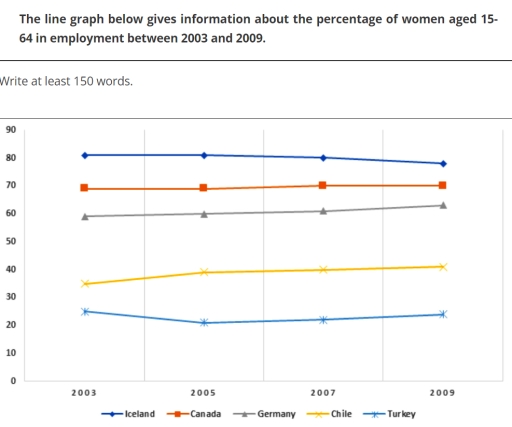
The image shows a line graph displaying the percentage of women aged 15-64 in employment between 2003 and 2009 in five different countries (Iceland, Canada, Germany, Chile, and Turkey). Data points for each country are represented by distinct shapes for each year. In 2003, Iceland had about 80%, Canada had about 70%, Germany had around 60%, Chile had approximately 35%, and Turkey started with about 25%. By 2005, Iceland's percentage increased slightly to just above 80%, Canada remained close to 70%, Germany showed a small increase to just above 60%, Chile's percentage dropped to just below 35%, and Turkey decreased to around 23%. In 2007, Iceland's percentage remained above 80%, Canada's stayed near 70%, Germany's increased to about 65%, Chile rose slightly to just above 35%, and Turkey decreased further to just above 20%. In the final year, 2009, Iceland's percentage remained steady above 80%, Canada's stayed near 70%, Germany's increased slightly to around 67%, Chile decreased to just below 35%, and Turkey decreased further to just below 20%. The graph illustrates trends over the six-year period for each country in terms of the percentage of women employed within the specified age range.
Given the complexity of the image, the above description may not be entirely accurate.
Skyrocket your IELTS band score by 1-2 points in under a month with our premium plan!
Note: Both the topic and the answer were created by one of our users.
The graph illustrates the percentage of the female employees in five different countries, namely Iceland, Canada, Germany, Chile, Turkey, between 15 to 64-years-old, spanning from 2003 to 2009.
Overall the change of percentage experienced a fluctuation and is stable, while Iceland stand at the top status, Canada act as the first-runner-up, Germany at he middle, while Chile below, whereas Turkey at the lowest.
From 2003 to 2005, Iceland levelled off at 80%, while Canada followed former’s action and kept constant at 69%, surprisingly, Germany remained the same at 58% as the actions of the two countries. On the contrary, Chile experienced a significant increase from 34% to 38%, simultaneously, Turkey fell from sky to the ground that it dropped from 24% to 21%.
Since 2005 till 2009, Iceland decreased slightly from 80% to 77%, in contrast, Canada rose a bit from 69% to 71%, interestingly, Germany acted as the shadow, raised a little from 58% from 61%. Considering the other two countries, Chile continued to skyrocketing from 38% to 41%, whereas Turkey warmed back from 21% to 26%.
Word Count: 178
