Our system will evaluate the answer based on this AI-generated description.
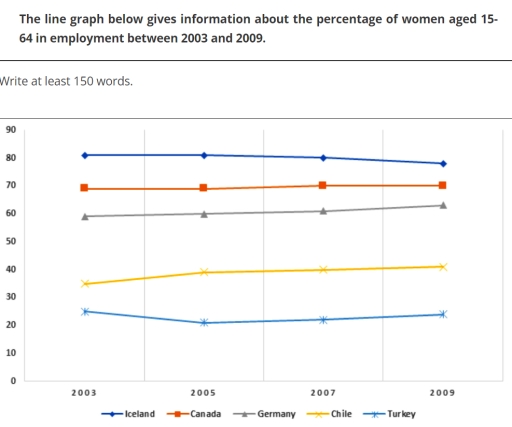
The image shows a line graph displaying the percentage of women aged 15-64 in employment between 2003 and 2009 in five different countries (Iceland, Canada, Germany, Chile, and Turkey). Data points for each country are represented by distinct shapes for each year. In 2003, Iceland had about 80%, Canada had about 70%, Germany had around 60%, Chile had approximately 35%, and Turkey started with about 25%. By 2005, Iceland's percentage increased slightly to just above 80%, Canada remained close to 70%, Germany showed a small increase to just above 60%, Chile's percentage dropped to just below 35%, and Turkey decreased to around 23%. In 2007, Iceland's percentage remained above 80%, Canada's stayed near 70%, Germany's increased to about 65%, Chile rose slightly to just above 35%, and Turkey decreased further to just above 20%. In the final year, 2009, Iceland's percentage remained steady above 80%, Canada's stayed near 70%, Germany's increased slightly to around 67%, Chile decreased to just below 35%, and Turkey decreased further to just below 20%. The graph illustrates trends over the six-year period for each country in terms of the percentage of women employed within the specified age range.
Given the complexity of the image, the above description may not be entirely accurate.
Skyrocket your IELTS band score by 1-2 points in under a month with our premium plan!
Note: Both the topic and the answer were created by one of our users.
The line graph performs data about the percentage of female around 15-64 year old who are employed in the period of 2003 to 2009.
As a shole, in the five nations, including Iceland, Canada, Germany, Chile and Turkey remained constant throughout the whole peroid between 2003 to 2009. The rankings of the level of female working group did not alter in seven years,. The decending order of rankings started with Iceland, Canada, Germany, Chile and Turkey, the percentage of fevale working group was 80%, 70%, nearly 60%, and slightly above 25%.
At the beginning, the percentage of that of Iceland was modestly over 80%, staying at the same level after 2 years. Then it slowly dropped below 80% 4 years later. Canada, reached 70%, become very stable form 2003 to 2005. The percentage of Canada climbed unnoticably in 2005, with a small percentage increase till the end of 2008. In the start, Germany rose more steadily, from 60% to slightly above 60%. Germany shortened the gap between Canada. It stated that Iceland Canada and Germany, that relatively more women are working, had not faced a significant increases in seven years.
Apart form Iceland, anada and Cermany, Chile and Turkey las the second lowest rankings throughout the whole period. Chile, in the middle of 45%, faced a crucial growth in percentage to 40%, while Turkey has a more subtle increase from 2005 to 2009 after a sudden drop to its trough to above 20%. The difference in percentage between Chile and Turkey widened by 2003.
Word Count: 254
