Our system will evaluate the answer based on this AI-generated description.
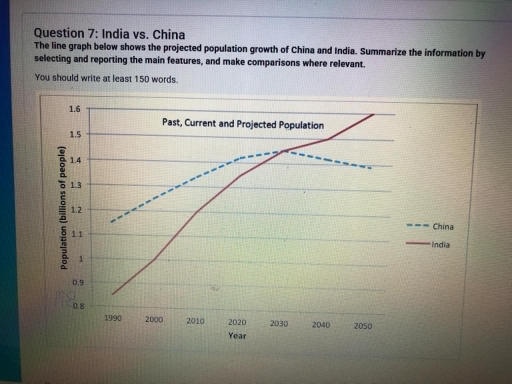
The image displays a line graph illustrating population data (billions of people) for China and India from 1990 to 2050. In 1990, China's population starts at 1.13 billion while India's is approximately 0.87 billion. By 2000, China's population reaches around 1.25 billion and India's near 1.01 billion. In 2010, China is at 1.34 billion and India at 1.17 billion. By 2020, China has a population of roughly 1.41 billion, and India has 1.32 billion. For 2030, China's projected population is 1.43 billion, and India's is 1.47 billion, marking India's population surpassing China's. In 2040, China is projected at roughly 1.44 billion and India at 1.57 billion. By 2050, China's population is expected to decline to 1.42 billion, while India's increases to 1.61 billion, maintaining India's position as more populated than China. The graph's horizontal axis represents years from 1990 to 2050, and the vertical axis indicates population in billions.
Given the complexity of the image, the above description may not be entirely accurate.
Skyrocket your IELTS band score by 1-2 points in under a month with our premium plan!
Note: Both the topic and the answer were created by one of our users.
The line graph illustrates the expected population growth of two countries, China and India.
Overall, it can be seen that China’s population is predicted to decrease, while the Indian population is planned to increase by the final year, overtaking the Chinese population.
To begin, in 1990, the number of inhabitants was under 1 billion in India, then it rose significantly to approximately 1.35 billion of people in 2020. Moreover, the number of citizens is predicted to increase dramatically to 1.6 billion by 2050
However, the Chinese population was around 1.15 billion in 1990, then it is forecasted to rise to approximately 1.45 billion of people in 2030, before planning to decrease just under 1.4 billion of people by 2050.
Word Count: 119
