Our system will evaluate the answer based on this AI-generated description.
The image contains a line graph illustrating the average attendance per top-level football match in Italy, England, and Germany from 1980 to 2004. In 1980, Italy had an attendance of 39,000, England 32,000, and Germany 25,000. By 1984, Italy's attendance slightly decreased to 38,000, England’s increased to 34,000, and Germany maintained 25,000. In 1988, Italy’s figure was 31,000, England's decreased to 30,000, and Germany's was stable at 25,000. In 1992, Italy's attendance further dropped to 29,000, England’s dipped to 21,000, while Germany's rose to 30,000. By 1996, Italy had 29,000, England slightly increased at 24,000, and Germany remained at 30,000. In 2000, Italy’s remained constant at 29,000, England increased to 33,000, and Germany stayed at 29,000. Finally, in 2004, Italy had 29,000, England rose to 35,000, while Germany experienced an increase to 33,000.
Given the complexity of the image, the above description may not be entirely accurate.
Skyrocket your IELTS band score by 1-2 points in under a month with our premium plan!
Note: Both the topic and the answer were created by one of our users.
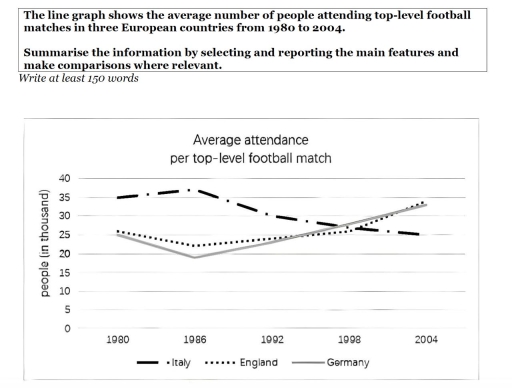
The provided graph illustrates the average attendance in top-level football matches in three European countries between 1980 and 2004. Units are measured in thousands. Overall, the number of average attendances in England and Germany increased throughout the period, whereas the reverse was true in Italy. In addition, the number of attendances in Italy dominated at the outset prior to a considerable drop by 2004, and being overtaken by both England and Germany. What stands out most is that England and Germany, which reached parity at the end of the period.
Focusing on decreasing trends first. Italy captured 35 thousand individuals in 1980, recording the dominant figure. This was followed by a gradual increase, hitting an all-time high of about 37 thousand in 1986. However, the figure then decreased steadily until 2004, hitting its low of 25 thousand people.
Looking at the other remaining figures. England and Germany recorded relatively similar number at the outset, with standing at just above and below 25 thousand, respectively. Despite a notable fall, both figures rose considerably to approximately 34 thousand in 2004, reaching parity.
Word Count: 180
