Our system will evaluate the answer based on this AI-generated description.
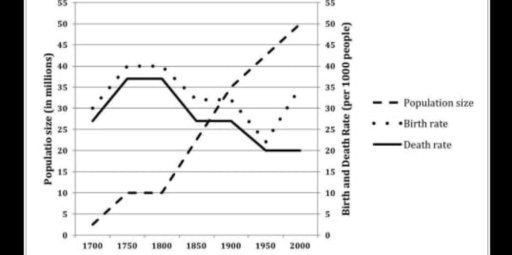
The image is a graph with two y-axes, showing population size (in millions) on the left and birth and death rate (per 1,000 people) on the right, plotted across a timeline from 1700 to 2000 on the x-axis. Three lines represent population size (dashed), birth rate (dotted), and death rate (solid). Population size starts at approximately 5 million in 1700, rises to just over 10 million around 1750, drops below 10 million by 1800, then climbs steadily to reach 30 million by 1850, around 40 million by 1900, and exceeds 50 million by 2000. Birth rate begins at about 30 per 1,000 people in 1700, fluctuates between 30 to just over 40 until 1850 where it peaks close to 50, then steeply declines to below 20 by 2000. Death rate starts just above 40 per 1,000 people in 1700, peaks at around 45 by 1750, drops to 20 by 1800, rises back to around 30 by 1850, and then falls to below 10 by 2000.
Given the complexity of the image, the above description may not be entirely accurate.
Skyrocket your IELTS band score by 1-2 points in under a month with our premium plan!
Note: Both the topic and the answer were created by one of our users.
The line graph gives information about changes in population size also birth and death figures in England ans Wales between 1700 and 2000.
Overall, it can be seen from the graph that the number of population size increased sharply. By comparison, the rates for birth and death experienced fluctuation. Birth rate remained higher than death over the whole period.
In the beginning with 1700, the number of population size was approximately 2.5 million. Then it showed a considerable rise to 10 million and remained stable until 1800. Starting from 1800 onwards, the figure of population increased exponentially to 50 million in the and of the period.
Focusing on birth and death rates, both figures fluctuated during the period. The birth rate was slightly higher than the death rate around 30 and 27 per 1000 people, respectively. Both of them had same changes until 1850. After that the gap between them became wider. By 1950, both rates decreased noticeably to around 20 per 1000 people. While the figure of death remained unchanged until 2000, the birth rate rose dramatically to 34 per 1000 people.
Word Count: 183
