🔥 Today Only: Save 30% on Premium — Offer Ends Soon! - Upgrade Now!
Line Graph

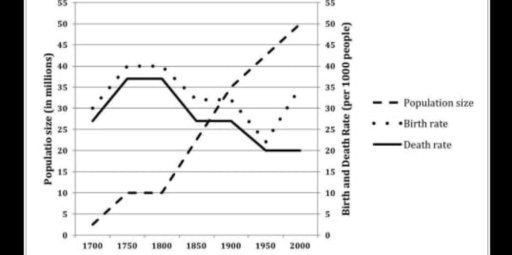
Band 4+: The line graph shows the changes i. Population size, birth rate and a thread overy period of 1700 to 2000. Summarise information by selecting and reporting me features and make comparisons where relevant.

Image for topic: The line graph shows the changes i. Population size, birth rate and a thread overy period of 1700 to 2000. Summarise information by selecting and reporting me features and make comparisons where relevant.
Our system will evaluate the answer based on this AI-generated description.
The image is a graph with two y-axes, showing population size (in millions) on the left and birth and death rate (per 1,000 people) on the right, plotted across a timeline from 1700 to 2000 on the x-axis. Three lines represent population size (dashed), birth rate (dotted), and death rate (solid). Population size starts at approximately 5 million in 1700, rises to just over 10 million around 1750, drops below 10 million by 1800, then climbs steadily to reach 30 million by 1850, around 40 million by 1900, and exceeds 50 million by 2000. Birth rate begins at about 30 per 1,000 people in 1700, fluctuates between 30 to just over 40 until 1850 where it peaks close to 50, then steeply declines to below 20 by 2000. Death rate starts just above 40 per 1,000 people in 1700, peaks at around 45 by 1750, drops to 20 by 1800, rises back to around 30 by 1850, and then falls to below 10 by 2000.
Given the complexity of the image, the above description may not be entirely accurate.
Note: Both the topic and the answer were created by one of our users.

The line graph show data about changes in population size, birth rate and also death rate between 1700 and 2000.

From an overall praspactive, the nuber of population dramticly incrased, while the nuber of death rate minimally decreased, while the number of birth rate almost no changed over the period.

Looking at the 1700 population size was around 3 million. It minimally rose to 10 million by 1750.

After that it dramticly incrased to 50 million coupled with reached at peak. In 1700 Birth rate was 30 million. It slowly grew up to 40 million in 1750. Coming in 1950 it significantly dropped to about 22 million. After that in minimally increased to a bit less than 35 million by 2000d In 1700 death rate was around 27 million. In 1750 it went up to between 40 and 35. It significantly declined to about 27 by 1850. Coming in 2000 it again dropped to 20 million.

Word Count: 156

Answers On The Same Topic:

The line graph shows the changes i. Population size, birth rate and a thread overy period of 1700 to 2000. Summarise information by selecting and reporting me features and make comparisons where relevant.

The line graph illustrates changed ,namely the population size, birth rate and the death rate in England and Wales, between 1700 and 2000. Overall, the number of population size stood at the lowest at the beginning, while it increased dramatically at the end of the survey. However, the figure for birth rate fluctuated over a […]

The line graph shows the changes i. Population size, birth rate and a thread overy period of 1700 to 2000. Summarise information by selecting and reporting me features and make comparisons where relevant.

The line graph provides information about how the population size, birth and death rates changed in two countries England and Wales between 1700 and 2000. It can be seen from the graph that, the population size experienced an upward trend, whereas both birth rate and death rate followed a considerable fluctuating pattern throughout the period. […]

The line graph shows the changes i. Population size, birth rate and a thread overy period of 1700 to 2000. Summarise information by selecting and reporting me features and make comparisons where relevant.

The line chart elucidates the changes in population size, birth rate, and death rate per 1000 people in the year of 1700 to 2000. In general, the population size experienced rise sharply until the end of period. Although the number population of birth rate and date rate increased in the early year of 1700, both […]

The line graph shows the changes i. Population size, birth rate and a thread overy period of 1700 to 2000. Summarise information by selecting and reporting me features and make comparisons where relevant.

The line graph compares changes in population size, birth rate and death rate in England and Wales between 1700 and 2000. Overall, the population rose dramatically over the period, especially after the mid-nineteenth century, while both birth and death rates showed long-term declines despite some fluctuations. Birth rates were consistently higher than death rates, which […]

The line graph shows the changes i. Population size, birth rate and a thread overy period of 1700 to 2000. Summarise information by selecting and reporting me features and make comparisons where relevant.

The line graph illustrates changes in population size, birth rate and death rate in England and Wales from 1700 to 2000. Overall, the population increased sharply over the period, particularly after 1800, while both birth and death rates generally declined. At all times, the birth rate remained higher than the death rate, contributing to sustained […]

See All

Other Topics:

The line graph shows social media use among 30-45 year-olds in New Zealand in 2018. Summarise the information by selecting and reporting the main features, and make comparisons where relevant.

The line graph compares the percentage of people using social media platforms such as Facebook, Pinterest, Twitter, and LinkedIn among 30-45 year olds in New Zealand in 2018. Overall, what stands out from the graph is that the Facebook platform had the highest proportion of users; furthermore, it remained the largest sector. Conversely, Twitter did […]

The line graph shows social media use among 30-45 year-olds in New Zealand in 2018. Summarise the information by selecting and reporting the main features, and make comparisons where relevant.

The line graph compares the percentage of using social medias such as Facebook, Pinterest, Twitter and LInkedin among 30-45 years old in New Zealand in 2018. Overall, what stands out from the graph is that Facebook platfrom had the highest proportion of users;furthermore, it remained the largest sector. Conversely, Twitter is not provided a significant […]

Writing task 1 The line graph illustrates the amount of spreads consumed from 1981 to 2007, in grams per person per week

The line graph shows the data consumption of three spreads over to almost three decades between 1981 until 2007. Overall the trends was fluctuated. The highest consumption was butter in the beginning but later people switched to used low fat & reduce spreads. In addition the lowest consumption when it’s started and later was margarine. […]

The line graph shows the percentage of people commuting to work by car, bus and bicycle in a city from 2000 to 2020. Summarise the information by selecting and reporting the main features, and make comparisons where relevant.

The line graph illustrates the percentage of people who commuted to work by bicycle, car and bus in a city between 2000 and 2020. Overall, car use declined steadily throughout the period, while bicycle use increased significantly. The percentage of bus users rose slightly before falling back to its initial level, matching the figure for […]

The graph compares employment rates in the 3 sectors of economy. In the UK, 2000-2010. Summarize information by selecting and reporting the main features, and make comparisons where relevant.

The graph illustrates the proportion of people employed across three distinct sectors in the UK’s public, private, and self-employed over a ten-year period. Overall, there was a substantial increase in both public sector staff and independent workers. Conversely, the figure for the private sector followed a remarkable decline trend. In terms of the public sector […]

The line graph highlights that the production of the world oil in four regions namely: middle east, africa, north america, asia, in four decades. Units measured in million barrels per day.

The line graph illustrates changes in daily oil production in four regions, namely the Middle East, Africa, North America and Asia, between 1960 and 2000. The figures are measured in millions of barrels per day. Overall, oil production increased in all four regions over the period. The Middle East experienced the most significant growth and […]

See All
We have detected unusual activity on your device.
Please verify your identity to continue.
Note: This verification step won't sign you in. If you have a premium account, please log in to access the service as usual.
Google/Gmail Verification
Or verify using Email/Code
We've sent a verification code to:
youremail@gmail.com (Not your email?)
Enter it below to complete the verification process.
Ensure your email address is correct, your inbox is not full, and you check your spam folder. If no email arrives, consider using an alternative email.
You will need a Premium plan to perform your action!
Note: If you already have a premium account, please log in to access our services as usual.

Plans & Pricing

Our mission is to make quality education accessible for everyone.
However, to keep our hardworking team running and this service alive, we genuinely need your support!
By opting for a premium plan, not only do you sustain us in achieving the mission, but you also unlock advanced features to enrich your learning experience.

Free

For learners who aren't pressed for time

What's included on Free
100+ Cambridge IELTS Tests
Instant IELTS Writing Task 1 & 2 Evaluation (2 times/month)
Instant IELTS Speaking Part 1, 2, & 3 Evaluation (2 times/month)
Instant IELTS Writing Task 1 & 2 Essay Generator (2 times/month)
500+ Dictation & Shadowing Exercises
100+ Pronunciation Exercises
Flashcards
Other Advanced Tools

Premium

For those serious about advancing their English proficiency, and for IELTS candidates aspiring to boost their band score by 1-2 points (especially in writing & speaking) in just 30 days or less

What's included on Premium
Save Your IELTS Test Progress & Analyze Mistakes By Question Type
Save Your Own Flashcard Sets & Use Them On Any Device
Unlock All Courses, IELTS Tests, Section & Part Practice
Unlimited AI Conversations
Unlimited AI Writing Enhancement Exercises
Unlimited IELTS Writing Task 1 & 2 Evaluation
Unlimited IELTS Speaking Part 1, 2, & 3 Evaluation
Checked Answers Will Not Be Published
Unlimited IELTS Writing Task 1 & 2 Essay Generator
Unlimited IELTS Speaking Part 1, 2, & 3 Sample Generator
Unlimited Usage Of Advanced Tools & AI Features
Priority Support within 24h (12-month plan only)

Due to the nature of our service and the provided free trials, payments are non-refundable.