Our system will evaluate the answer based on this AI-generated description.
The image depicts a line graph showing total fiber demand in million tons from 1980 to 2015 for four types of fibers: Polyester, Cotton, Cellulosic, and Wool. Polyester starts at just above 10 million tons in 1980, increasing steadily to just below 20 million tons in 1995, followed by a steeper incline to nearly 80 million tons in 2015. Cotton begins at nearly 10 million tons in 1980, rising gradually to approximately 25 million tons in 2015. Cellulosic starts at 5 million tons in 1980, with modest growth to around 6 million tons in 1995, followed by a sharper rise to about 15 million tons in 2015. Wool displays the least growth, starting at roughly 3 million tons in 1980 and ending at around 4 million tons in 2015. The graph includes a horizontal axis marking years at five-year intervals and a vertical axis marking fiber demand from 0 to 80 million tons in increments of 10.
Given the complexity of the image, the above description may not be entirely accurate.
Skyrocket your IELTS band score by 1-2 points in under a month with our premium plan!
Note: Both the topic and the answer were created by one of our users.
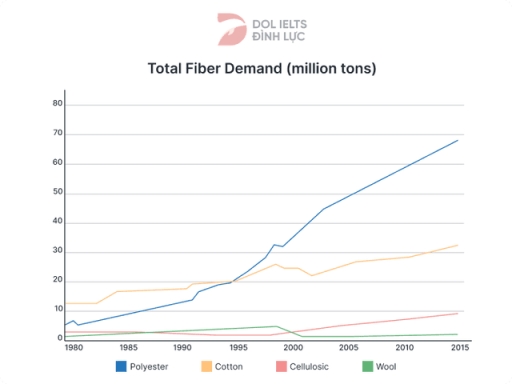
The line graph below illustrates the worldwide demand in million tons for various types of textile between 1980 and 2015.
Overall, it can be seen that all types of textiles grew in global demand over the period. However, Wool remained unchanged.
In 1980, Cotton hit the highest number of fiber demand accounted for 12 million tons.While the figure of Polyester was twice as low as Cotton, about 6 million tons. In the following 15 years, both these types of textiles grew steadily and stood at similar positions, of 20 million tons. After, trends of Cotton and Polyester changed significantly. The figure of Polyester experienced a dramatic growth and reached the highest point throughout the period, just under 70 million tons. Meanwhile, the figure of Cotton climbed steadily to only 32 million tones in comparison with Polyester.
In contrast, the Cellulosic and Wool did not experience such a huge growth. In the beginning, these types of textiles had approximately 1 and 2 million tons respectively. In the next 20 years, both of them remained stable. However, in 2000, they had an opposite trend. The figures of Cellulosic increased slightly, while Wool declined and reached 9 and 1 million tons, respectively.
Word Count: 199
