Our system will evaluate the answer based on this AI-generated description.
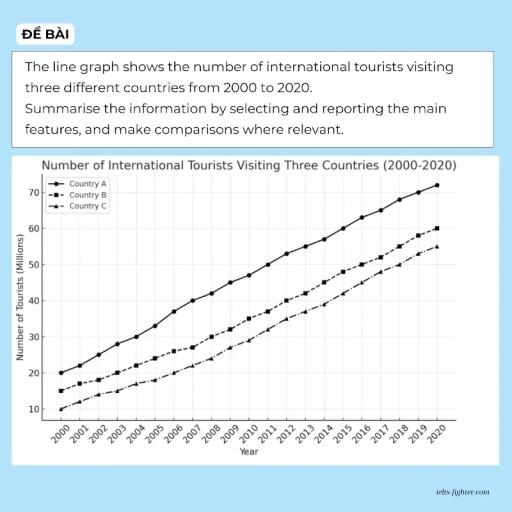
The image displays a line graph titled 'Number of International Tourists Visiting Three Countries (2000-2020)', with the number of tourists measured in millions. For Country A, the data points are: 20 (2000), 22 (2001), 24 (2002), 28 (2003), 30 (2004), 33 (2005), 37 (2006), 40 (2007), 42 (2008), 45 (2009), 48 (2010), 50 (2011), 53 (2012), 55 (2013), 57 (2014), 60 (2015), 63 (2016), 66 (2017), 68 (2018), 70 (2019), and 72 (2020). For Country B, the corresponding figures are: 15 (2000), 17 (2001), 18 (2002), 20 (2003), 22 (2004), 24 (2005), 26 (2006), 27 (2007), 30 (2008), 32 (2009), 35 (2010), 37 (2011), 40 (2012), 42 (2013), 45 (2014), 47 (2015), 50 (2016), 52 (2017), 54 (2018), 57 (2019), and 60 (2020). For Country C, the numbers are: 10 (2000), 12 (2001), 14 (2002), 15 (2003), 17 (2004), 18 (2005), 20 (2006), 22 (2007), 24 (2008), 26 (2009), 29 (2010), 31 (2011), 33 (2012), 35 (2013), 37 (2014), 39 (2015), 42 (2016), 45 (2017), 48 (2018), 52 (2019), and 55 (2020).
Given the complexity of the image, the above description may not be entirely accurate.
Skyrocket your IELTS band score by 1-2 points in under a month with our premium plan!
Note: Both the topic and the answer were created by one of our users.
The graph illustrates the number of tourists who travelled to three different countries between 2000 and 2021. Units are measured in millions.
Overall, it is clear that all of the countries show an upward trend throughout the years. International tourists dominated country A over the period. Meanwhile, country C was the least visited by international visitors.
To begin, country A was the most visited country by international tourists from the beginning until the end of the period. Moreover, the number of tourists in country A steadily increased from 20 million to above 70 million between 2000 and 2021. Similarly, country C, the least visited country, had a constant rise from 10 million to approximately 55 million.
Furthermore, country B had a similar trend to the other countries, experiencing a rise from around 15 million to 60 million over the period. At the end, country A, compared with the other countries, had a peak that was about 10 million higher. However, the number of visitors to country B and country C only had a 5 million gap.
Word Count: 176
