Our system will evaluate the answer based on this AI-generated description.
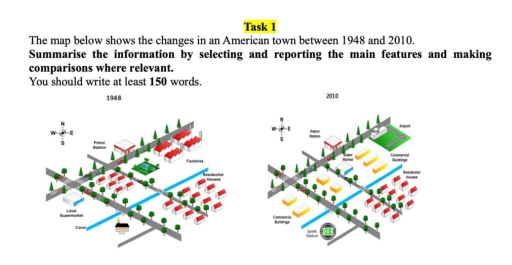
The image displays comparing maps from 1948 and 2010 in an American town, indicating infrastructural evolution: 1948 presents features such as a main road running east-west with a bridge over a river, surrounded by residential houses, factories, and farmland; discernibly, residential buildings are located south of the main road and northwest with factory zones nearby, a canal stretches north-south aligning the eastern section; petrol stations and local supermarkets dot the area with commercial buildings central along the street; 2010's map shows expansion with the main road remaining, suburbs growing significantly in quantity and alignment; commercial buildings relocate centrally north of the main road; inclusion of airport northeast grid enhances connectivity, while large supermarkets and expansion of residential zones south demonstrate broadened utility; factories replaced by enlarged suburbs depict shifting economic activities; transformation highlights infrastructural development indicative of urbanization over time.
Given the complexity of the image, the above description may not be entirely accurate.
Skyrocket your IELTS band score by 1-2 points in under a month with our premium plan!
Note: Both the topic and the answer were created by one of our users.
The map illustrates changes in American city for time period.
Overall, the town experienced significant development over the period, transforming from a mainly residential and industrial area into a more commercial and modern urban environment. While some features were removed or replaced, the road network largely remained the same.
In 1948, the town was dominated by residential houses located mainly in the eastern and southern parts. There were several factories situated in the north-east, and farmland occupied a large area in the north. In addition, a river ran through the town, with a canal in the south-west. A local supermarket and a school were also present.
By 2010, major changes had taken place. The farmland in the north was replaced by an airport, while the factories were removed and commercial buildings were constructed instead. Several new shops and commercial facilities appeared, especially near the central area. The number of houses decreased slightly, making room for business developments. However, the main roads, the river and the canal remained unchanged, continuing to connect different parts of the town.
In summary, the town became more commercialised and developed over time, with fewer industrial and agricultural areas.
Word Count: 193
