Our system will evaluate the answer based on this AI-generated description.
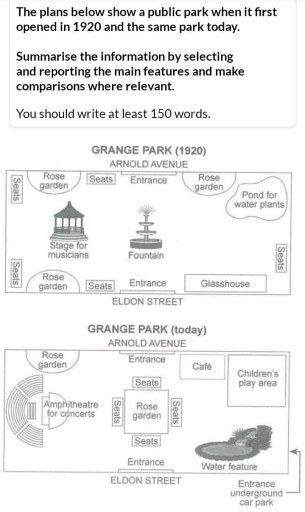
The image compares a park in 1920 and today. Originally rectangular, the park was accessible via Arnold Avenue, had a stage in the top left corner with musician icons, a circular rose garden with a bench and a single path leading to a fountain. A glasshouse was positioned on the right side, and a pond for water plants on the bottom left corner with three circular benches around it. The entrance carriage park was at the bottom of the park. Today, the park is accessible via Eldon Street with four icon trees indicating an arboretum nearby, an amphitheater for summer concerts at the top left, a larger circular rose garden with a statue, a water feature replacing the fountain, and a pond on the right with a circular water plant feature and multiple small benches surrounding it. The entrance, indicated by a ticket area, is on the bottom right, and the park has expanded southward, resulting in an irregular shape.
Given the complexity of the image, the above description may not be entirely accurate.
Skyrocket your IELTS band score by 1-2 points in under a month with our premium plan!
Note: Both the topic and the answer were created by one of our users.
The map compares Grange Park between 1920 and today.
Overall,it is clear that the park has undergone a myriad of changes over the years. The seats which were around the park initially have been removed.
To begin with, there was Rose Garden Northwest of the park and seats beside it in the year 1920. Towards the right of the garden was an entrance and another Rose Garden North of the park. Northeast of the park was a pond for water plants. There were more seats at the east of the park. At the centre of the park, was a fountain and adjacent to it towards the left was a stage for mucisians. At the south of the park was another entrance with a glasshouse just next to it on the right. There was another Rose Garden at the southwest of the park with other seats on both sides of the park.
Word Count: 151
