Our system will evaluate the answer based on this AI-generated description.
The image contains two bar graphs comparing the number of male and female students in full-time and part-time education across three academic years. For males in 1970/71, there were about 275 in part-time and 900 in full-time education. In 1980/81, males increased to approximately 325 in part-time and 975 in full-time education. By 1990/91, males in part-time education rose to around 400, and full-time education to 1100. For females in 1970/71, part-time education had about 225 students, and full-time had nearly 1150. In 1980/81, females in part-time education went up to roughly 350, and full-time to nearly 1250. In 1990/91, females in part-time education surged to about 475, and full-time education to around 1350. The trend for both genders indicates growth in both full-time and part-time education over the 20-year span, with females outnumbering males in full-time education, and the gap between genders in full-time education increasing over time.
Given the complexity of the image, the above description may not be entirely accurate.
Skyrocket your IELTS band score by 1-2 points in under a month with our premium plan!
Note: Both the topic and the answer were created by one of our users.
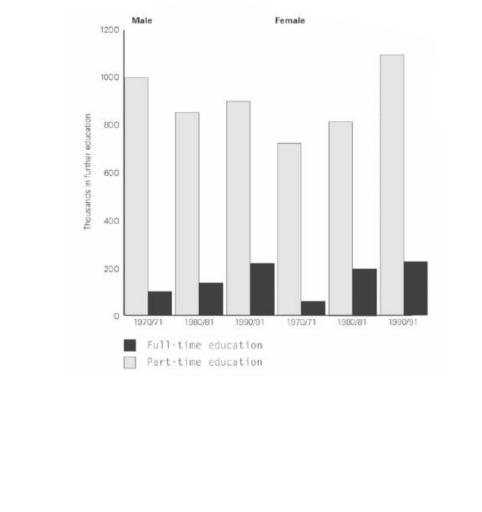
The illustration above depicts the number of men and women in Britain, measured in thousands, across various periods in the 1970s, 1980s, and 1990s.
Overall, the number of people who opted for part-time education is higher than that of full-time participants for both genders. The full-time trend indicates positive development, whereas the part-time trend exhibits fluctuations.
A significant increase occurred during 1980-1981, compared to the preceding 10 years, in full-time female students, which continued steadily to approximately 200,000 in 1990-1991. Meanwhile, the graph shows a gradual increase in the number of full-time male attendees over these 20 years. In 1970-1971, the number of men attending part-time education was approximately 1,000, which experienced a mild decline over the next 10 years, but eventually climbed to 900 students by the end. In contrast, a sequential upward trend is evident in part-time women educators, peaking at 1,100 in 1990-1991.
Word Count: 146
