Our system will evaluate the answer based on this AI-generated description.
The image contains two bar graphs comparing the number of male and female students in full-time and part-time education across three academic years. For males in 1970/71, there were about 275 in part-time and 900 in full-time education. In 1980/81, males increased to approximately 325 in part-time and 975 in full-time education. By 1990/91, males in part-time education rose to around 400, and full-time education to 1100. For females in 1970/71, part-time education had about 225 students, and full-time had nearly 1150. In 1980/81, females in part-time education went up to roughly 350, and full-time to nearly 1250. In 1990/91, females in part-time education surged to about 475, and full-time education to around 1350. The trend for both genders indicates growth in both full-time and part-time education over the 20-year span, with females outnumbering males in full-time education, and the gap between genders in full-time education increasing over time.
Given the complexity of the image, the above description may not be entirely accurate.
Skyrocket your IELTS band score by 1-2 points in under a month with our premium plan!
Note: Both the topic and the answer were created by one of our users.
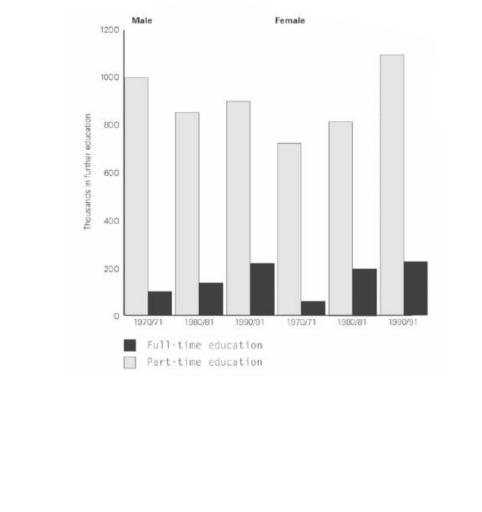
The bar chart illustrates how many thousands of people studied at university, with fulltime or part-time in Britain between the years of 1970 and 1991.
Overall, it is evident that throughout the period the majority of all students studied part-time education with the highest numbers in 1970/71 followed by 1990/91.
Focusing on the preferences, part-time education attracted one million people, while less than 200 thousand students chose to study in full-time education in 1970/71. The difference between the number of students studying in both education systems shrank to about 620 thousand, with part-time education decreasing slightly to 810 thousand in the next couple of years. In 1990/91, both of them experienced a slight rise by 30 thousand to account for 830 and 210 thousand, respectively.
Turning to 1970/71, the smallest number of students studied in both education systems, reporting 800 thousand in total. However, after considerable rises, the full-time education had around 150 thousand students in 1990/91 while the part-time education increased considerably to 200 thousand in 1980/81 and 210 thousand in the student number in the next decade.
Word Count: 179
