Our system will evaluate the answer based on this AI-generated description.
The image depicts a line chart titled "U.S. Energy Consumption by Fuel (1980-2030)" with six labeled lines representing "Petrol and Oil," "Coal," "Natural Gas," "Nuclear," "Solar/Wind," and "Hydropower." The chart's X-axis spans from 1980 to 2030, with the years 1985, 1995, 2005, 2010, 2015, 2020, and 2025 marked. The Y-axis measures quadrillion units from 0 to 50, in increments of 5. "Petrol and Oil" begins at approximately 30 quadrillion units in 1980, peaking near 45 in 2010 and projected to rise slightly above that by 2030. "Coal" starts near 15, peaks at 25 around 2005, and is projected to decline to just above 20. "Natural Gas" begins below 15, surpasses "Coal" near 2010 just under 25, and is expected to reach 30 by 2030. "Nuclear" maintains a steady rise from 5 in 1980 to a projected 10 in 2030. "Solar/Wind" starts at 0, shows a sharp increase after 2010, and is projected to surpass "Nuclear" by 2030, reaching approximately 15. "Hydropower" hovers consistently around 5 quadrillion units throughout the timeline.
Given the complexity of the image, the above description may not be entirely accurate.
Skyrocket your IELTS band score by 1-2 points in under a month with our premium plan!
Note: Both the topic and the answer were created by one of our users.
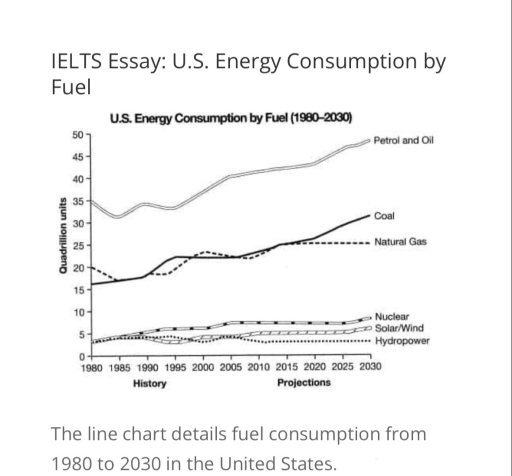
The given chart provides the amount of expenditure power of fuel in six categories between 1980 and 2030 in the U. S, measured in quadrillion.
Overall, petrol and oil had the highest rates of consumption, followed by coal and natural gas that had similar trends, and lastly nuclear, solar/wind, and hydropower that were the least. However, all types of energies experienced an increase, except hydropower which fluctuated.
According to the chart, in the beginning of 1960, petrol and oil had around 35 units and those energies fluctuated in the next 15 years then increased significantly, reaching its peak at merely 50. For the coal and natural gas, at first, coal had less figures than natural gas with roughly 15 and 20 proportions, respectively, but they grew slightly and had the same amount of utilization in 2015. Moreover, over a fifteen-year of period, coal still climbed to 30 by 2030, while natural gas kept at the same number with 25 of rates.
Turning to the next data, nuclear, solar/wind, and hydropower started from the same number, merely 3 quadrillion in 1980. Furthermore, nuclear increased gradually for the given period with about 5 difference. On the other hand, remaining energies fluctuated and level off in 2015 at about 3 quadrillion for hydropower and just above 5 quadrillion for solar/wind.
Word Count: 217
