Our system will evaluate the answer based on this AI-generated description.
The image presents a line graph depicting three different communication methods used by teenagers in the United States from 1990 to 2020, represented by text messages, calls, and face-to-face. In 1990, text messages start at approximately 0%, calls at about 70%, and face-to-face at 90%. By 2000, text messages rise to around 15%, calls decline to roughly 75%, and face-to-face drops to about 80%. In 2010, text messages increase to approximately 40%, calls continue to decrease to around 50%, and face-to-face falls to about 60%. In 2020, text messages surge to 80%, calls further decrease to around 30%, and face-to-face plummets to about 40%. Each communication method's line intersects with the others at different points between 2000 and 2010, with text messages and calls intersecting at around 2005 near 40%, and text messages and face-to-face intersecting close to 2010 at nearly 50%.
Given the complexity of the image, the above description may not be entirely accurate.
Skyrocket your IELTS band score by 1-2 points in under a month with our premium plan!
Note: Both the topic and the answer were created by one of our users.
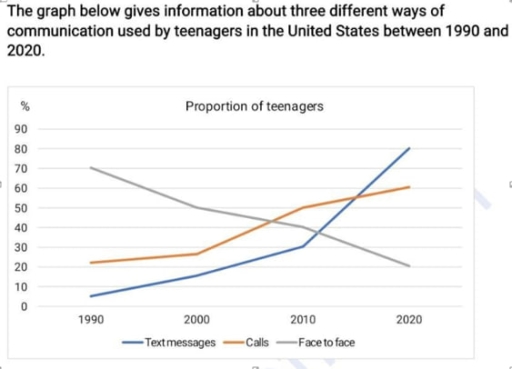
The line graph compares the proportion of teenagers in the United States who used three different types of communication – face-to-face interaction, text messaging, and phone calls – between 1990 and 2020.
Overall, the rate of face-to-face communication among teenagers declined dramatically over the period, while both text messaging and phone communication increased substantially.
Looking at the data in more detail, in-person communication was by far the most common form in 1990, accounting for around 70% of all teenage interactions. However, this figure fell sharply to 50% by 2000 and continued to decline steadily, reaching a record low of 20% by 2020.
In contrast, communication through text messages rose consistently throughout the period. Starting at just 5% in 1990, it grew steadily to 30% by 2010 and reached an all-time high of 50% by 2020, reflecting a clear shift towards digital communication.
Similarly, the share of phone-based communication followed an upward trend. It began at just over 20% in 1990, climbed gradually to about 30% by 2000, and then surged to 60% by the end of the period, showing teenagers’ growing reliance on mobile phones for interaction.
Word Count: 187
