Our system will evaluate the answer based on this AI-generated description.
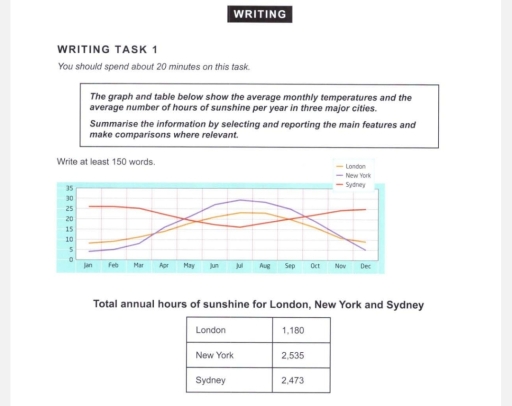
The image depicts a graph and a table; the graph illustrates average monthly temperatures over a year across three cities: London, New York, and Sydney, with temperatures in Celsius on the y-axis ranging from 0 to 30, matching months January to December on the x-axis; a line represents each city. Specific approximate monthly temperatures for London are: January 5°C, February 5°C, March 8°C, April 11°C, May 15°C, June 18°C, July 20°C, August 20°C, September 17°C, October 13°C, November 10°C, December 7°C. For New York: January 3°C, February 4°C, March 8°C, April 14°C, May 19°C, June 24°C, July 27°C, August 26°C, September 22°C, October 16°C, November 10°C, December 5°C. For Sydney: January 25°C, February 25°C, March 23°C, April 20°C, May 17°C, June 14°C, July 13°C, August 15°C, September 17°C, October 19°C, November 22°C, December 24°C. The table presents total annual hours of sunshine, with London at 1,180 hours, New York at 2,535 hours, and Sydney at 2,473 hours.
Given the complexity of the image, the above description may not be entirely accurate.
Skyrocket your IELTS band score by 1-2 points in under a month with our premium plan!
Note: Both the topic and the answer were created by one of our users.
The diagram illustrates the average monthly temperatures across three major cities – Sydney, London, and New York – whereas the second graph demonstrates the mean sunshine hours in the same cities.
Overall, Sydney is recorded with the highest monthly temperatures, while London and New York’s temperatures have experienced major fluctuations throughout the period. New York reportedly has the highest amount of sun exposure, while London receives the least amount of solar exposure.
Sydney’s temperature gradually receded from above 25 degrees Celsius to approximately 20 degrees Celsius in the latter half of May, before a marked increase to a peak of 25 degrees Celsius in December. In contrast, both New York and London’s temperatures started below 10 degrees Celsius. Over the following months, New York’s and London’s temperatures experience a sharp increase, reaching well above 20 degrees Celsius by June. However, temperatures have dipped significantly, falling below 10 degrees Celsius by the end of the period.
Regarding the average sun exposure, New York receives the maximum hours of sun exposure at 2535 hours, followed by Sydney at 2473 hours. Conversely, this isn’t the case for London, which receives the minimum amount of sunlight at 1180 hours.
Word Count: 195
