🔥 Today Only: Save 30% on Premium — Offer Ends Soon! - Upgrade Now!
Process Diagram

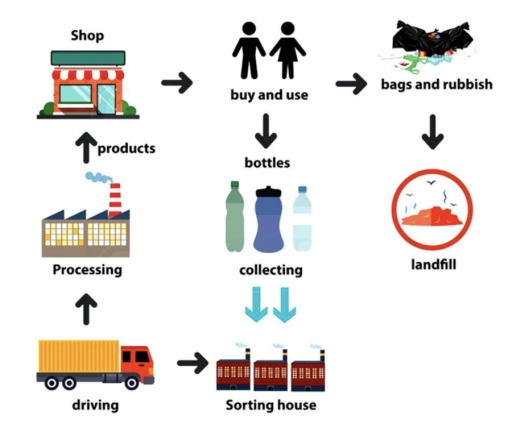
Band 8+: The diagram below shows the recycling process of plastics. Summarise the information by selecting and reporting the main features, and make comparisons where relevant.

Image for topic: The diagram below shows the recycling process of plastics. Summarise the information by selecting and reporting the main features, and make comparisons where relevant.
Our system will evaluate the answer based on this AI-generated description.
The image shows a diagram representing the lifecycle of a product from the shop, through processing, driving, a sorting house, collecting bottles, and use by individuals, to the final stage of becoming bags and rubbish in a landfill. The initial step depicts a shop selling products, followed by a man and woman icons representing the stage of buying and use. The next depiction is a black garbage bag with discarded items, symbolizing the transformation into bags and rubbish. A factory portrays the processing stage, while a truck signifies the transportation or driving phase. A graphic of a building with multiple windows indicates a sorting house, and a series of bottles symbolizes the collecting stage. Finally, a circular arrow encloses an image of a landfill, marking the end of the product lifecycle. No numerical data points, percentages, or specific country/category/year information is present.
Given the complexity of the image, the above description may not be entirely accurate.
Note: Both the topic and the answer were created by one of our users.

The diagram provides information about the process of plastic recycling.

Overall, there are six stages in this process, commencing with the consumption of plastic products by the consumer and culminating with the newly manufactured products being distributed to the stores.

The process starts when plastic items are displayed and sold in the stores, where customers buy products that are made from plastic. Once these items, such as bags and other waste, have been used, they are discarded into bins. From there, they are collected and eventually buried in landfill sites. In contrast, plastic bottles are gathered and transported to a sorting house, where they are categorized by color.

In the next stage of the process, after they have been sorted based on their color, they are loaded into trucks and delivered to a processing factory. At this factory, these items are transformed into entirely new products. Finally, these new plastic products are delivered to the shops and the recycling process starts over from the beginning.

Word Count: 165

Answers On The Same Topic:

The diagram below shows the recycling process of plastics. Summarise the information by selecting and reporting the main features, and make comparisons where relevant.

The diagram shows how products, especially plastic bottles, are used by people and then recycled or disposed of. Overall, the process is cyclical. Some waste is sent directly to landfill, while bottles are collected, recycled, and made into new products that are returned to shops. At the beginning of the process, products are produced and […]

The diagram below shows the recycling process of plastics. Summarise the information by selecting and reporting the main features, and make comparisons where relevant.

The diagram shows how the recycling cycle of plastic products takes place. Overall, the process consists of several stages, beginning with customer purchases of the goods at the stores and concluding in two possible outcomes: plastic waste being discarded or recycled into new plastic items. At the initial stage of the process, plastic packaging of […]

The diagram below shows the recycling process of plastics. Summarise the information by selecting and reporting the main features, and make comparisons where relevant.

The diagram illustrates the process of how plastic bottles are used and recycled. Overall, the process consists of several stages, starting from buying and using products, and ending with either recycling them through a series of steps or disposing of them in landfill. In the first stage, consumers buy and use plastic products such as […]

The diagram below shows the recycling process of plastics. Summarise the information by selecting and reporting the main features, and make comparisons where relevant.

Introduction: The Image provided illustrates the various stages involved into recycling plastic product. Since, plastic is non-biodegradable product, recycling is crucial to protect environment. Overall, Recycling plastic is lengthy and intricate, consisting six keys steps, from initial collection to finally distribution to retails shops. In the first steps, customers purchase and use plastics materials and […]

See All

Other Topics:

The diagram illustrates the process of online food shopping. Summarize the information by selecting and reporting the main features and make comparisons where relevant.

The diagram illustrates the process of producing sugar from sugar cane, including the seven main steps from growing the plant to getting sugar. Overall, obviously that the process is step-by-step and consists of seven stages beginning with growing and harvesting of sugar cane ending with drying and cooling the final product. There are different mechanical […]

The diagram shows processes of either recycling plastic items to produce goods, or trash into dustbins to fill land

The diagram illustrates the process by which plastic is recycled. Overall, plastic waste serves two main purposes, as it is collected at a point for recycling or disposed of in a landfill. The recycling process involves 5 stages, starting with the use of plastic products, and then in the production of new items returned to […]

The diagram shows how tea leaves are processed into five tea types. Summarize the information by selecting and reporting the main features and make comparisons where relevant.

The diagram illustrates the process of how five kinds of tea are gained from the leaves of tea. Overall, the process efficiently converts the tea leaves to five types of tea through a series of well-defined steps. The process starts when the tea crops are grown and the leaves are plucked by the people. These […]

The picture below shows green coffee production. Summarize the information by selecting and reporting main features, and make comparisons where relevant.

The diagram illustrates the process of producing green coffee. Overall, the process involves several stages, starting with green coffee beans and ending with the production of coffee liquor and coffee by-products. Initially, green coffee beans are dried and then soaked in water. After soaking, the mixture is filtered to separate pure liquid from solid matter. […]

Task 1: The diagrams below show the stages and equipment used in the cement- making process, and how cement is used to produce concrete for building purposes. Summarise the information by selecting and reporting the main features, and make comparison where relevant.

The diagram illustrates the process of cement- making and how cement is used to produce concrete for building purpose. Overall, there are 6 main steps in this process beginning with the collection of limestone and slay and ending with the packaging of cement into bags. Meanwhile, concrete is produced in a single step by mixing […]

The images below illustrate the process and potential of how garbage can be recycled to create aviation biofuel. Summarise the information by selecting and reporting the main features, and make comparisons where relevant.

The diagram elucidates the method and potential of how aviation biofuel is produced through trash re-usage. Overall, it is observable that the creation of aviation biofuel is made up of four processes including collecting, processing, delivery and the use of the fuel. Firstly, the garbage is gathered and delivered in to the factory. Afterwards, the […]

See All
We have detected unusual activity on your device.
Please verify your identity to continue.
Note: This verification step won't sign you in. If you have a premium account, please log in to access the service as usual.
Google/Gmail Verification
Or verify using Email/Code
We've sent a verification code to:
youremail@gmail.com (Not your email?)
Enter it below to complete the verification process.
Ensure your email address is correct, your inbox is not full, and you check your spam folder. If no email arrives, consider using an alternative email.
You will need a Premium plan to perform your action!
Note: If you already have a premium account, please log in to access our services as usual.

Plans & Pricing

Our mission is to make quality education accessible for everyone.
However, to keep our hardworking team running and this service alive, we genuinely need your support!
By opting for a premium plan, not only do you sustain us in achieving the mission, but you also unlock advanced features to enrich your learning experience.

Free

For learners who aren't pressed for time

What's included on Free
100+ Cambridge IELTS Tests
Instant IELTS Writing Task 1 & 2 Evaluation (2 times/month)
Instant IELTS Speaking Part 1, 2, & 3 Evaluation (5 times/month)
Instant IELTS Writing Task 1 & 2 Essay Generator (2 times/month)
500+ Dictation & Shadowing Exercises
100+ Pronunciation Exercises
Flashcards
Other Advanced Tools

Premium

For those serious about advancing their English proficiency, and for IELTS candidates aspiring to boost their band score by 1-2 points (especially in writing & speaking) in just 30 days or less

What's included on Premium
Save Your IELTS Test Progress
Unlock All Courses & IELTS Tests
Unlimited AI Conversations
Unlimited AI Writing Enhancement Exercises
Unlimited IELTS Writing Task 1 & 2 Evaluation
Unlimited IELTS Speaking Part 1, 2, & 3 Evaluation
Checked Answers Will Not Be Published
Unlimited IELTS Writing Task 1 & 2 Essay Generator
Unlimited IELTS Speaking Part 1, 2, & 3 Sample Generator
Unlimited Usage Of Advanced Tools
Priority Support within 24h (12-month plan only)

Due to the nature of our service and the provided free trials, payments are non-refundable.
Nếu bạn là người Việt Nam và không có hoặc không muốn trả bằng credit/debit cards, bạn có thể thanh toán bằng phương thức chuyển khoản:


Chọn gói:
419,000₫ 277,000 ₫ cho gói 1 tháng (chỉ 9,233₫/ngày)
1,239,000₫ 597,000 ₫ cho gói 3 tháng (chỉ 6,633₫/ngày)
2,469,000₫ 1,027,000 ₫ cho gói 6 tháng (chỉ 5,706₫/ngày)
4,929,000₫ 1,417,000 ₫ cho gói 12 tháng (chỉ 3,936₫/ngày)


Sau khi chuyển khoản, vui lòng đợi trình duyệt tự động điều hướng bạn trở lại Engnovate và bạn sẽ ngay lập tức nhận được mã kích hoạt tài khoản premium.
Nếu có lỗi xảy ra, bạn có thể liên hệ với team thông qua một trong các phương thức: email đến helloengnovate@gmail.com hoặc nhắn tin qua facebook.com/engnovate.
Vì toàn bộ công cụ trên website đều có thể sử dụng thử miễn phí, Engnovate không hỗ trợ hoàn tiền.