Our system will evaluate the answer based on this AI-generated description.
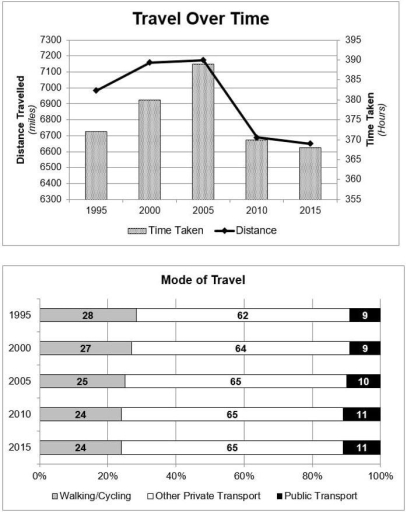
The image shows a bar and line graph titled "Travel Over Time" with distance traveled in miles and time taken in hours from 1995 to 2015. The graph shows distance traveled: 6700 (1995), 7100 (2000), 7200 (2005), 6800 (2010), 6600 (2015) and time taken (hours): 375 (1995), 385 (2000), 390 (2005), 380 (2010), 375 (2015). The second section is a bar chart depicting "Mode of Travel" with walking/cycling, other private transport, and public transport percentages for each year. For 1995: 28% walking/cycling, 62% other private transport, 9% public transport. For 2000: 27% walking/cycling, 64% other private transport, 9% public transport. For 2005: 25% walking/cycling, 65% other private transport, 10% public transport. For 2010: 24% walking/cycling, 65% other private transport, 11% public transport. For 2015: 24% walking/cycling, 65% other private transport, 11% public transport.
Given the complexity of the image, the above description may not be entirely accurate.
Skyrocket your IELTS band score by 1-2 points in under a month with our premium plan!
Note: Both the topic and the answer were created by one of our users.
The charts gives information about the journey of the people in one particular country.Overall, although people more travel in 2005, a least travel distances and times registered in 2015. The majority of people took a journey by car.
On the first chart, travel distance rate started just above the 6700 miles in 1995, with the time of about 382 hours.This was followed by an increase to aproximately 7150 miles. Five years later, the both rates were reach peak, with 7200 miles of distance and and 390 hours to travel.However, after a decade, the rates experienced a downward trajectory which distance rate stood at under the 6700 miles and in terms of the time, it accounted about 368.
There is no significant change in the context of travel’s modes.More people(62%) traveled by their private car.This figure increased and accounted for 65% in the final years of the survey. Around 9% people opted for the public transport to go on a trip and this was experinced a slight rise to 11% in the 2015.The opposite was true for the rate of walking/cycling which decreased from 28% in 1995 to 24% in 2015.
Word Count: 190
