Our system will evaluate the answer based on this AI-generated description.
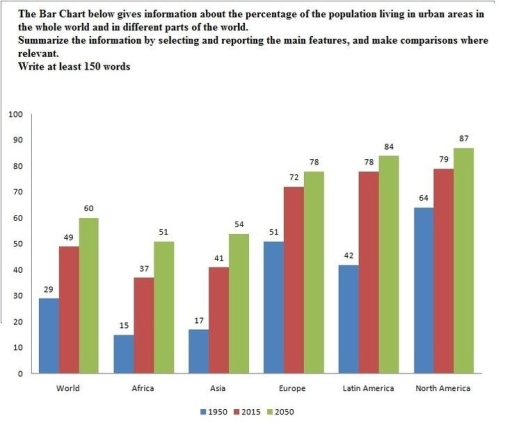
The image presents a bar chart showing the percentages of populations living in urban areas across different world regions and global averages in the years 1950, 2015, and projected for 2050. The percentages for each respective year and region are as follows: World (1950 - 29%, 2015 - 49%, 2050 - 60%), Africa (1950 - 15%, 2015 - 37%, 2050 - 51%), Asia (1950 - 17%, 2015 - 41%, 2050 - 54%), Europe (1950 - 51%, 2015 - 72%, 2050 - 78%), Latin America (1950 - 42%, 2015 - 64%, 2050 - 79%), and North America (1950 - 64%, 2015 - 79%, 2050 - 87%). The chart displays substantial growth in all regions, with Europe and North America starting at higher urbanization levels in 1950 and still showing significant projected increases by 2050. Meanwhile, regions with initially lower percentages like Africa and Asia display dramatic rises over the century, reflecting accelerated urbanization trends.
Given the complexity of the image, the above description may not be entirely accurate.
Skyrocket your IELTS band score by 1-2 points in under a month with our premium plan!
Note: Both the topic and the answer were created by one of our users.
The chart given shows the number of urban communities in separate regions of the world from 1950 to 2050.
Overall, the regions across the globe all undergo a significant population elevation over time.
In 1950, Africa had the lowest degree of urban people with only 15%, while North America had the most with 64%. From 1950 to 2007, the fraction of city dwellers surged as the amount of urban populations in Latin America rose the most with 34%, from 42% to 76%. Meanwhile, Oceania has risen the least, from 62% to 71%, equivalent to a 9% rise in total.
During the 43-year period from 2007 to 2050, Asia and Africa will have an equal citizen boost of 15%, both of them rising the most in this period. Oceania, in contrast, will only have a 5% increase, from 71% to 76%. The rest of the regions will undergo a boost in urban resident percentage from 11% at least to 13% at most.
Word Count: 161
