Our system will evaluate the answer based on this AI-generated description.
The image is a line graph with four lines representing the average number of weekly patients to four different clinics - Birth Control, Eye, Diabetic, and Dental - within one hospital from 2010 to 2016; the y-axis ranges from 0 to 400 in increments of 50, and the x-axis is marked at 2010, 2012, 2014, and 2016. The Birth Control clinic starts at approximately 50 patients in 2010, steadily increases to around 350 in 2014, and slightly drops to just below 350 in 2016. The Eye clinic starts at around 200 patients in 2010, remains consistent in 2012, drops to 150 in 2014, and then experiences a small increase to about 175 in 2016. The Diabetic clinic starts at approximately 175 patients in 2010, shows a slight increase to 200 in 2012, a decrease to around 125 in 2014, and a sharp increase to slightly below 350 in 2016. Lastly, the Dental clinic starts at roughly 150 patients in 2010, decreases slightly in 2012, increases to about 225 in 2014, and peaks at 300 in 2016.
Given the complexity of the image, the above description may not be entirely accurate.
Skyrocket your IELTS band score by 1-2 points in under a month with our premium plan!
Note: Both the topic and the answer were created by one of our users.
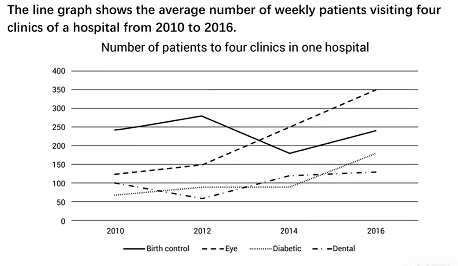
The line graph illustrates how many patients visited the hospital for their particular situation per week between 2010 and 2016.
Overall, there was an increase in the number of medical cases which is related to eye, diabetes, and dental, while a leveling off was seen in birth control leveling. It can also be seen that from 2012, the figure for patient numbers, who had eye issues, increased dramatically to surpass that of birth control making it the most popular issue from mid-2013 onwards.
The number of patients who came to the hospital for birth control started at about 250 people per week (PPW), then it slightly increased and reached a peak of approximately 2754PW in the next 2 years before dropping sharply to the lowest point at just over 175 PPW in 2014 and ending the period with gradual growth. In contrast, the figure for dental issues began with a slight decrease, and reached a low of just over 50PPW in 2012, followed by a marginal rise onwards.
Exactly 125 people visited the hospital for eye issues in 2010, with a subsequent dramatic rise throughout the period. Similarly, the figure for patients who had a diabetic problem rose considerably in the last 2 years after increasing steadily from 2010 to 2014.
Word Count: 211
