Our system will evaluate the answer based on this AI-generated description.
The image presents a bar chart displaying the number of US households in millions, segmented by annual income for the years 2007, 2011, and 2015. Five income brackets are represented: Less than $25,000; $25,000-$49,999; $50,000-$74,999; $75,000-$99,999; $100,000 or more. In 2007, households earning less than $25,000 numbered 25 million, $25,000-$49,999 had 30 million, $50,000-$74,999 with 20 million, $75,000-$99,999 captured 15 million, and $100,000 or more included 10 million households. In 2011, numbers slightly decreased for the first three brackets to 23, 28, and 18 million respectively, while the last two brackets increased to 17 and 12 million respectively. By 2015, the less than $25,000 bracket further decreased to 20 million, $25,000-$49,999 reduced to 25 million, $50,000-$74,999 remained at 18 million, $75,000-$99,999 increased to 20 million, and $100,000 or more saw significant growth to 25 million households.
Given the complexity of the image, the above description may not be entirely accurate.
Skyrocket your IELTS band score by 1-2 points in under a month with our premium plan!
Note: Both the topic and the answer were created by one of our users.
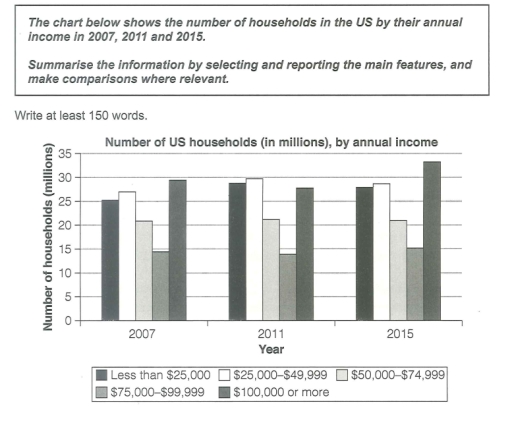
The bar chart given provides information about the number of families in the US by their yearly revenue in three particular years, 2007,2011 and 2015.
Overall, it can be seen that, there was a big proportion of families among the highest and the lowest earning groups. Additionally, those households that earned between $75,000 and $ 99,999 were the least in number.
The category that earned an annual amount of $100,000 or more, were the majority; accounting for approximately 29 million, 27 million, and 33 million for 2007, 2011, and 2015 respectively. This was closely followed by the least earners, of less than $25,000 at an average of 27 million households for the 3 years under study.
By contrast, the band that earned a revenue of $75,000 to $ 99,999 per year, had the smallest proportion of households, it hovered around 15,000,000 for the three years, with the highest being 2015 and the least occurring in 2011. It interesting to note that this magnitude was nearly a half of the highest earning category in all the three years.
Word Count: 177
