Our system will evaluate the answer based on this AI-generated description.
The image contains two bar graphs comparing the number of male and female students in full-time and part-time education across three academic years. For males in 1970/71, there were about 275 in part-time and 900 in full-time education. In 1980/81, males increased to approximately 325 in part-time and 975 in full-time education. By 1990/91, males in part-time education rose to around 400, and full-time education to 1100. For females in 1970/71, part-time education had about 225 students, and full-time had nearly 1150. In 1980/81, females in part-time education went up to roughly 350, and full-time to nearly 1250. In 1990/91, females in part-time education surged to about 475, and full-time education to around 1350. The trend for both genders indicates growth in both full-time and part-time education over the 20-year span, with females outnumbering males in full-time education, and the gap between genders in full-time education increasing over time.
Given the complexity of the image, the above description may not be entirely accurate.
Skyrocket your IELTS band score by 1-2 points in under a month with our premium plan!
Note: Both the topic and the answer were created by one of our users.
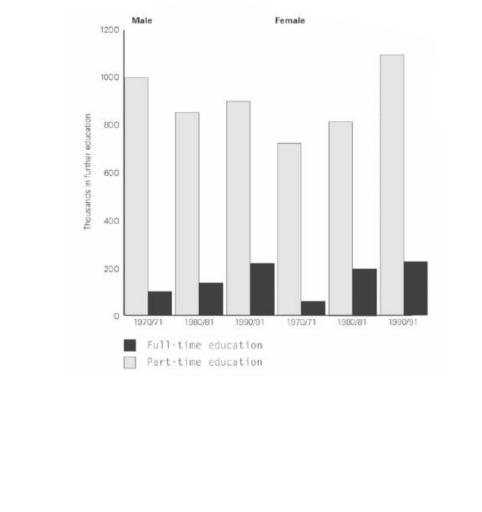
The graphical figure illustrates the comparison of male and female as fall time or part-time students to continue their education in Britain for the school years 1970-1971, 1980-1981, and 1990-1991. Overall, women shows an increasing trends of populations for both part-time and full time students, while those who engage as part-time dominates the comparison in the entire observation period.
In detail, part-time male category is ahead by 1,000 populations than female at only 70 from the start of 1970-1971. On the other hand, male also shows a hundred high number of full-time students as compare to female by roughly 70 students in the same year. In addition, both full time and part-time students under women category have increases their populations until 1990-1991 by 200 and 1,500, respectively.
Furthermore, male presents a fluctuating trend by declining their populations in year 1980-1981 at an estimated 820 part-time students. Moreover, they started to ascend at the end of 1990-1991 by 840 populations.
Word Count: 159
