
Rosewood House and Gardens - IELTS Listening Answers & Explanations
From Cambridge IELTS 06 Academic Listening Test 3 · Part 2 · Questions 11–20
Audio
Questions
Questions 11–13 One Choice
Choose the correct letter, A, B or C.
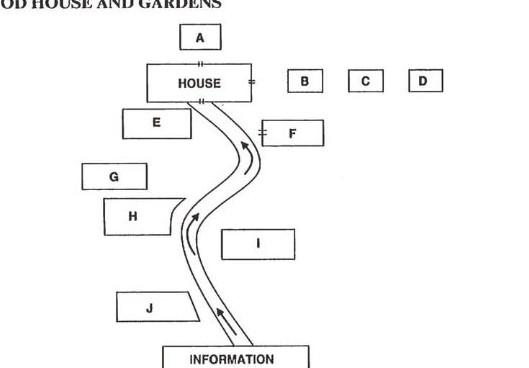
Questions 14–17 Map Labeling
Label the map below.
Write the correct letter, A-J, next to questions 14-17.
Questions 18–20 Sentence Completion
Complete the sentences below.
Write ONE WORD ONLY for each answer.
- You can walk through the 18 that goes along the river bank.
- You can go over the 19 and then into a wooded area.
- On your way back, you could also go up to the 20 .
Answers & Explanations Summary
| # | Answer | Evidence | Explanation |
|---|---|---|---|
| Q11 | C | At that time the owners let it out to a tenant because George was too slow making up his mind to buy it | Excerpt/Transcript Explanation: The transcript explains that the owners gave the house to another person (a tenant) to live in because George had not decided yet if he wanted to buy it. Answer Explanation: The answer means that Sebastian George was not certain if he wanted to purchase the house when he first looked at it. Reason For Correctness: The correct answer is correct because the transcript mentions that George was "too slow making up his mind." To "make up one's mind" is an English idiom that means to decide. Because he took a long time to decide (he was "slow"), it shows he was unsure or hesitant during his first visit. As a result, he didn't buy the house right away and the owners rented it to a tenant instead. |
| Q12 | A | His professional success was enormous, but his personal life wasn't as successful. He was no longer on speaking terms with his brother and had been devastated by the death at the age of seven of his elder daughter, Josephine | Excerpt/Transcript Explanation: The transcript explains that although George's career was doing very well, his family life was not. It points out that he did not talk to his brother anymore and was very upset about the death of his seven-year-old daughter. Answer Explanation: The answer means that Sebastian George had difficult things happen in his family life before he moved into the house. Reason For Correctness: The correct answer is A because the transcript describes specific family issues George faced in the years before buying Rosewood. While he was a very famous and successful writer, his personal life was troubled. Two main problems are mentioned: he had a bad relationship with his brother and stopped talking to him (he was 'no longer on speaking terms'), and he was extremely sad ('devastated') because his young daughter had died. |
| Q13 | C | George regarded Rosewood as a pure example of a traditional country house of this part of England and did some of his most successful writing here | Excerpt/Transcript Explanation: The transcript states that George thought the home was a classic model of an old-style house from that specific area. In English, 'traditional' and 'pure example' describe something 'typical,' and 'this part of England' refers to the 'region'. Answer Explanation: The answer means that George saw the house as a perfect example of the standard style of buildings found in that specific area. Reason For Correctness: The correct answer is C because the speaker says George saw the house as a 'pure example' of a 'traditional' house from 'this part of England'. This shows he believed it represented the usual local style. Choice A is wrong because while he wrote books there, the text doesn't say the house provided the ideas for them. Choice B is wrong because he actually did lots of work (writing) there, so it wasn't an escape from work. |
| Q14 | H | As you go further down the path, there's the kitchen garden on the right and as you go round the first sharp corner you will find, to your left, an area where different types of pear tree have been planted as well as some lovely flowers, and this is known as Pear Alley - designed by George himself | Excerpt/Transcript Explanation: The transcript explains that when you walk past the garden where vegetables grow (the kitchen garden) and turn the first sharp corner, Pear Alley will be on your left side. Answer Explanation: The answer means that the location labeled H on the map is Pear Alley. Reason For Correctness: The correct answer is H because the speaker gives specific directions from the Information Centre. After passing the orchard and the kitchen garden, visitors must turn a sharp corner. Pear Alley is the area located immediately on the left side after making that turn. The speaker notes that this area was designed by Sebastian George and contains pear trees and flowers. |
| Q15 | F | Follow the path round the second corner and on your right you will see the entrance to the Mulberry Garden with its 500-year-old tree | Excerpt/Transcript Explanation: The transcript explains that after you walk around the second turn in the path, the entrance to the garden with a 500-year-old tree will be on your right side. Answer Explanation: The answer F is the place on the map where the Mulberry Garden is located. Reason For Correctness: The correct answer is found by following the guide's directions on the map. After turning past the kitchen garden and walking past the greenhouse, the guide tells the visitors to go around the 'second corner'. Immediately after making that turn, the Mulberry Garden is located on the 'right' side of the path. This specific location matches letter F on the map. |
| Q16 | B | If you would like to purchase any of George's books or other souvenirs, then leave the house by the side entrance, where you will find our shop, which is situated between the house and the garage which contains the magnificent old Rolls-Royce car which used to belong to George | Excerpt/Transcript Explanation: The transcript explains that the shop is used for buying books or gifts. It is located outside the house through a side door and is found in the space between the main house and the garage. Answer Explanation: The answer is point B on the map, which represents the shop. Reason For Correctness: The correct answer is determined by the verbal directions provided in the tour description. The guide mentions that the shop is located at the side entrance of the house. Crucially, it explains that the shop is positioned between the house and the garage (where a famous car is kept). On the map, location B sits specifically between the main house building and the garage, matching this description. |
| Q17 | D | Most visitors are, so why don't you visit the tea room on the far side of the garage | Excerpt/Transcript Explanation: The transcript tells the listeners that if they want a break, they should go to the tea room located on the other side of the garage. Answer Explanation: The answer D is the location of the tea room on the map. Reason For Correctness: The correct answer is D because the speaker describes the tea room as being on the 'far side' of the garage. In this context, 'far side' means the side that is further away from the house and shop. The speaker suggests that visitors go there for 'refreshment,' which is another word for food and drinks. |
| Q18 | field | You cross the field which spreads along the banks of the river | Excerpt/Transcript Explanation: The transcript explains that visitors should walk across an open, grassy space (a field) that is right next to the river. Answer Explanation: The answer "field" refers to an open area of land, usually covered in grass, where people can walk. Reason For Correctness: The correct answer is "field" because the speaker describes a path that goes near the water. They specifically say that visitors should "cross the field" that is located "along the banks of the river." This matches the first sentence in the task, which describes walking through an area that follows the side of the river. |
| Q19 | footbridge | Spend a minute or two watching the water pass by underneath as you cross the footbridge, and then continue along the River Walk through the woodland | Excerpt/Transcript Explanation: The transcript says that as you walk, you will go over a small bridge and then keep walking through the woods. Answer Explanation: The answer means a small bridge that people walk across on foot. Reason For Correctness: The correct answer is 'footbridge' because the speaker describes crossing it while walking near the river. This bridge leads to a 'woodland,' which is another way of saying a 'wooded area.' In the text, the instruction is to cross the bridge and then move into the area with trees. |
| Q20 | viewpoint | And, finally, for those of you who would like to see stunning views of the surrounding countryside and who are a little bit more energetic, when you return from the mill take the first turning on your left and climb up to the viewpoint | Excerpt/Transcript Explanation: The transcript tells visitors that after they finish seeing the water mill and start coming back, they can turn left and go up to a high spot called the viewpoint to see the pretty scenery. Answer Explanation: The answer is a high place where you can see a beautiful view of the land around you. Reason For Correctness: The correct answer is "viewpoint" because the speaker tells visitors what they can do when they are coming back from the water mill. The speaker uses the phrase "when you return" to mean "on your way back" and "climb up" to mean "go up." By following these directions, visitors will reach the viewpoint. |
Transcript
Welcome, everybody, to the lovely house and gardens of Rosewood, once the home of the famous writer, Sebastian George. He bought the house in 1902 although he had first seen it two years earlier. At that time the owners let it out to a tenant because George was too slow making up his mind to buy it. When it came back on the market, there was no hesitation and he bought it immediately, for £9,300, even though the house had no bathroom, no running water upstairs, and no electricity.
When he came here, he'd been married for ten years. During that time, he'd become one of the most famous writers in the English-speaking world. His professional success was enormous, but his personal life wasn't as successful. He was no longer on speaking terms with his brother and had been devastated by the death at the age of seven of his elder daughter, Josephine.
Moving to Rosewood allowed the family to start a new life. George regarded Rosewood as a pure example of a traditional country house of this part of England and did some of his most successful writing here. The house and its grounds became the family haven and their escape to privacy and quiet. The walls, and the mullioned windows were built of the local sandstone, the tiles on the roofs and the bricks of the chimney stack were baked from local clay, and the wooden structures inside came from oak trees which grow around here.
Now, please look at the map I've given you of the house and gardens. We're here at the Information Centre. Follow the path marked with the arrow and the first area you come to is the orchard on your left.
As you go further down the path, there's the kitchen garden on the right and as you go round the first sharp corner you will find, to your left, an area where different types of pear tree have been planted as well as some lovely flowers, and this is known as Pear Alley - designed by George himself.
Next to this is the greenhouse where some exotic plants and fruits are grown. Follow the path round the second corner and on your right you will see the entrance to the Mulberry Garden with its 500-year-old tree. Past the Mulberry Garden, follow the path until you reach the front of the house. I suggest you spend a good hour wandering around this lovely building. A guide takes visitor groups round every two hours.
If you would like to purchase any of George's books or other souvenirs, then leave the house by the side entrance, where you will find our shop, which is situated between the house and the garage which contains the magnificent old Rolls-Royce car which used to belong to George. I expect by this time you may also be in need of a rest and some refreshment. Most visitors are, so why don't you visit the tea room on the far side of the garage?
If you have time, there is a lovely walk down towards the River Dudwell. For me, this is the best part of the estate. This isn't on the map but it is all clearly signposted. You cross the field which spreads along the banks of the river. In spring, this area is well worth a visit. Spend a minute or two watching the water pass by underneath as you cross the footbridge, and then continue along the River Walk through the woodland. On a hot summer's day the trees along this path provide welcome shade. Eventually you come to the water mill which used to provide the electricity for the house - only about four hours every evening - in George's time. And, finally, for those of you who would like to see stunning views of the surrounding countryside and who are a little bit more energetic, when you return from the mill take the first turning on your left and climb up to the viewpoint. You won't regret it.
Enjoy your visit!