
ALTERNATIVE MEDICINE IN AUSTRALIA - IELTS Reading Answers & Explanations
From Cambridge IELTS 04 Academic Reading Test 2 · Part 2 · Questions 14–26
Reading Passage
You should spend about 20 minutes on Questions 14-26 which are based on Reading Passage 2 below.
ALTERNATIVE MEDICINE IN AUSTRALIA
The first students to study alternative medicine at university level in Australia began their four-year, full-time course at the University of Technology, Sydney, in early 1994. Their course covered, among other therapies, acupuncture. The theory they learnt is based on the traditional Chinese explanation of this ancient healing art: that it can regulate the flow of 'Qi' or energy through pathways in the body. This course reflects how far some alternative therapies have come in their struggle for acceptance by the medical establishment.
Australia has been unusual in the Western world in having a very conservative attitude to natural or alternative therapies, according to Dr Paul Laver, a lecturer in Public Health at the University of Sydney. 'We've had a tradition of doctors being fairly powerful and I guess they are pretty loath to allow any pretenders to their position to come into it.' In many other industrialised countries, orthodox and alternative medicine have worked 'hand in glove' for years. In Europe, only orthodox doctors can prescribe herbal medicine. In Germany, plant remedies account for 10% of the national turnover of pharmaceuticals. Americans made more visits to alternative therapists than to orthodox doctors in 1990, and each year they spend about $US12 billion on therapies that have not been scientifically tested.
Disenchantment with orthodox medicine has seen the popularity of alternative therapies in Australia climb steadily during the past 20 years. In a 1983 national health survey, 1.9% of people said they had contacted a chiropractor, naturopath, osteopath, acupuncturist or herbalist in the two weeks prior to the survey. By 1990, this figure had risen to 2.6% of the population. The 550,000 consultations with alternative therapists reported in the 1990 survey represented about an eighth of the total number of consultations with medically qualified personnel covered by the survey, according to Dr Laver and colleagues writing in the Australian Journal of Public Health in 1993. 'A better educated and less accepting public has become disillusioned with the experts in general, and increasingly sceptical about science and empirically based knowledge,' they said. 'The high standing of professionals, including doctors, has been eroded as a consequence.'
Rather than resisting or criticising this trend, increasing numbers of Australian doctors, particularly younger ones, are forming group practices with alternative therapists or taking courses themselves, particularly in acupuncture and herbalism. Part of the incentive was financial, Dr Laver said. 'The bottom line is that most general practitioners are business people. If they see potential clientele going elsewhere, they might want to be able to offer a similar service.'
In 1993, Dr Laver and his colleagues published a survey of 289 Sydney people who attended eight alternative therapists' practices in Sydney. These practices offered a wide range of alternative therapies from 25 therapists. Those surveyed had experienced chronic illnesses, for which orthodox medicine had been able to provide little relief. They commented that they liked the holistic approach of their alternative therapists and the friendly, concerned and detailed attention they had received. The cold, impersonal manner of orthodox doctors featured in the survey. An increasing exodus from their clinics, coupled with this and a number of other relevant surveys carried out in Australia, all pointing to orthodox doctors' inadequacies, have led mainstream doctors themselves to begin to admit they could learn from the personal style of alternative therapists. Dr Patrick Store, President of the Royal College of General Practitioners, concurs that orthodox doctors could learn a lot about bedside manner and advising patients on preventative health from alternative therapists.
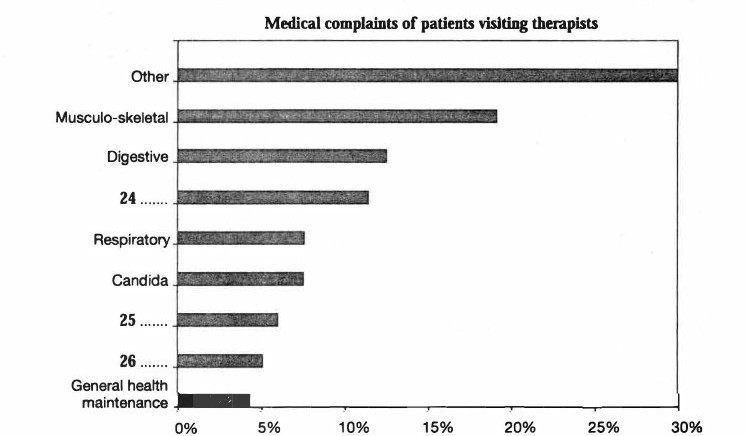
According to the Australian Journal of Public Health, 18% of patients visiting alternative therapists do so because they suffer from musculo-skeletal complaints; 12% suffer from digestive problems, which is only 1% more than those suffering from emotional problems. Those suffering from respiratory complaints represent 7% of their patients, and candida sufferers represent an equal percentage. Headache sufferers and those complaining of general ill health represent 6% and 5% of patients respectively, and a further 4% see therapists for general health maintenance.
The survey suggested that complementary medicine is probably a better term than alternative medicine. Alternative medicine appears to be an adjunct, sought in times of disenchantment when conventional medicine seems not to offer the answer.
Questions
Questions 14–15 One Choice
Choose the correct letter, A, B, C or D.
Questions 16–23 Yes / No / Not Given
Do the following statements agree with the views of the writer in Reading Passage 2?
YES if the statement agrees with the views of the writer
NO if the statement contradicts the views of the writer
NOT GIVEN if it is impossible to say what the writer thinks about this
Questions 24–26 Diagram Labeling
Complete the vertical axis on the table below.
Choose NO MORE THAN THREE WORDS from Reading Passage 2 for each answer.
Answers & Explanations Summary
| # | Answer | Evidence | Explanation |
|---|---|---|---|
| Q14 | C | Australia has been unusual in the Western world in having a very conservative attitude to natural or alternative therapies, according to Dr Paul Laver, a lecturer in Public Health at the University of Sydney. 'We've had a tradition of doctors being fairly powerful and I guess they are pretty loath to allow any pretenders to their position to come into it.' In many other industrialised countries, orthodox and alternative medicine have worked 'hand in glove' for years | Excerpt/Passage Explanation: The passage states that Australia is unique because its traditional doctors are very powerful and do not want to let other types of healers take their place. It contrasts this with other countries where regular and alternative medicine have collaborated for a long time. Answer Explanation: The answer means that for a long time, doctors in Australia did not want to work with or accept people who use natural or alternative health treatments. Reason For Correctness: The correct answer is C because the passage explains that Australia is different from other Western countries. In many places, regular doctors and alternative healers work together closely (this is called working 'hand in glove'). However, Australian doctors have a 'conservative' (unchanging) attitude. They are 'loath' to let others join their field, which means they are unwilling or reluctant to share their power with alternative therapists. |
| Q15 | B | Americans made more visits to alternative therapists than to orthodox doctors in 1990 | Excerpt/Passage Explanation: The passage says that in 1990, people in America went to alternative medical experts more times than they went to see traditional doctors. Answer Explanation: The answer means that in the year 1990, people in the United States went to see alternative health practitioners more frequently than they went to see regular medical doctors. Reason For Correctness: The correct answer is B because the passage states that in 1990, the total number of visits made by Americans to alternative therapists was higher than the number of visits they made to standard (orthodox) doctors. The word 'consulted' in the question is a synonym for 'made more visits' as used in the passage. |
| Q16 | YES | Disenchantment with orthodox medicine has seen the popularity of alternative therapies in Australia climb steadily during the past 20 years | Excerpt/Passage Explanation: The passage explains that because people were unhappy with regular medicine, the number of people choosing different types of treatments has gone up continuously for the last 20 years. Answer Explanation: The answer confirms that over the last two decades, more and more people in Australia have started using natural or non-traditional medicine. Reason For Correctness: The correct answer is YES because the passage states that the use of alternative therapies has grown regularly for 20 years. It mentions that people became unhappy with standard doctors, causing the demand for other types of healing to go up. The text even gives numbers to prove this growth, showing how the percentage of the population using these services rose between 1983 and 1990. |
| Q17 | NO | In a 1983 national health survey, 1.9% of people said they had contacted a chiropractor, naturopath, osteopath, acupuncturist or herbalist in the two weeks prior to the survey. By 1990, this figure had risen to 2.6% of the population | Excerpt/Passage Explanation: The passage shows that the percentage of people using these medical treatments only changed from 1.9% to 2.6% over seven years. This small growth proves that the statement's claim of an 8% increase is incorrect. Answer Explanation: The answer is NO because the statement says the number of people using alternative medicine grew by 8% of the population, which is not true according to the text. Reason For Correctness: The correct answer is NO because the passage provides specific statistics for the years 1983 and 1990. In 1983, 1.9% of the population used alternative therapies, and by 1990, this number was 2.6%. This is a small increase of only 0.7% (2.6 minus 1.9), not the 8% claimed in the question. While the text later mentions 'an eighth' (which is about 12.5%), this refers to the number of doctor visits compared to other doctor visits, not a percentage of the total population. |
| Q18 | YES | The 550,000 consultations with alternative therapists reported in the 1990 survey represented about an eighth of the total number of consultations with medically qualified personnel covered by the survey, according to Dr Laver and colleagues writing in the Australian Journal of Public Health in 1993 | Excerpt/Passage Explanation: The passage says that a 1990 study recorded 550,000 appointments with people who practice alternative medicine. Answer Explanation: The answer means that a study done in 1990 found that people had 550,000 meetings with non-traditional health experts. Reason For Correctness: The correct answer is YES because the passage mentions a specific report from 1990. This report says there were 550,000 'consultations' (which means meetings or visits) with alternative therapists. Since the number, the year, and the subject (alternative therapists) in the text match the question, the statement is true. The word 'consultations' is an important word for learners to know as it refers to professional appointments. |
| Q19 | YES | 'A better educated and less accepting public has become disillusioned with the experts in general, and increasingly sceptical about science and empirically based knowledge,' they said. 'The high standing of professionals, including doctors, has been eroded as a consequence.' | Excerpt/Passage Explanation: The passage explains that because people are now more likely to doubt experts and scientific facts, the high level of respect that doctors used to have has decreased over time. Answer Explanation: The answer YES means that in the past, people in Australia had more respect for doctors and a better opinion of them than they have now. Reason For Correctness: The correct answer is YES because the text mentions that the high level of respect—called 'high standing'—that doctors and other professionals once had has been 'eroded.' To erode means to slowly wear away or decrease. This shows that their reputation used to be higher than it is today, as people have become more 'sceptical,' or doubtful, of medical experts and science. |
| Q20 | YES | Rather than resisting or criticising this trend, increasing numbers of Australian doctors, particularly younger ones, are forming group practices with alternative therapists or taking courses themselves, particularly in acupuncture and herbalism | Excerpt/Passage Explanation: The passage explains that instead of being upset by the shift toward alternative medicine, many doctors in Australia are actually joining new medical groups or studying these methods on their own. Answer Explanation: The answer is YES because the original text confirms that some doctors in Australia are indeed learning how to practice alternative medicine. Reason For Correctness: The correct answer is YES because the passage states that more Australian doctors are choosing to take classes to learn about different types of medicine. Specifically, it mentions that younger doctors are "taking courses themselves," which is another way of saying they are retraining. The text gives examples of these subjects, such as acupuncture and herbalism, which are forms of alternative therapies. |
| Q21 | NOT GIVEN | Part of the incentive was financial, Dr Laver said. 'The bottom line is that most general practitioners are business people. If they see potential clientele going elsewhere, they might want to be able to offer a similar service.' | Excerpt/Passage Explanation: The passage explains that doctors care about money and want to keep their patients, but it does not give any facts about the actual salaries of doctors or alternative therapists. Answer Explanation: The answer is NOT GIVEN because the article does not provide any information about the income or annual pay of alternative therapists compared to doctors. Reason For Correctness: The correct answer is NOT GIVEN because while the passage discusses money in terms of hospital spending and doctors acting as business people, it never mentions specific salaries. Even though it notes that doctors are worried about losing 'clientele' (customers) to alternative medicine, it does not state that therapists earn more money than doctors. Since this comparison is missing from the text, we cannot determine if the statement is true or false. |
| Q22 | NO | In 1993, Dr Laver and his colleagues published a survey of 289 Sydney people who attended eight alternative therapists' practices in Sydney. These practices offered a wide range of alternative therapies from 25 therapists | Excerpt/Passage Explanation: The passage states that the 1993 survey included 289 people who went to clinics where many different types of alternative treatments—not just acupuncture—were available. Answer Explanation: The answer is NO, which means the statement is false according to the information in the text. Reason For Correctness: The correct answer is NO because the statement says the 289 people in the survey went specifically for acupuncture. However, the passage explains that the survey involved people who went to clinics offering a variety of different treatments. Using the words "wide range" shows that it was not limited to just one therapy like acupuncture. |
| Q23 | YES | Those surveyed had experienced chronic illnesses, for which orthodox medicine had been able to provide little relief | Excerpt/Passage Explanation: The passage explains that the individuals who participated in the survey suffered from 'chronic illnesses.' This tells us that their medical complaints were long-term and difficult to fix with standard medicine. Answer Explanation: The answer YES means that the statement correctly matches the facts presented by the writer in the text regarding the 1993 survey. Reason For Correctness: The correct answer is YES because the passage specifically mentions that the people involved in the 1993 Sydney survey were those who had 'chronic illnesses.' The word 'chronic' is a synonym for 'long-term,' which means the health problems lasted for a long period of time and were not just temporary. Therefore, the description in the question matches the description in the passage. |
| Q24 | emotional / emotional problems | 12% suffer from digestive problems, which is only 1% more than those suffering from emotional problems | Excerpt/Passage Explanation: The passage explains that the percentage of people with stomach issues (digestive) is very close to the percentage of people with feeling or mood issues (emotional). Answer Explanation: The answer identifies a specific health condition that people have when they seek alternative medical care. Reason For Correctness: The correct answer is found in the section of the text that lists various health issues and the percentage of people who have them. The text mentions that 12% of patients have digestive issues. It then explains that this number is only 1% higher than the number of people who visit therapists for 'emotional problems' (which would be 11%). Keywords to watch for are 'suffer from' and 'problems'. |
| Q25 | headache / headaches | Headache sufferers and those complaining of general ill health represent 6% and 5% of patients respectively, and a further 4% see therapists for general health maintenance | Excerpt/Passage Explanation: The passage lists 'Headache sufferers' as a specific group of people who visit these therapists, noting that they represent 6% of the total patients. This confirms that 'headache' is the correct label for that section of the health data. Answer Explanation: The answer refers to the specific health problem of having pain in the head. In this context, it is listed as one of the reasons why people in Australia visit alternative medicine doctors. Reason For Correctness: The correct answer is determined by looking at the sixth paragraph, which lists the different health problems (complaints) patients have when visiting alternative therapists. The text provides a breakdown of these visitors by percentage. It states that people who have pains in the head, or 'Headache sufferers', make up 6% of the patients. This matches the data typically found on a chart or table organized by health categories. |
| Q26 | general ill health | Headache sufferers and those complaining of general ill health represent 6% and 5% of patients respectively, and a further 4% see therapists for general health maintenance | Excerpt/Passage Explanation: The passage lists the different amounts of people who see alternative doctors. It explains that 6% go because of headaches, while 5% go because they feel sick in a general way. Another 4% go to the doctor just to stay healthy. Answer Explanation: The answer 'general ill health' refers to when someone feels poorly or sick overall, rather than having just one specific problem like a broken leg or a cough. Reason For Correctness: The correct answer is found in the section of the text that reports on a survey about why patients visit alternative therapists. The passage lists several categories of health problems and gives the percentage of patients for each. It specifically links the phrase 'general ill health' to the 5% figure mentioned in the data, making it the correct term to use for that part of the statistics. |