
Crowdmapping - IELTS Reading Answers & Explanations
From Collins Practice Tests For IELTS 1 Academic Reading Test 2 · Part 3 · Questions 30–40
Reading Passage
You should spend about 20 minutes on Questions 30-40, which are based on Reading Passage 3 below.
Crowdmapping
One of the most exciting mass movements today is crowdmapping: sharing data collectively to produce a visualisation on a map giving almost-instant information on current events. Crowdmapping produces a picture of events on the ground as they happen by taking text messages and social media feeds together with geographic data to distribute real-time, interactive information on events such as revolutions, wars, humanitarian crises and natural disasters. This new application of social networking can bring fresh insights into events, which can be nearly impossible to cover through traditional methods of journalism where individuals report into a central newsroom. It has the additional advantage of mapping longer-term trends that fall in and out of the news.
Technologies like mobile phones and the world wide web have made it possible for those people caught up in a war or natural disaster to broadcast information from the affected area and for this information to be collected in a way that emergency aid services can use and act on. In a disaster situation the most current information is essential because the needs of, for example, flood victims change minute by minute. It enables response organisations to get an understanding of a crisis situation quickly (thus it is sometimes called crisis mapping), give targeted aid to people most in need and form a network of reliable reporters on the ground to check information going to the live updated map. When an emergency situation arises, a small army of volunteers comes together to collect incoming information and put it on the map. Some of the information comes from official sources such as the United Nations, but the most powerful aspect of data collection is the ability to pull information from Twitter posts, emails and text messages. Once this information is available, volunteers collaborate via the Internet to put data on to a map, which is updated every second to build a comprehensive picture of the scale and severity of the disaster. Volunteers from all over the world translate the messages coming in from the disaster zone into English and plot the information on the live interactive map.
One of the originators of crowdmapping is Ushahidi. The developers of crowdmapping software began the project in Kenya to map reports of violence after a controversial election result in 2008. Later, in 2010 in Haiti, a similar approach of collectively sharing information to help emergency services deal with the situation was adopted. A small team released a free phone number – 4636 – to allow victims of the 7.0-magnitude earthquake to text their requests for medical aid, water and shelter. Over 1,000 workers and volunteers around the globe, contacted via Facebook, translated the messages, mostly in Haitian Creole. They then prioritised and geolocated the requests for help via crowdmapping software. Through this service, emergency response teams were able to save the lives of hundreds of people and send food, water and medicine to tens of thousands. The success of Project 4636 led to the development of crowdmapping when dealing with critical and even non-critical situations.
Most recently, crowdmapping has been used to track violent activity in warzones and areas with uprisings. In one country, when the people rose up against their leader, the United Nations monitored the escalating violence via a crowdmap to provide them with information on what was happening in the country. In another country, rebel fighters reported people who were missing, killed or arrested according to eyewitnesses. Other uses for the software have included the Danish people's attempt to map the extent of CCTV surveillance in their country. Since the project began, 2,220 CCTV cameras have been photographed and verified by journalists. However, not all attempts at crowdmapping have been successful. The attempt to map an uprising in one country was cut short when the authorities took the country offline and, when the Internet was brought back, the crowdmap had been forgotten.
There are other downsides to crowdmapping. According to George Chamales, there are security challenges: it must be ensured that the system stays operational and that the information collated is not misused. Firstly, the lead crowdmap tends to be the one that is set up first and has the most users. Unfortunately, the organisation behind the first crowdmap may not be the best one to manage the complex process of collecting and managing the data. Secondly, there are several platforms for producing crowdmaps including commercial products and open-source projects like Ushahidi. Some have even been developed for a particular crisis such as the nuclear meltdown in Fukushima - all of these have their own disadvantages: commercial software may need to patch bugs in the programme; open source software may overlook security in favour of functionality. The information collected needs to come from trustworthy sources, which are then relied on for more reports; this may make the person sending the report a potential target in war situations. Finally, there is the human element in processing the information, relying on thousands of volunteers to translate, categorise and prioritise the information. There is an obvious risk in giving strangers access to messages generated in dangerous circumstances: messages may be deleted and the sender's identity may be compromised.
While the introduction of any new technology has flaws, George Chamales believes that crowdmapping cannot afford to go through the same maturation as other technologies: the risks to people using it in hostile political situations are too great and could lead to them being arrested or killed. Furthermore, over time the technology may be labelled as dangerous, leading organisations to shun an extremely useful instrument. The answer, Chamales believes, can be found in developing standards through collaboration between IT security experts and the crowdmapping movement. New challenges and issues will arise with each crisis mapped by the people affected, but George Chamales thinks that establishing security standards would be a good starting point to allow this valuable new form of networking to evolve.
Questions
Questions 30–34 Diagram Labeling
Label the diagram below using words from the box.
Write the correct letter, A-E, in spaces 30-34.
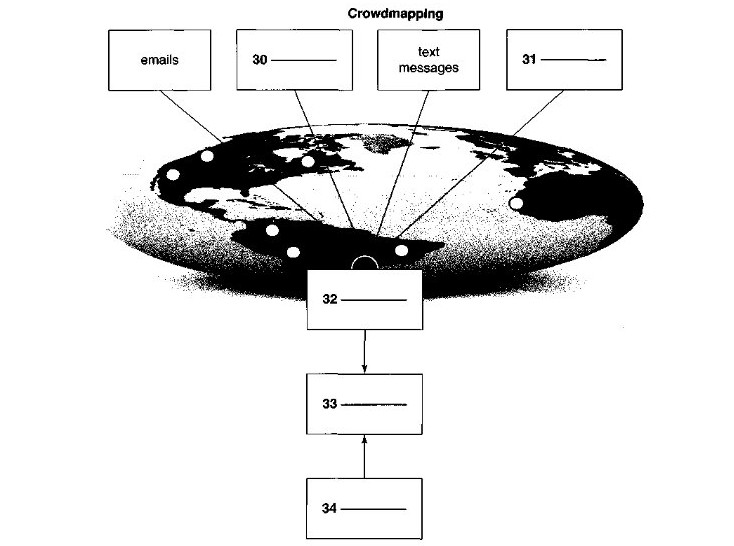
A. interactive map | B. social media feeds | C. emergency services
D. volunteers collect and translate | E. official sources
Questions 35–40 One Choice
Choose the correct letter, A, B, C or D.
Answers & Explanations Summary
| # | Answer | Evidence | Explanation |
|---|---|---|---|
| Q30 | B | Crowdmapping produces a picture of events on the ground as they happen by taking text messages and social media feeds together with geographic data to distribute real-time, interactive information on events such as revolutions, wars, humanitarian crises and natural disasters | Excerpt/Passage Explanation: The passage explains that crowdmapping creates a map of current events by using text messages and social media updates along with location information to share news quickly as it happens. Answer Explanation: The answer B, social media feeds, refers to the updates and posts shared by people on social networking websites like Twitter or Facebook. Reason For Correctness: The correct answer is social media feeds because the text explains that crowdmapping works by collecting data from various sources to create a live map. It specifically mentions that 'social media feeds' and text messages are used together with location data to provide instant information about events happening on the ground, such as wars or natural disasters. This makes these feeds a primary source of information for the mapping process. |
| Q31 | E | Some of the information comes from official sources such as the United Nations, but the most powerful aspect of data collection is the ability to pull information from Twitter posts, emails and text messages | Excerpt/Passage Explanation: The passage states that some information is provided by recognized groups like the United Nations, while other information is gathered from people's messages on the internet. Answer Explanation: The answer is 'official sources.' These are formal and trusted groups, like the United Nations, that give information to be used on a map. Reason For Correctness: The correct answer is 'official sources' because the passage explains that the data used for crowdmapping comes from two main places. The first place is official groups like the United Nations, and the second place is messages from social media. These sources provide the basic facts that are needed before any map can be made. |
| Q32 | D | When an emergency situation arises, a small army of volunteers comes together to collect incoming information and put it on the map Volunteers from all over the world translate the messages coming in from the disaster zone into English and plot the information on the live interactive map |
Excerpt/Passage Explanation: The passage explains that when there is a sudden problem, a large group of people who help for free gathers to find new information. It also mentions that these helpers from all over the world turn those messages into English. Answer Explanation: The answer means that people who work for free (volunteers) gather information and change it into a language that others can understand (translate). Reason For Correctness: The correct answer is 'D' because the text describes how a crowdmap is built. During a crisis, a group of unpaid helpers, referred to as volunteers, works together to gather (collect) the incoming messages. The text also mentions that these same helpers change (translate) the messages they receive into English so that the information can be correctly placed on the interactive map. |
| Q33 | A | Volunteers from all over the world translate the messages coming in from the disaster zone into English and plot the information on the live interactive map | Excerpt/Passage Explanation: The passage explains that people working for free from many countries translate reports and then put that information onto a digital map that updates as things change. Answer Explanation: The answer 'A' stands for the 'interactive map.' This is a digital map that updates quickly with new information so people can use it during emergencies. Reason For Correctness: The correct answer is 'A' because the goal of crowdmapping is to take various sources of data and turn them into a 'visualisation on a map' that provides 'almost-instant information.' The passage describes how volunteers process messages and then 'plot' or mark that information onto a 'live interactive map' to help others see what is happening in real time. |
| Q34 | C | Technologies like mobile phones and the world wide web have made it possible for those people caught up in a war or natural disaster to broadcast information from the affected area and for this information to be collected in a way that emergency aid services can use and act on | Excerpt/Passage Explanation: The passage explains that modern technology allows people in danger to send out information, which is then put together so that rescue teams can use it to help them. Answer Explanation: The answer is "emergency services," which are groups like rescuers, doctors, and relief workers who provide help during dangerous events like disasters or wars. Reason For Correctness: The correct answer is 'C' because the passage explains that the purpose of collecting and mapping information is to help organizations that respond to crises. It mentions that data is gathered in a specific way so that "emergency aid services" or "response organisations" can see where help is needed most and take action to save lives. Synonyms or related terms used in the text include "emergency aid services," "emergency response teams," and "response organisations." |
| Q35 | A | It has the additional advantage of mapping longer-term trends that fall in and out of the news | Excerpt/Passage Explanation: The passage explains that crowdmapping is useful because it tracks patterns that stay important over a long time, unlike regular news which only talks about things for a short while. Answer Explanation: The answer means that crowdmapping provides information about patterns or habits that happen over a long period of time. Reason For Correctness: The correct answer is A because the text mentions that crowdmapping can show 'longer-term trends.' In this context, 'trends' are the same as patterns of behavior, and 'longer-term' means they cover a wide span of time, including what happened in the past (historical) and what might keep happening (future). While it does cover political events and natural disasters, its ability to track these lasting patterns is a specific goal highlighted in the text. |
| Q36 | D | It enables response organisations to get an understanding of a crisis situation quickly (thus it is sometimes called crisis mapping), give targeted aid to people most in need and form a network of reliable reporters on the ground to check information going to the live updated map | Excerpt/Passage Explanation: The passage explains that these map tools help emergency groups see what is happening in a disaster very fast, so they can send help directly to the people who need it most. Answer Explanation: The answer means that crowdmapping helps groups that provide help (like rescue workers) to work faster and send aid to the exact places where it is most needed. Reason For Correctness: The correct answer is D because the passage explains that crowdmapping allows response organizations to understand a crisis "quickly." It also highlights that they can give "targeted aid," which implies sending help to specific people or areas based on the data provided by the map. Keywords to look for are "quickly" and "targeted aid." |
| Q37 | C | Finally, there is the human element in processing the information, relying on thousands of volunteers to translate, categorise and prioritise the information | Excerpt/Passage Explanation: The passage explains that people are a necessary part of handling the data, and the system needs thousands of helpers to translate the messages and decide which ones are most important. Answer Explanation: The answer means that the way crowdmapping works depends very much on many people changing messages from local languages into another language, like English. Reason For Correctness: The correct answer is C because the text highlights that the process depends on the work of many people. In the fifth paragraph, it states that there is a 'human element' in managing the data. It explains that the system relies on 'thousands of volunteers' to do the work of translating, sorting, and organizing the incoming messages. Without these people to translate the information from the disaster zone, the maps could not be updated or used effectively. |
| Q38 | C | Most recently, crowdmapping has been used to track violent activity in warzones and areas with uprisings | Excerpt/Passage Explanation: The passage describes how crowdmapping technology is used to monitor and follow violence in places where there is a war or where people are rebelling against their government. Answer Explanation: The answer means locations where war or violent fighting is happening. Reason For Correctness: The correct answer is C because the fourth paragraph focuses on how crowdmapping is used in places where there is social or military trouble. It mentions using these maps to follow 'violent activity' in 'warzones' and during 'uprisings' (which are types of conflict). It also describes how people use the technology to report when individuals are 'missing, killed or arrested' during these events. While Denmark is mentioned for mapping security cameras, the majority of the examples in this section relate to conflict. |
| Q39 | D | Unfortunately, the organisation behind the first crowdmap may not be the best one to manage the complex process of collecting and managing the data The information collected needs to come from trustworthy sources, which are then relied on for more reports There is an obvious risk in giving strangers access to messages generated in dangerous circumstances: messages may be deleted and the sender's identity may be compromised |
Excerpt/Passage Explanation: The passage describes three main problems: first, the group in charge might not be able to handle all the data well; second, the information might not be from a trustworthy or reliable place; and third, there are safety risks where someone's identity could be found or messages could be deleted. Answer Explanation: The answer is D because the text does not mention computers suddenly stopping or breaking as a problem of crowdmapping. Reason For Correctness: The correct answer is D because the passage lists several problems (disadvantages) of crowdmapping, but it never talks about computer crashes. The text mentions that some groups might not be good at managing the large amount of information (Option A). It mentions that we must trust the sources and that strangers might delete messages, which relates to information being unreliable (Option B). It also clearly states there are security problems where a person's name or identity might be in danger (Option C). Because A, B, and C are discussed as problems in the passage, D is the only one that is NOT a listed disadvantage. |
| Q40 | C | The answer, Chamales believes, can be found in developing standards through collaboration between IT security experts and the crowdmapping movement | Excerpt/Passage Explanation: The passage states that the way to fix the problems is for computer security experts and mapping groups to work together to make a set of rules and safety points. Answer Explanation: The answer means that the right way to solve the issues with crowdmapping is for everyone to work together and agree on rules that make the technology safe for everyone to use. Reason For Correctness: The correct answer is C because the final paragraph of the passage discusses how to fix the risks and mistakes of crowdmapping. It mentions that an expert, George Chamales, believes the solution (the "answer") is to create "standards" (rules or common practices) by having experts and mapping groups work together ("collaboration"). This matches the idea of agreeing on shared ways to keep the system "secure" or safe. |