
GLASS CAPTURING THE DANCE OF LIGHT - IELTS Reading Answers & Explanations
From Cambridge IELTS 01 Academic Reading Test 4 · Part 1 · Questions 1–13
Reading Passage
You should spend about 20 minutes on Questions 1-13 which are based on Reading Passage 1 below
GLASS CAPTURING THE DANCE OF LIGHT
A Glass, in one form or another, has long been in noble service to humans As one of the most widely used of manufactured materials, and certainly the most versatile, it can be as imposing as a telescope mirror the width of a tennis court or as small and simple as a marble rolling across dirt The uses of this adaptable material have been broadened dramatically by new technologies glass fibre optics — more than eight million miles — carrying telephone and television signals across nations, glass ceramics serving as the nose cones of missiles and as crowns for teeth; tiny glass beads taking radiation doses inside the body to specific organs, even a new type of glass fashioned of nuclear waste in order to dispose of that unwanted material.
B On the horizon are optical computers These could store programs and process information by means of light - pulses from tiny lasers - rather than electrons And the pulses would travel over glass fibres, not copper wire These machines could function hundreds of times faster than today’s electronic computers and hold vastly more information Today fibre optics are used to obtain a clearer image of smaller and smaller objects than ever before - even bacterial viruses. A new generation of optical instruments is emerging that can provide detailed imaging of the inner workings of cells. It is the surge in fibre optic use and in liquid crystal displays that has set the U.S. glass industry (a 16 billion dollar business employing some 150,000 workers) to building new plants to meet demand.
C But it is not only in technology and commerce that glass has widened its horizons. The use of glass as art, a tradition spins back at least to Roman times, is also booming. Nearly everywhere, it seems, men and women are blowing glass and creating works of art. «I didn’t sell a piece of glass until 1975,» Dale Chihuly said, smiling, for in the 18 years since the end of the dry spell, he has become one of the most financially successful artists of the 20th century. He now has a new commission - a glass sculpture for the headquarters building of a pizza company - for which his fee is half a million dollars.
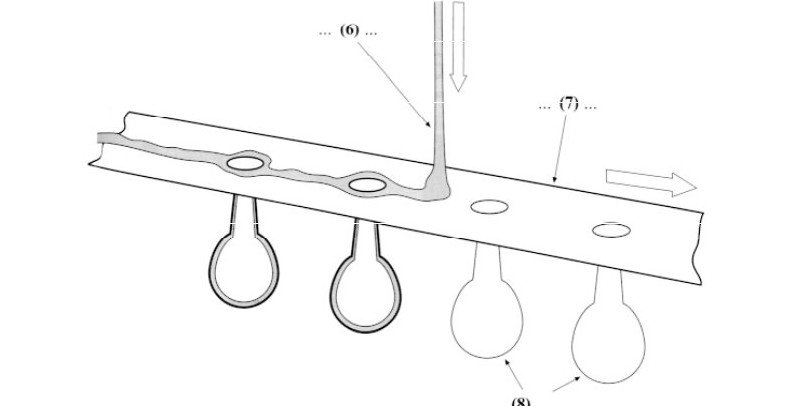
D But not all the glass technology that touches our lives is ultra-modern. Consider the simple light bulb; at the turn of the century most light bulbs were hand blown, and the cost of one was equivalent to half a day’s pay for the average worker. In effect, the invention of the ribbon machine by Corning in the 1920s lighted a nation. The price of a bulb plunged. Small wonder that the machine has been called one of the great mechanical achievements of all time. Yet it is very simple: a narrow ribbon of molten glass travels over a moving belt of steel in which there are holes. The glass sags through the holes and into waiting moulds. Puffs of compressed air then shape the glass. In this way, the envelope of a light bulb is made by a single machine at the rate of 66,000 an hour, as compared with 1,200 a day produced by a team of four glassblowers.
E The secret of the versatility of glass lies in its interior structure. Although it is rigid, and thus like a solid, the atoms are arranged in a random disordered fashion, characteristic of a liquid. In the melting process, the atoms in the raw materials are disturbed from their normal position in the molecular structure; before they can find their way back to crystalline arrangements the glass cools. This looseness in molecular structure gives the material what engineers call tremendous “formability” which allows technicians to tailor glass to whatever they need.
F Today, scientists continue to experiment with new glass mixtures and building designers test their imaginations with applications of special types of glass. A London architect, Mike Davies, sees even more dramatic buildings using molecular chemistry. “Glass is the great building material of the future, the «dynamic skin»,” he said. “Think of glass that has been treated to react to electric currents going through it, glass that will change from clear to opaque at the push of a button, that gives you instant curtains. Think of how the tall buildings in New York could perform a symphony of colours as the glass in them is made to change colours instantly.” Glass as instant curtains is available now, but the cost is exorbitant. As for the glass changing colours instantly, that may come true. Mike Davies’s vision may indeed be on the way to fulfilment.
Questions
Questions 1–5 Matching Headings
Reading Passage 1 has six paragraphs (A-F). Choose the most suitable heading/or each paragraph from the list of headings below.
NB There are more headings than paragraphs so you will not use all of them.
You may use any heading more at once.
i. Growth in the market for glass crafts
ii. Computers and their dependence on glass
iii. What makes glass so adaptable
iv. Historical development of glass
v. Scientists’ dreams cost millions
vi. Architectural experiments with glass
vii. Glass art galleries flourish
viii. Exciting innovations in fibre optics
ix. A former glass technology
x. Everyday uses of glass
Questions 6–8 Diagram Labeling
The diagram below shows the principle of Coming’s ribbon machine. Label the diagram by selecting NO MORE THAN THREE WORDS from the Reading Passage to fill each numbered space.
Questions 9–13 Matching Features
Look at the list below of the uses of glass. According to the passage, state whether these uses exist today, will exist in the future or are not mentioned by the writer.
A. if the uses exist today
B. if the uses will exist in the future
C. if the uses are not mentioned by the writer
Answers & Explanations Summary
| # | Answer | Evidence | Explanation |
|---|---|---|---|
| Q1 | viii | On the horizon are optical computers These could store programs and process information by means of light - pulses from tiny lasers - rather than electrons And the pulses would travel over glass fibres, not copper wire These machines could function hundreds of times faster than today’s electronic computers and hold vastly more information Today fibre optics are used to obtain a clearer image of smaller and smaller objects than ever before - even bacterial viruses. A new generation of optical instruments is emerging that can provide detailed imaging of the inner workings of cells | Excerpt/Passage Explanation: The passage describes how scientists are creating fast computers that use light and glass threads instead of electricity. It also says that these glass threads (fibre optics) help doctors and scientists see very tiny living things like viruses and cells in a new, better way. Answer Explanation: The answer viii means that the second paragraph (Paragraph B) is mainly about new and amazing developments in how we use thin glass threads called fibre optics. Reason For Correctness: The correct answer is viii because Paragraph B focuses on upcoming and current high-tech uses for glass fibers. It explains how 'optical computers' will use light through 'glass fibres' to work much faster than current computers. It also mentions that 'fibre optics' are being used right now to see tiny things like 'bacterial viruses' and the inside of 'cells' clearer than ever before. These are all examples of new and 'exciting' 'innovations.' |
| Q2 | i | The use of glass as art, a tradition spins back at least to Roman times, is also booming. Nearly everywhere, it seems, men and women are blowing glass and creating works of art. «I didn’t sell a piece of glass until 1975,» Dale Chihuly said, smiling, for in the 18 years since the end of the dry spell, he has become one of the most financially successful artists of the 20th century | Excerpt/Passage Explanation: The passage says that using glass for art is growing very fast. It explains that many people are making glass art everywhere. It also gives an example of an artist who used to sell nothing but is now very rich from his glass work. Answer Explanation: The answer means that more people are buying glass art, and the business of making glass objects by hand is becoming very popular and successful. Reason For Correctness: The correct answer is i because Paragraph C describes how the use of glass as art is 'booming,' which is a synonym for growing rapidly. The text explains that many people are now creating glass art and highlights the financial success of artist Dale Chihuly, whose high fees for glass sculptures demonstrate the growth and value of the market for glass crafts. |
| Q3 | ix | But not all the glass technology that touches our lives is ultra-modern. Consider the simple light bulb; at the turn of the century most light bulbs were hand blown, and the cost of one was equivalent to half a day’s pay for the average worker. In effect, the invention of the ribbon machine by Corning in the 1920s lighted a nation | Excerpt/Passage Explanation: The passage explains that some ways of making glass are not new or modern. It describes how light bulbs were once made by hand and how a machine from the year 1920 changed things, showing that these are older techniques from a previous time. Answer Explanation: The answer 'ix' means that this paragraph describes a machine or method used to make glass that comes from the past and is not brand new. Reason For Correctness: The correct answer is 'ix' because Paragraph D focuses on the history of glass-making technology for light bulbs. It states that not all glass machines are 'ultra-modern' and discusses how things were done 'at the turn of the century' (the 1900s) and during the 1920s. By contrasting these older methods—like hand-blowing and the 1920s 'ribbon machine'—with modern technology, the text identifies them as 'former' (past) technologies. |
| Q4 | iii | The secret of the versatility of glass lies in its interior structure This looseness in molecular structure gives the material what engineers call tremendous “formability” which allows technicians to tailor glass to whatever they need |
Excerpt/Passage Explanation: The passage explains that the reason glass can be used in so many ways is because of how it is built on the inside. Because its tiny parts (molecules) are not tightly locked in place, the material is very easy to shape and change to fit different jobs. Answer Explanation: The answer iii means that Paragraph E explains the internal, scientific reasons why glass is a material that can be easily changed or shaped for many different purposes. Reason For Correctness: The correct answer is iii because the paragraph discusses the "versatility" (a synonym for adaptability) of glass. It explains that the way atoms are arranged inside glass is messy and "disordered," rather than fixed in a strict pattern. This internal structure gives the material "formability," meaning it can be easily shaped or "tailored" to meet any specific need. Phrases like "versatility of glass" and "tailor glass to whatever they need" directly support the idea of it being highly adaptable. |
| Q5 | vi | Today, scientists continue to experiment with new glass mixtures and building designers test their imaginations with applications of special types of glass. A London architect, Mike Davies, sees even more dramatic buildings using molecular chemistry. “Glass is the great building material of the future, the «dynamic skin»,” he said | Excerpt/Passage Explanation: The passage explains that people who design buildings are thinking of new ways to use glass. An expert named Mike Davies believes glass will be the most important part of future buildings, acting like a skin that can change. Answer Explanation: The answer vi means Paragraph F talks about using glass for buildings in new and creative ways. Reason For Correctness: The correct answer is vi because the paragraph describes how building designers and architects are trying new ideas with glass. It mentions an architect named Mike Davies who believes glass will be a very important material for the buildings of the future. The text explains experiments with glass that can change from clear to dark with a button or even change colors, which fits the idea of architectural experiments. |
| Q6 | molten glass / ribbon of glass / molten glass ribbon | Yet it is very simple: a narrow ribbon of molten glass travels over a moving belt of steel in which there are holes | Excerpt/Passage Explanation: The passage explains that a thin, melted stream of glass goes across a metal belt with holes in it. Answer Explanation: The answer refers to the hot, liquid-like material that the machine uses to make light bulbs. Reason For Correctness: The correct answer is found in paragraph D, where the operation of the ribbon machine is explained. The text specifies that a 'narrow ribbon of molten glass' is the material that moves across the machine's steel belt. The word 'molten' describes how the glass has been melted into a liquid state so it can be easily shaped. |
| Q7 | belt of steel / steel belt / moving belt | Yet it is very simple: a narrow ribbon of molten glass travels over a moving belt of steel in which there are holes | Excerpt/Passage Explanation: The passage explains that the light bulb machine uses a thin piece of hot glass that moves on top of a metal belt that is moving and has holes in it. Answer Explanation: The answer refers to a metal part of the machine that moves and supports the hot glass. Reason For Correctness: The correct answer is found in the description of how the ribbon machine works. The text explaining the process mentions that a strip of hot glass moves across a 'moving belt of steel' that has holes in it. This part of the machine is what allows the glass to sag through and form the shape of a light bulb. Key terms to notice are 'moving belt' and 'steel'. |
| Q8 | waiting moulds / moulds / waiting molds / molds | The glass sags through the holes and into waiting moulds | Excerpt/Passage Explanation: The passage explains that liquid glass drops through holes and goes into shaped containers (called moulds) that are ready and waiting to receive it. Answer Explanation: The answer refers to the containers that catch the glass and give it a specific shape. Reason For Correctness: The correct answer is found in Paragraph D, which explains how the ribbon machine works. The text says that glass 'sags' or drops down through holes and into 'waiting moulds.' These moulds are the parts of the machine that hold the glass to give it the shape of a light bulb. Using the words 'waiting moulds' accurately describes this part of the process mentioned in the passage. |
| Q9 | A | glass ceramics serving as the nose cones of missiles and as crowns for teeth | Excerpt/Passage Explanation: The passage says that glass is used to make crowns for teeth. Since a crown is a type of dental fitting, this shows that glass is used for this purpose today. Answer Explanation: The answer means that glass is already used by dentists to help or fix teeth right now. Reason For Correctness: The correct answer is A because the passage mentions 'crowns for teeth' as a use for glass ceramics. In dentistry, a crown is a specific type of dental fitting used to repair a broken or weak tooth. The text lists this as an example of how the uses of glass have already grown and become common in the modern world. |
| Q10 | B | On the horizon are optical computers | Excerpt/Passage Explanation: The passage uses the phrase "on the horizon" to explain that optical computers are a technology that is coming in the future rather than one that exists today. Answer Explanation: The answer means that optical computers are not available now, but they are expected to be used in the future. Reason For Correctness: The correct answer is B because the passage describes optical computers as being "on the horizon." In English, this phrase is used to talk about something that is expected to happen or be ready soon. The writer describes how these computers "could" work and compares them to "today’s" electronic computers, which shows that optical computers are still a development for the future. |
| Q11 | A | He now has a new commission - a glass sculpture for the headquarters building of a pizza company - for which his fee is half a million dollars | Excerpt/Passage Explanation: The passage explains that an artist currently has a job to make a sculpture out of glass for a business office. Answer Explanation: The answer means that people are currently making and selling glass sculptures in the present day. Reason For Correctness: The correct answer is A because the passage describes the use of glass in art as a thriving business in modern times. It highlights that artists are currently making glass art and specifically mentions a famous artist, Dale Chihuly, who has a "new commission" (a current job) to create a "glass sculpture." The text also uses the word "booming" to describe how popular glass art is right now, confirming that these sculptures exist today. |
| Q12 | C | even a new type of glass fashioned of nuclear waste in order to dispose of that unwanted material the atoms are arranged in a random disordered fashion, characteristic of a liquid |
Excerpt/Passage Explanation: The passage uses the word "fashioned" to mean "made out of" or "shaped," and the word "fashion" to describe a "way" or "manner" in which tiny atoms are organized. It never uses these words to talk about clothes or the style industry. Answer Explanation: The answer C means that the author of the text does not mention "fashions" (clothing, apparel, or style) as a way that glass is actually used. Reason For Correctness: The correct answer is C because there is no information in the passage describing glass as a material used for clothing or in the fashion industry. The text lists many historical, modern, and future uses of glass—such as telescope mirrors, fiber optics for phones, dental crowns, and light bulbs—but fashion is not among them. While the word "fashion" and its variation "fashioned" appear in the text, they refer to the way atoms are arranged or how a material was shaped, rather than to wearable items. |
| Q13 | A | Glass as instant curtains is available now, but the cost is exorbitant | Excerpt/Passage Explanation: The passage explains that glass curtains are ready to be used right now. It tells us that they are already made and can be used, so they are not just an idea for the future. Answer Explanation: The answer means that glass can be used for curtains today. Reason For Correctness: The correct answer is A because the text says that glass curtains are 'available now.' In English, 'available now' means you can get it or buy it at this time. This shows that the use of glass for curtains exists today, even if it is very expensive. |