
High Speed, High Rise - IELTS Reading Answers & Explanations
From Official Cambridge Guide to IELTS Academic Reading Test 3 · Part 2 · Questions 14–26
Reading Passage
You should spend about 20 minutes on Questions 14-26, which are based on Reading Passage 2 on the following pages.
High Speed, High Rise
A Chinese entrepreneur has figured out a way to manufacture 30-story, earthquake-proof skyscrapers that snap together in just 15 days.
A Zhang Yue is founder and chairman of Broad Sustainable Building (otherwise known as 'Broad') who, on 1 January, 2012, released a time-lapse video of its 30-story achievement. It shows construction workers buzzing around like gnats while a clock in the corner of the screen marks the time. In just 360 hours, a 100-metre-tall tower called the T30 rises from an empty site to overlook Hunan's Xiang River. At the end of the video, the camera spirals around the building overhead as the Broad logo appears on the screen: a lowercase b that wraps around itself in an imitation of the @ symbol. The company is in the process of franchising its technology to partners in India, Brazil, and Russia. What it is selling is the world's first standardized skyscraper and with it, Zhang aims to turn Broad into the McDonald's of the sustainable building industry. When asked why he decided to start a construction company, Zhang replies, 'It's not a construction company. It's a structural revolution.'
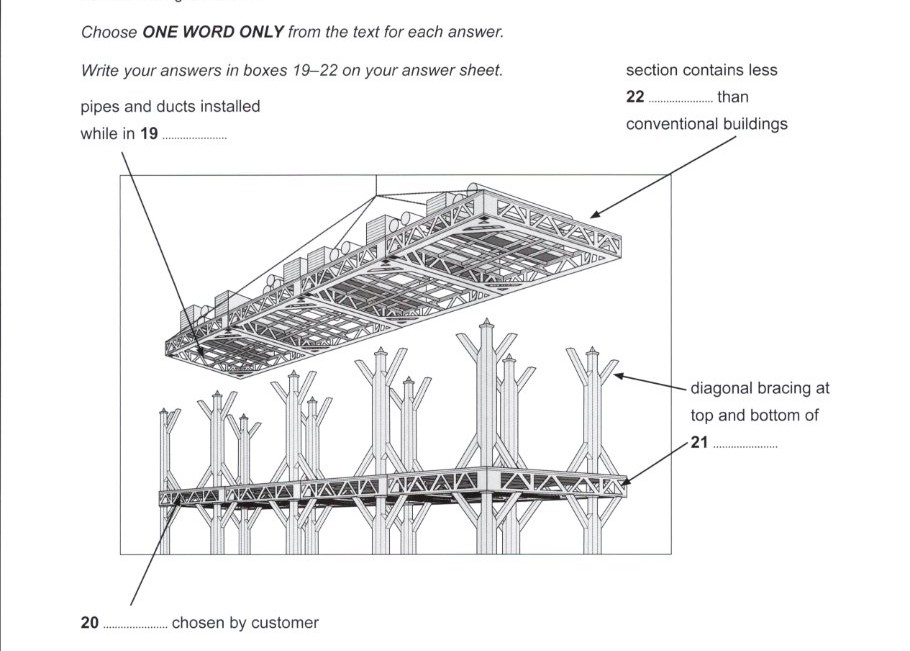
B So far, Broad has built 16 structures in China, plus another in Cancun. They are fabricated at two factories in Hunan, roughly an hour's drive from Broad Town, the sprawling headquarters. The floors and ceilings of the skyscrapers are built in sections, each measuring 15.6 by 3.9 meters with a depth of 45 centimeters. Pipes and ducts for electricity, water and waste are threaded through each floor module while it is still in the factory. The client's choice of flooring is also pre-installed on top. Standardized truckloads carry two modules each to the site with the necessary columns, bolts and tools to connect them stacked on top of each other. Once they arrive at the location, each section is lifted by crane directly to the top of the building, which is assembled like toy Lego bricks. Workers use the materials on the module to quickly connect the pipes and wires. The unique column design has diagonal bracing at each end and tabs that bolt into the floors above and below. In the final step, heavily insulated exterior walls and windows are slotted in by crane. The result is far from pretty but the method is surprisingly safe – and phenomenally fast.
C Zhang attributes his success to his creativity and to his outsider perspective on technology. He started out as an art student in the 1980s, but in 1988, Zhang left the art world to found Broad. The company started out as a maker of non-pressurized boilers. His senior vice-president, Juliet Jiang, says, 'He made his fortune on boilers. He could have kept doing this business, but ... he saw the need for nonelectric air-conditioning.' Towards the end of the decade, China's economy was expanding past the capacity of the nation's electricity grid, she explains. Power shortages were becoming a serious obstacle to growth. Large air-conditioning (AC) units fueled by natural gas could help companies ease their electricity load, reduce overheads, and enjoy more reliable climate control into the bargain. Today, Broad has units operating in more than 70 countries, in some of the largest buildings and airports on the planet.
D For two decades, Zhang's AC business boomed. But a couple of events conspired to change his course. The first was that Zhang became an environmentalist. The second was the earthquake that hit China's Sichuan Province in 2008, causing the collapse of poorly constructed buildings. Initially, he says, he tried to convince developers to refit existing buildings to make them both more stable and more sustainable, but he had little success. So Zhang drafted his own engineers and started researching how to build cheap, environmentally friendly structures that could also withstand an earthquake. Within six months of starting his research, Zhang had given up on traditional methods. He was frustrated by the cost of hiring designers and specialists for each new structure. The best way to cut costs, he decided, was to take building to the factory. But to create a factory-built skyscraper, Broad had to abandon the principles by which skyscrapers are typically designed. The whole load-bearing structure had to be different. To reduce the overall weight of the building, it used less concrete in the floors; that in turn enabled it to cut down on structural steel.
E Around the world, prefabricated and modular buildings are gaining in popularity. But modular and prefabricated buildings elsewhere are, for the most part, low-rise. Broad is alone in applying these methods to skyscrapers. For Zhang, the environmental savings alone justify the effort. According to Broad's numbers, a traditional high-rise will produce about 3,000 tons of construction waste, while a Broad building will produce only 25 tons. Traditional buildings also require 5,000 tons of water onsite to build, while Broad buildings use none. The building process is also less dangerous. Elevator systems – the base, rails, and machine room – can be installed at the factory, eliminating the risk of injury. And instead of shipping an elevator car to the site in pieces, Broad orders a finished car and drops it into the shaft by crane. In the future, elevator manufacturers are hoping to preinstall the doors, completely eliminating any chance that a worker might fall. 'Traditional construction is chaotic,' he says. 'We took construction and moved it into the factory.' According to Zhang, his buildings will help solve the many problems of the construction industry and what's more, they will be quicker and cheaper to build.
Questions
Questions 14–18 Matching Headings
The text on the following pages has five paragraphs, A-E.
Choose the correct heading for each paragraph from the list of headings below.
Write the correct number, i-viii, in boxes 14-18 on your answer sheet.
i. A joint business project
ii. Other engineering achievements
iii. Examining the overall benefits
iv. A building like no other
v. Some benefits of traditional methods
vi. A change of direction
vii. Examples of similar global brands
viii. From factory to building site
Questions 19–22 Diagram Labeling
Label the diagram below.
Choose ONE WORD ONLY from the text for each answer.
Write your answers in boxes 19-22 on your answer sheet.
Questions 23–26 Sentence Completion
Complete the sentences below.
Choose NO MORE THAN TWO WORDS from the text for each answer.
Write your answers in boxes 23-26 on your answer sheet.
- Zhang refers to his business as a 23.
- The first products Broad manufactured were 24.
- In the late eighties, 25 were holding back industrial progress in China.
- In addition to power and cost benefits, Broad's AC units improve 26.
Answers & Explanations Summary
| # | Answer | Evidence | Explanation |
|---|---|---|---|
| Q14 | iv | What it is selling is the world's first standardized skyscraper and with it, Zhang aims to turn Broad into the McDonald's of the sustainable building industry. When asked why he decided to start a construction company, Zhang replies, 'It's not a construction company. It's a structural revolution.' | Excerpt/Passage Explanation: The passage explains that this building is the first of its kind in history. The owner says that his work is not a normal building company; instead, it is a completely new and special way to create buildings. Answer Explanation: The answer is the heading 'A building like no other'. Reason For Correctness: The correct answer is 'iv' because Paragraph A describes a skyscraper that is built in a way that had never been seen before. It explains that a 30-story building was put together in only 360 hours (15 days), which is incredibly fast. The passage calls it the 'world's first standardized skyscraper' and a 'structural revolution,' which means it is a unique and completely new method of construction that is different from anything else. |
| Q15 | viii | They are fabricated at two factories in Hunan, roughly an hour's drive from Broad Town, the sprawling headquarters Standardized truckloads carry two modules each to the site with the necessary columns, bolts and tools to connect them stacked on top of each other |
Excerpt/Passage Explanation: The passage states that the building parts are first made in a factory. Then, it explains that trucks take these pre-made parts to the building location (the site) to be put together. Answer Explanation: The answer identifies the best summary for Paragraph B, which describes the process of making building parts in a factory and moving them to the construction location. Reason For Correctness: The correct answer is viii because Paragraph B focuses entirely on the logistics of the construction process. It details how building components are made in a factory environment and then transported to the construction site. It uses words like 'fabricated at two factories' and describes 'truckloads' carrying parts to the 'site,' which perfectly matches the heading 'From factory to building site.' |
| Q16 | ii | The company started out as a maker of non-pressurized boilers. His senior vice-president, Juliet Jiang, says, 'He made his fortune on boilers. He could have kept doing this business, but he saw the need for nonelectric air-conditioning.' Towards the end of the decade, China's economy was expanding past the capacity of the nation's electricity grid, she explains. Power shortages were becoming a serious obstacle to growth. Large air-conditioning (AC) units fueled by natural gas could help companies ease their electricity load, reduce overheads, and enjoy more reliable climate control into the bargain |
Excerpt/Passage Explanation: The passage explains that before building tall buildings, Zhang's company became very successful and rich by making boilers and large air-conditioning machines. These are different types of engineering work. Answer Explanation: The answer identifies the correct heading for Paragraph C as 'Other engineering achievements'. Reason For Correctness: The correct answer is 'ii' because Paragraph C details the successful history of Zhang Yue's company prior to and alongside its skyscraper construction. It highlights products like non-pressurized boilers and large non-electric air-conditioning (AC) units used globally. These products are examples of engineering achievements distinct from the modular skyscrapers discussed in other sections. |
| Q17 | vi | For two decades, Zhang's AC business boomed. But a couple of events conspired to change his course | Excerpt/Passage Explanation: The passage explains that Zhang had a very successful business for twenty years, but then some specific things happened that made him decide to do something new. Answer Explanation: The answer vi. A change of direction indicates that the paragraph explains why the owner of the company decided to stop focusing on his original business and start a new, different project. Reason For Correctness: The correct answer is vi because Paragraph D describes a major shift in Zhang Yue's career. It starts by mentioning his successful air-conditioning business but then explains how two specific events—becoming an environmentalist and the 2008 Sichuan earthquake—forced him to 'change his course.' This led him to abandon traditional construction methods and research factory-built, earthquake-proof buildings instead. The phrase 'change his course' is a direct synonym for a 'change of direction.' |
| Q18 | iii | According to Zhang, his buildings will help solve the many problems of the construction industry and what's more, they will be quicker and cheaper to build | Excerpt/Passage Explanation: The passage says that these buildings fix many difficulties in the building business and are also faster and less expensive to create, which are examples of their project's benefits. Answer Explanation: The answer means that Paragraph E describes the many good reasons why this new construction method is better than old methods. Reason For Correctness: The correct answer is iii because Paragraph E lists several advantages (benefits) of the 'Broad' building style. It discusses 'environmental savings' like using less water and making less trash compared to traditional buildings. It also explains that building parts in a factory makes the work 'less dangerous' and results in structures that are 'quicker and cheaper' to build. Because it covers environmental, safety, and economic advantages, it is examining the 'overall benefits.' |
| Q19 | factory | Elevator systems – the base, rails, and machine room – can be installed at the factory, eliminating the risk of injury | Excerpt/Passage Explanation: The passage explains that parts of the elevator, such as the bottom and the tracks, are put in place at the factory where the building pieces are made. This prevents workers from getting hurt at the construction site. Answer Explanation: The answer 'factory' refers to the building or workshop where parts of the skyscraper are made and put together before being sent to the construction site. Reason For Correctness: The correct answer is 'factory' because the passage explains that Broad Sustainable Building builds most of its skyscraper parts indoors before moving them to the actual building site. By completing tasks like installing elevator systems or pipes in a factory, the company can build much faster and keep workers safer compared to traditional building methods. The word 'installed' is a key verb that connects the building parts to the 'factory' location. |
| Q20 | flooring / floor | The client's choice of flooring is also pre-installed on top | Excerpt/Passage Explanation: The passage explains that the floor covering is already put in place on the top of the building part while it is still in the factory. Answer Explanation: The answer is the material used to cover the surface of a room where people walk. Reason For Correctness: The correct answer is found in the description of how modular building parts are made in a factory. The text states that the material the customer picks for their floor is put onto the floor sections before they are sent to the construction site. This matches a diagram that would show the different layers of a pre-built floor section. The word 'flooring' refers to this surface layer. |
| Q21 | columns / column | Standardized truckloads carry two modules each to the site with the necessary columns, bolts and tools to connect them stacked on top of each other | Excerpt/Passage Explanation: The passage explains that trucks bring the building parts, including the floor pieces and the columns, to the construction site so that they can be put together fast. Answer Explanation: The answer 'column(s)' refers to the tall, strong vertical posts that stand upright to hold up the weight of the building's floors. Reason For Correctness: The correct answer is found in Paragraph B, which details how the skyscraper is built using separate parts. The text explains that trucks deliver floor sections (modules) to the site along with the 'columns' and other hardware needed to join them together. It further describes a 'unique column design' that includes 'diagonal bracing' and 'tabs' to help 'bolt' the pieces to the floors above and below, ensuring the building is stable. |
| Q22 | concrete | To reduce the overall weight of the building, it used less concrete in the floors; that in turn enabled it to cut down on structural steel | Excerpt/Passage Explanation: The passage explains that to make the building weigh less, they used a smaller amount of concrete in the floors. This change also allowed them to use less steel. Answer Explanation: The answer is concrete, which is a hard building material made of stone, sand, and cement. Reason For Correctness: The correct answer is 'concrete' because Section D explores how Zhang Yue changed the way skyscrapers are designed. To make the buildings lighter and more efficient, the company decided to use a smaller amount of concrete in the floors. By reducing the volume of this heavy material, they were also able to use less steel in the overall frame (structural steel) of the building. |
| Q23 | structural revolution | 'It's not a construction company. It's a structural revolution.' | Excerpt/Passage Explanation: The passage shows that Zhang Yue uses a special name for his business to show that his way of building is a huge change from how buildings were made before. Answer Explanation: The answer 'structural revolution' means a completely new and big change in the way buildings are made. Reason For Correctness: The correct answer is located in Paragraph A. When someone asks Zhang Yue why he started his building business, he explains that he does not see it as just a normal construction company. Instead, he uses the words 'structural revolution' to describe his new and different method of building skyscrapers. |
| Q24 | non-pressurized boilers / boilers | The company started out as a maker of non-pressurized boilers | Excerpt/Passage Explanation: The passage confirms that the first business activity of the company was manufacturing these specific heating machines. Answer Explanation: The answer means the very first items the company created were machines called boilers (which are used to heat water), and they were specifically the type that does not use pressure. Reason For Correctness: The correct answer is located in paragraph C. The text describes the history of Zhang Yue's company, Broad. It states that before they built skyscrapers or air conditioners, the company "started out" (which means "first started") as a "maker" (a synonym for manufacturer) of non-pressurized boilers. This matches the sentence completion requirement perfectly. |
| Q25 | power shortages | Towards the end of the decade, China's economy was expanding past the capacity of the nation's electricity grid, she explains. Power shortages were becoming a serious obstacle to growth | Excerpt/Passage Explanation: The passage explains that near the end of the 1980s, China's businesses needed more power than the country could provide. This lack of electricity became a major problem that stopped the country's industry from growing. Answer Explanation: The answer 'power shortages' describes a situation where there is not enough electricity to meet the needs of all the regular users, like homes and factories. Reason For Correctness: The correct answer is 'power shortages' because section C mentions that towards the 'end of the decade' (the late eighties), China's economy was growing faster than the 'electricity grid' could handle. This caused a lack of electricity. The text says these shortages were a 'serious obstacle to growth,' which is a synonym for 'holding back industrial progress.' |
| Q26 | climate control | Large air-conditioning (AC) units fueled by natural gas could help companies ease their electricity load, reduce overheads, and enjoy more reliable climate control into the bargain | Excerpt/Passage Explanation: The passage explains that the big air-conditioning machines helped businesses use less electricity, spend less money, and enjoy a better way to manage the temperature inside their buildings. Answer Explanation: The answer "climate control" refers to the system used to keep the temperature and air quality inside a building comfortable for people. Reason For Correctness: The correct answer is "climate control" because the passage mentions three specific benefits of using Broad's air-conditioning (AC) units. First, they help companies use less power (referred to as easing their "electricity load"). Second, they help companies save money (referred to as reducing "overheads"). Third, they allow companies to have better and more "reliable climate control." |