
How Lock Picking Works - IELTS Reading Answers & Explanations
From Oxford IELTS Practice Tests Academic Reading Test 3 · Part 2 · Questions 15–27
Reading Passage
You should spend about 20 minutes on Questions 15–27, which are based on Reading Passage 2.
How Lock Picking Works
Section A
Lock picking is an essential skill for locksmiths because it lets them get past a lock without destroying it. When you lock yourself out of your house or lose your key, a locksmith can let you back in very easily.
Lock-picking skills are not particularly common among burglars, mainly because there are so many other, simpler ways of breaking into a house (throwing a brick through a back window, for example). For the most part, only intruders who need to cover their tracks, such as spies and detectives, will bother to pick a lock.
Simply understanding the principles of lock picking may change your whole attitude toward locks and keys. Lock picking clearly demonstrates that normal locks are not infallible devices. They provide a level of security that can be breached with minimal effort. With the right tools, a determined intruder can break into almost anything.
Section B
Locksmiths define lock-picking as the manipulation of a lock's components to open a lock without a key. To understand lock-picking, then, you first have to know how locks and keys work.
Think about the normal deadbolt lock you might find on a front door. In this sort of lock, a movable bolt or latch is embedded in the door so it can be extended out to the side. This bolt is lined up with a notch in the frame. When you turn the lock, the bolt extends into the notch in the frame, so the door can't move. When you retract the bolt, the door moves freely. The lock's only job is to make it simple for someone with a key to move the bolt but difficult for someone without a key to move it.
Section C
The most widely-used lock design is the cylinder lock. In this kind, the key turns a cylinder in the middle of the lock, which turns the attached mechanism. When the cylinder is turned one way, the mechanism pulls in on the bolt and the door can open. When the cylinder turns the other way, the mechanism releases the bolt so the door cannot open.
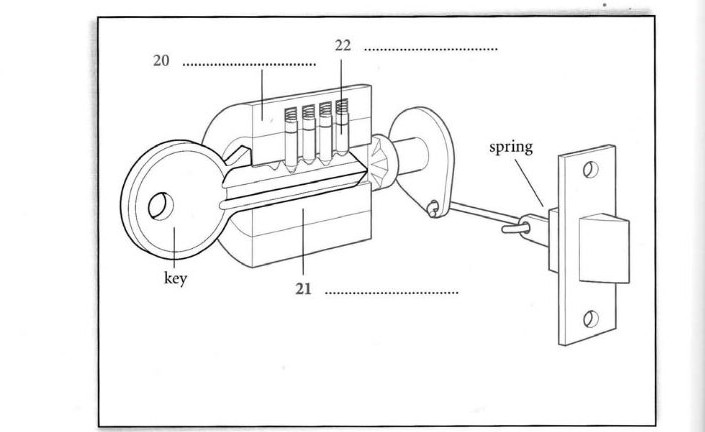
One of the most common cylinder locks is the pin design. Its main components are the housing (the outer part of the lock which does not move), the central cylinder, and several vertical shafts that run down from the housing into the cylinder. Inside these shafts are pairs of metal pins of varying length, held in position by small springs.
Without the key, the pins are partly in the housing and partly in the cylinder, so that the mechanism cannot turn and the lock, therefore, cannot open. When you put the correct key into the cylinder, the notches in the key push each pair of pins up just enough so that the top pin is completely in the housing and the bottom pin is entirely in the cylinder. It now turns freely, and you can open the lock.
Section D
To pick a pin lock, you simply move each pin pair into the correct position, one by one. There are two main tools used in the picking process.
Picks: long, thin pieces of metal that curve up at the end (like a dentist's pick).
A tension wrench: the simplest sort of tension wrench is a thin screwdriver.
The first step in picking a lock is to insert the tension wrench into the keyhole and turn it in the same direction that you would turn the key. This turns the cylinder so that it is slightly offset from the housing around it, creating a slight ledge in the pin shafts.
While applying pressure on the cylinder, you slide the pick into the keyhole and begin lifting the pins. The object is to lift each pin pair up to the level at which the top pin moves completely into the housing, as if pushed by the correct key. When you do this while applying pressure with the tension wrench, you feel or hear a slight click when the pin falls into position. This is the sound of the upper pin falling into place on the ledge in the shaft. The ledge keeps the upper pin wedged in the housing, so it won't fall back down into the cylinder. In this way, you move each pin pair into the correct position until all the upper pins are pushed completely into the housing and all the lower pins rest inside the cylinder. At this point, the cylinder rotates freely and you can open the lock.
Section E
You'll find pin locks everywhere, from houses to padlocks. They are so popular because they are relatively inexpensive but offer moderate security.
Another common type of cylinder lock is the wafer lock. These work the same basic way as pin locks, but they have flat, thin pieces of metal called wafers rather than pins. You pick the wafers exactly the same way you pick pins – in fact, it is a little bit easier to pick wafer locks because the keyhole is wider. Despite giving relatively low security, these locks are found in most cars.
Tubular locks provide superior protection to pin and wafer locks, but they are also more expensive. Instead of one row of pins, tubular locks have pins positioned all the way around the circumference of the cylinder. This makes them much harder to pick. Conventional lock-picking techniques don't usually work on this type of lock, which is why they are often found on vending machines.
Questions
Questions 15–19 Matching Headings
Reading passage 2 has five sections A–E.
Choose the most suitable headings for sections A–E from the list of headings below.
Write the correct number i–x
i. How to make the locks in your home more secure
ii. How to open a lock without a key
iii. Choosing the right tools to open locks
iv. The cylinder and the bolt
v. How to open a lock with a different key
vi. Lock varieties
vii. How a basic deadbolt system works
viii. The people who open locks without a key
ix. How a cylinder lock works
x. How to pick different kinds of lock
Questions 20–22 Diagram Labeling
Complete the diagram below.
Choose ONLY ONE WORD from the passage for each answer.
Questions 23–25 Note Completion
Complete the notes below.
Choose NO MORE THAN THREE WORDS from the passage for each answer.
Picking a lock
Turn cylinder slightly using 23
Hold cylinder still and insert 24
Push top pin into shaft.
Hold top pin above cylinder, on 25
Lift and hold all other pins in same way.
Turn cylinder and open lock.
Questions 26–27 Table Completion
Complete the table below.
Choose NO MORE THAN THREE WORDS from the passage for each answer.
| Type of lock | How secure? | Where used? |
|---|---|---|
| Pin | 26 | houses, padlocks, etc |
| 27 | relatively low security | most cars |
| Tubular | superior protection | vending machines |
Answers & Explanations Summary
| # | Answer | Evidence | Explanation |
|---|---|---|---|
| Q15 | viii | Lock-picking skills are not particularly common among burglars, mainly because there are so many other, simpler ways of breaking into a house (throwing a brick through a back window, for example). For the most part, only intruders who need to cover their tracks, such as spies and detectives, will bother to pick a lock | Excerpt/Passage Explanation: The passage explains which people (such as burglars, spies, and detectives) choose to pick locks or break into buildings without using a key. Answer Explanation: The answer "viii" refers to the heading "The people who open locks without a key". Reason For Correctness: The correct answer is viii because Section A focuses on the different groups of individuals who use or avoid lock picking (opening locks without a key). The passage mentions "locksmiths" helping people get into their houses, "burglars" who usually choose easier ways to enter, and other intruders like "spies and detectives" who pick locks secretly. |
| Q16 | vii | Think about the normal deadbolt lock you might find on a front door. In this sort of lock, a movable bolt or latch is embedded in the door so it can be extended out to the side. This bolt is lined up with a notch in the frame. When you turn the lock, the bolt extends into the notch in the frame, so the door can't move. When you retract the bolt, the door moves freely | Excerpt/Passage Explanation: The passage explains the simple way a standard deadbolt lock functions by sliding a piece of metal (the bolt) into the frame to lock the door and pulling it back to let the door open. Answer Explanation: The answer "vii" means "How a basic deadbolt system works". Reason For Correctness: The correct answer is vii because Section B specifically explains how a standard front-door deadbolt operates. It describes how the movable bolt extends into the notch in the doorframe when locked to keep the door shut and retracts when unlocked to let the door open. Keywords from the passage like "normal deadbolt lock", "movable bolt or latch", and "when you turn the lock, the bolt extends" match the idea of "How a basic deadbolt system works". |
| Q17 | ix | The most widely-used lock design is the cylinder lock. In this kind, the key turns a cylinder in the middle of the lock, which turns the attached mechanism. When the cylinder is turned one way, the mechanism pulls in on the bolt and the door can open. When the cylinder turns the other way, the mechanism releases the bolt so the door cannot open | Excerpt/Passage Explanation: The passage explains that cylinder locks are the most common type of lock and describes the way turning the key inside the cylinder controls the bolt to open or close a door. Answer Explanation: The answer 'ix' means the heading 'How a cylinder lock works'. Reason For Correctness: The correct answer is ix because Section C introduces the cylinder lock design and explains its parts and the way it operates. The section details the cylinder, the housing, the pins, and explains how inserting the correct key lifts the pins so the cylinder can turn freely to open the door. Key words in the text include 'cylinder lock', 'mechanism', 'components', and how 'you can open the lock'. |
| Q18 | ii | To pick a pin lock, you simply move each pin pair into the correct position, one by one. There are two main tools used in the picking process | Excerpt/Passage Explanation: The passage explains the basic method and tools needed to pick (open without a key) a pin lock. Answer Explanation: The answer "ii" means "How to open a lock without a key". Reason For Correctness: The correct answer is ii because Section D describes the step-by-step process of picking a pin lock using tools (a tension wrench and picks) instead of an actual key. In Section B, lock picking is defined as opening a lock without a key. Section D explains how to apply pressure, lift the pins, and rotate the cylinder to open it. Keywords to pay attention to include "pick a pin lock", "tools", "first step in picking a lock", and "open the lock". |
| Q19 | vi | You'll find pin locks everywhere, from houses to padlocks Another common type of cylinder lock is the wafer lock Tubular locks provide superior protection to pin and wafer locks, but they are also more expensive |
Excerpt/Passage Explanation: The passage lists different kinds of locks (pin locks, wafer locks, and tubular locks) across the paragraphs of Section E, showing that the main topic is lock varieties. Answer Explanation: The answer "vi" means "Different types of locks". Reason For Correctness: The correct answer is vi because Section E introduces and compares several different kinds or varieties of locks. It discusses pin locks, wafer locks, and tubular locks, explaining how each type is built, how secure it is, and where it is typically used. Keywords like "pin locks", "type", "wafer lock", and "Tubular locks" show that the section is about different lock varieties. |
| Q20 | housing | Its main components are the housing (the outer part of the lock which does not move), the central cylinder, and several vertical shafts that run down from the housing into the cylinder | Excerpt/Passage Explanation: The passage explains that the main parts of a pin lock include the housing (the outer part that stays still), the middle cylinder, and vertical holes running between them. Answer Explanation: The answer "housing" refers to the outer, stationary casing or frame of a lock that holds the other internal parts inside it. Reason For Correctness: The correct answer is "housing" because Section C identifies the main components of a pin-design cylinder lock. It explicitly defines the "housing" as "the outer part of the lock which does not move", distinguishing it from the inner rotating cylinder and the vertical shafts containing pins. |
| Q21 | cylinder | Its main components are the housing (the outer part of the lock which does not move), the central cylinder, and several vertical shafts that run down from the housing into the cylinder | Excerpt/Passage Explanation: The passage explains that a pin lock is mainly made of three parts: the fixed outer cover (housing), the middle part that turns (the central cylinder), and vertical shafts going from the housing into the cylinder. Answer Explanation: The answer refers to the round, turning part located inside a lock that rotates when the correct key is turned. Reason For Correctness: The correct answer is supported by Section C of the passage, which explains the main parts of a pin cylinder lock. It states that the key turns a "cylinder in the middle of the lock" and identifies "the central cylinder" as one of the key components surrounded by the outer housing. |
| Q22 | pins | Inside these shafts are pairs of metal pins of varying length, held in position by small springs | Excerpt/Passage Explanation: The passage explains that pairs of small metal pieces, called pins, are located inside the vertical spaces (shafts) of the lock. Answer Explanation: The answer refers to the small pieces of metal ("pins") inside the shafts of a lock that prevent it from turning without the right key. Reason For Correctness: The correct answer is supported by Section C, which describes the inner parts of a pin cylinder lock. It explains that inside the shafts of the lock, there are pairs of metal "pins" of different lengths held by springs. When locked, these pins sit between the housing and cylinder to keep the lock from turning. |
| Q23 | a tension wrench / a wrench / the tension wrench / the wrench / tension wrench / wrench | The first step in picking a lock is to insert the tension wrench into the keyhole and turn it in the same direction that you would turn the key. This turns the cylinder so that it is slightly offset from the housing around it, creating a slight ledge in the pin shafts | Excerpt/Passage Explanation: The passage explains that to begin picking a lock, you place a tension wrench inside the lock and turn it, which makes the cylinder turn slightly out of its normal position. Answer Explanation: The answer refers to a specific tool called a "tension wrench," which is used to turn and rotate the lock's cylinder a little bit. Reason For Correctness: The correct answer is supported by Section D of the passage. The text explains the steps of picking a lock, stating that the very first action is to put a "tension wrench" into the keyhole and turn it. This turns the cylinder so that it is slightly offset. Therefore, the tool used to turn the cylinder slightly is the "tension wrench" (or "wrench"). |
| Q24 | a pick / the pick / pick | While applying pressure on the cylinder, you slide the pick into the keyhole and begin lifting the pins | Excerpt/Passage Explanation: The passage explains that while holding pressure on the cylinder, you push the pick inside the keyhole to start lifting the metal pins. Answer Explanation: The answer means a long, thin metal tool used to lift the lock's pins. Reason For Correctness: The correct answer is confirmed by Section D. The notes describe the steps of picking a lock. After turning and applying pressure to the cylinder (holding it in place), the text says that you slide "the pick" into the keyhole to push up the pins. |
| Q25 | the ledge / ledge / ledge in shaft | This is the sound of the upper pin falling into place on the ledge in the shaft. The ledge keeps the upper pin wedged in the housing, so it won't fall back down into the cylinder | Excerpt/Passage Explanation: The passage explains that when you push the top pin up, it rests on a small shelf called a ledge. This ledge stops the top pin from falling back down into the cylinder. Answer Explanation: The answer refers to the small ridge or "ledge" inside the shaft that supports and holds the top pin in place above the cylinder. Reason For Correctness: The correct answer is supported by the text explaining how the lock is picked. When lifting each pin, the upper pin lands on a ledge inside the shaft, which keeps it held up in the housing so it does not drop back into the cylinder. Therefore, the top pin is held above the cylinder on "the ledge" or "the ledge in the shaft". |
| Q26 | moderate security / moderate | You'll find pin locks everywhere, from houses to padlocks. They are so popular because they are relatively inexpensive but offer moderate security | Excerpt/Passage Explanation: The passage explains that pin locks are commonly used in houses and padlocks because they do not cost much and provide a medium level of protection. Answer Explanation: The answer "moderate security" means an average or medium level of safety and protection. Reason For Correctness: The correct answer is found in Section E, where the author discusses pin locks. The table asks about the level of security ("How secure?") for pin locks, which are used in "houses, padlocks, etc". The text directly states that pin locks are popular because they are cheap and "offer moderate security". |
| Q27 | the wafer lock / wafer lock / the wafer / wafer | Another common type of cylinder lock is the wafer lock. These work the same basic way as pin locks, but they have flat, thin pieces of metal called wafers rather than pins. You pick the wafers exactly the same way you pick pins – in fact, it is a little bit easier to pick wafer locks because the keyhole is wider. Despite giving relatively low security, these locks are found in most cars | Excerpt/Passage Explanation: The passage explains that wafer locks are another type of lock. Even though they provide only a low level of security, they are used in most cars. Answer Explanation: The answer "wafer" refers to a specific type of lock (wafer lock) that provides low security and is commonly used in automobiles. Reason For Correctness: The correct answer is "wafer" because the table asks for the type of lock that offers "relatively low security" and is used in "most cars". Section E directly mentions that "the wafer lock" provides "relatively low security" and is found in "most cars". |