
Mutualism - IELTS Reading Answers & Explanations
From Collins Practice Tests For IELTS 2 Academic Reading Test 3 · Part 2 · Questions 13–26
Reading Passage
You should spend about 20 minutes on Questions 13-26, which are based on Reading Passage 2 below.
Mutualism
Mutualism is an association between individuals belonging to two different species that benefit each other. There are numerous examples of this: the way flowers rely on insects to pollinate them or even how we humans rely on bacteria within our digestive system to break down our food.
One of the most visible forms of mutualism can be found in the pampas grasslands of Argentina, where organisms belonging to two different species work together not only to benefit each other but also to change the ecosystem around them. Grasscutter ants have been instrumental in shaping the landscape of the pampas grasslands - in fact, the landscape has been created almost entirely by the ants. Although they are only 1.5 cm long, they are one of the few creatures capable of shaping their own environment and one of the few living creatures apart from humans that cultivate their own food. The ants harvest the grasslands to supply their colony with grass. Each year over 0.5 tonnes of grass are harvested by a single colony. However, grass consists largely of cellulose, which the ants cannot digest, so the ants have developed a mutualistic relationship with an organism that can digest it. Deep inside the ant nests is a fungus that is able to grow on the compost produced by the grass. The fungus is unique to the habitat inside the ants' nest and it produces edible gardens for the ants. The relationship is so successful that a single colony can consist of up to eight million ants.
One of the reasons for the ants' success is the sophistication of their social organisation: they are all members of a single society but there is a division of labour within it. There are three main castes: the queen, the soldiers (or majors) and the worker ants. The worker ants are further divided into categories: the minims (the smallest ants), the minors and the mediae, each with different duties. The soldier ants defend the colony against physical threats. They also clear the paths for the other workers. The mediae are the foraging ants that look for grass to cut up and take back to the nest. Once the grass has been harvested, the forager ants carry it to the nest by following a chemical trail. But often they are not alone: minims ride on them or on the grass in order to protect them from a particular species of fly that parasitises the foragers. As soon as the grass leaves arrive at the nest, the forager ants pass them to smaller gardener ants, which cut up the leaves into smaller and smaller pieces until they are small enough to feed to the fungus. They then pass the tiny pieces on to the smallest ants, which feed the grass to the fungus and tend the fungal gardens.
A very important function of the smallest ants is to keep the fungus healthy. They do this by carefully inspecting each piece of grass leaf and making sure that it is free from other fungi or pests. In fact, the mutualistic relationship is supplemented by bacteria that live on the ants and give out chemicals that kill microbes harmful to the fungus. The relationship between the fungus and the ants is so developed that the grasscutter ants are sensitive to the fungus's reaction to different plants; if a particular plant is poisonous to the fungus, the ants no longer collect it. Waste disposal is another serious concern. Waste is collected by waste-disposer ants, which tend to be the older ants, thus ensuring that the younger ones can tend to other work. The waste-disposer ants remove waste (including dead ants) from the nest and take it underground into the deepest tunnels, where they aid its decomposition by moving it around.
Because the fungus at the heart of the colony nest is a living and breathing organism, it produces carbon dioxide - a very toxic gas. The ant nest is a masterpiece of construction, carefully made to keep air circulating in order to prevent suffocation through the build-up of carbon dioxide. The nest has two methods of air circulation. Firstly, the hot air produced by the fungal gardens at the centre of the nest flows up through a central tunnel and draws in cooler, cleaner air from the outside passages. The second method involves a series of towers at the top of the nest. When the wind blows over the towers, it draws out old air and fresh air rushes into the nest from nest holes that extend outwards from the main nest. A nest can measure up to 30 metres across, and other mounds extend away from the central nest for up to 80 metres. As the nest also dominates the underground world, often extending seven metres down, the rapid flow of air through the nest is essential to the health of the inhabitants and their garden.
Questions
Questions 13–19 True / False / Not Given
Do the following statements agree with the information given in Reading Passage 2?
Write
TRUE if the statement agrees with the information
FALSE if the statement contradicts the information
NOT GIVEN if there is no information on this
Questions 20–23 Matching Features
Classify the following as typical of
Write the correct letter, A, B or C, next to Questions 20-23.
A. majors
B. mediae
C. minims
Questions 24–26 Diagram Labeling
Label the diagram below using words from the box.
Write the correct letter, A-C, in spaces 24-26.
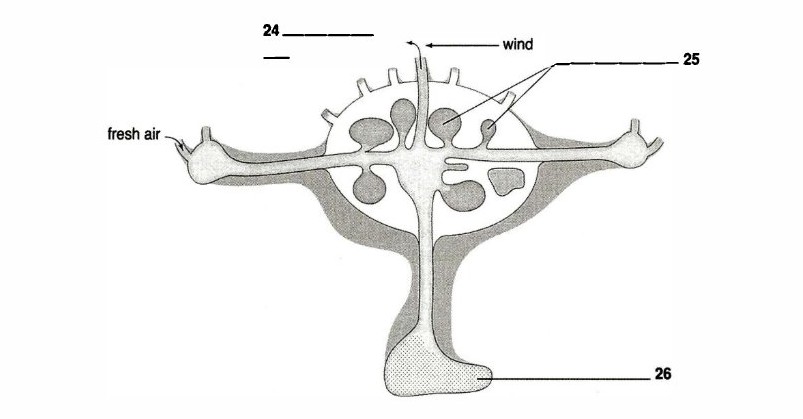
A. fungal gardens | B. waste tunnel | C. carbon dioxide
Answers & Explanations Summary
| # | Answer | Evidence | Explanation |
|---|---|---|---|
| Q13 | TRUE | Although they are only 1.5 cm long, they are one of the few creatures capable of shaping their own environment and one of the few living creatures apart from humans that cultivate their own food the ants have developed a mutualistic relationship with an organism that can digest it. Deep inside the ant nests is a fungus that is able to grow on the compost produced by the grass |
Excerpt/Passage Explanation: The passage states that these ants are one of only a small number of animals that grow their own food like people do. It then explains that they do this by joining together with another living thing—a fungus—that eats the grass the ants collect. Answer Explanation: The answer is TRUE because the text says these ants are among a very small number of animals that grow their own food by working with another living thing. Reason For Correctness: The correct answer is TRUE because the passage identifies grasscutter ants as 'one of the few living creatures' that grow (cultivate) their own food, placing them in a small group alongside humans. It explains that they 'use other organisms' by having a special relationship with a fungus. The ants provide the fungus with grass, and the fungus grows into an 'edible garden' for the ants to eat. This process of using one species to provide food for another is a rare form of social behavior described in the text. |
| Q14 | TRUE | The fungus is unique to the habitat inside the ants' nest and it produces edible gardens for the ants | Excerpt/Passage Explanation: The passage confirms that this specific fungus exists only in the environment (habitat) found inside where the ants live and is not found elsewhere. Answer Explanation: The answer is TRUE, meaning that this specific fungus only lives inside the homes (nests) built by these ants. Reason For Correctness: The correct answer is TRUE because the text explicitly states that the fungus is found only in the environment within the ant colony. In the passage, the author uses the word 'unique' to describe the fungus's relationship to its habitat. In English, 'unique' means being the only one of its kind, which confirms that it does not grow in other environments outside of the ants' nest. |
| Q15 | FALSE | As soon as the grass leaves arrive at the nest, the forager ants pass them to smaller gardener ants, which cut up the leaves into smaller and smaller pieces until they are small enough to feed to the fungus | Excerpt/Passage Explanation: The passage explains that some ants take the grass and cut it into very small bits so they can give it to a fungus that lives in their home. Answer Explanation: The answer means that the statement is incorrect. The ants do not cut up the grass because they want to eat the grass themselves. Reason For Correctness: The correct answer is FALSE because the passage states that ants cannot digest (use as food in their bodies) the grass because it contains cellulose. Instead of eating the grass, the ants cut it into tiny pieces for a different purpose: they give it to a fungus. The fungus grows on the grass pieces and creates a garden that the ants can then eat. Therefore, the reason they cut the grass is to feed the fungus, not to eat the grass directly. |
| Q16 | FALSE | The worker ants are further divided into categories: the minims (the smallest ants), the minors and the mediae, each with different duties The mediae are the foraging ants that look for grass to cut up and take back to the nest |
Excerpt/Passage Explanation: The passage explains that there are three types of worker ants. The first excerpt notes that the group called the 'minims' are the smallest ants. The second excerpt explains that the group called the 'mediae' are the ones that do the foraging work. Answer Explanation: The answer means that the statement is incorrect according to the text. Reason For Correctness: The correct answer is FALSE because the passage identifies 'minims' as the smallest group of ants within the worker category. It then identifies 'mediae' as the group responsible for foraging (searching for and gathering food). Since the smallest ants (minims) and the foraging ants (mediae) are distinct groups, it is incorrect to say that forager ants are the smallest. |
| Q17 | NOT GIVEN | Once the grass has been harvested, the forager ants carry it to the nest by following a chemical trail. But often they are not alone: minims ride on them or on the grass in order to protect them from a particular species of fly that parasitises the foragers | Excerpt/Passage Explanation: The passage explains that ants carry grass and other smaller ants to their home, but it does not say if the grass or the extra ants are heavier than the ant who is carrying them. Answer Explanation: The answer is NOT GIVEN because the passage does not tell us if the items the ants carry are heavier than the ants' own bodies. Reason For Correctness: The correct answer is NOT GIVEN because while the text mentions that ants 'carry' grass and even have smaller ants riding on them, it never provides information about weight or a comparison between the load and the ant's body weight. To answer this question as True or False, the passage would need to specifically mention how heavy the loads are relative to the ants. Since this specific detail is missing, the answer is NOT GIVEN. |
| Q18 | FALSE | the grasscutter ants are sensitive to the fungus's reaction to different plants; if a particular plant is poisonous to the fungus, the ants no longer collect it | Excerpt/Passage Explanation: The passage states that when the ants notice a plant is bad for the fungus, they stop collecting it. This proves that they had to collect it first to see how the fungus would react. Answer Explanation: The answer is FALSE, which means the statement in the question contradicts (is opposite to) what is written in the text. Reason For Correctness: The correct answer is FALSE because the text explains that the ants are 'sensitive to the fungus's reaction' and will 'no longer collect' a plant if it is poisonous to the fungus. The words 'no longer collect' tell us that the ants did collect the plant at first, but they stopped doing it after they saw it was harmful. The question says they 'never' collect these plants, but the text shows they must collect them at least once to find out they are dangerous. Therefore, the statement is false. |
| Q19 | TRUE | Waste is collected by waste-disposer ants, which tend to be the older ants, thus ensuring that the younger ones can tend to other work | Excerpt/Passage Explanation: The passage says that the ants in charge of picking up waste are usually the ones that are older, so that the younger ants can do different work. Answer Explanation: The answer means that it is a fact that the ants who have lived a long time are the ones who clean up and remove the trash. Reason For Correctness: The correct answer is TRUE because the passage explicitly states that 'waste-disposer ants'—the ones responsible for 'getting rid of waste'—are typically the 'older ants'. The text explains that this arrangement allows the younger ants to focus on different types of work. Since the passage directly links the older ants to the task of waste collection, the statement is correct. |
| Q20 | B | The mediae are the foraging ants that look for grass to cut up and take back to the nest | Excerpt/Passage Explanation: The passage says that the mediae are the ants that search for grass, cut it, and carry it home to the nest. Answer Explanation: The answer is the mediae, which is a specific group of worker ants within the colony. Reason For Correctness: The correct answer is B because the passage identifies the mediae as the ants responsible for foraging. It specifically states that their role involves finding grass, cutting it, and bringing it back to the colony (the nest). While the 'majors' defend the colony and 'minims' protect the mediae, only the mediae are tasked with the physical transport of the grass. |
| Q21 | A | The soldier ants defend the colony against physical threats | Excerpt/Passage Explanation: The passage explains that the job of the soldier ants (majors) is to protect the home and the group from dangerous things. Answer Explanation: The answer is A, which refers to the majors (also called soldier ants). Their job is to keep the colony safe from danger. Reason For Correctness: The correct answer is A because the text says that the 'majors' are the 'soldier' ants. It specifically states that these ants protect the colony from 'physical threats.' In this context, 'physical threats' means the same thing as 'invaders.' |
| Q22 | A | There are three main castes: the queen, the soldiers (or majors) and the worker ants The soldier ants defend the colony against physical threats. They also clear the paths for the other workers |
Excerpt/Passage Explanation: The passage explains that "majors" is another name for "soldiers" and that these soldier ants have the specific task of cleaning the paths so that other ants can travel back and forth. Answer Explanation: The answer is A because "majors" are the same as "soldier ants," and their job is to clean and open trails so other ants can move easily. Reason For Correctness: The correct answer is A because the text connects the name "majors" to the "soldier ants." It then explains that these specific ants have the duty of clearing the paths for the other workers in the colony. This corresponds directly to making sure the way to the food source (grass) is not blocked. |
| Q23 | C | The worker ants are further divided into categories: the minims (the smallest ants), the minors and the mediae, each with different duties They then pass the tiny pieces on to the smallest ants, which feed the grass to the fungus and tend the fungal gardens |
Excerpt/Passage Explanation: The passage first defines the 'minims' as being the 'smallest' type of ants in the group. It then states that these 'smallest ants' have the job of giving grass to the fungus and looking after the fungal gardens. Answer Explanation: The answer 'C' means that the 'minims' are the specific group of ants responsible for taking care of and growing the fungus. Reason For Correctness: The correct answer is 'C' because the passage divides worker ants into different groups based on their size and jobs. It identifies 'minims' as the 'smallest ants.' Later, it specifically notes that these 'smallest ants' are the ones who feed the grass to the fungus and 'tend' (look after) the gardens. In this context, feeding and tending the fungus is the same as farming it. |
| Q24 | C | Because the fungus at the heart of the colony nest is a living and breathing organism, it produces carbon dioxide - a very toxic gas the hot air produced by the fungal gardens at the centre of the nest flows up through a central tunnel |
Excerpt/Passage Explanation: The passage explains that since the fungus is alive, it creates carbon dioxide gas. It also describes how the warm air containing this gas naturally moves upward and out through a main tunnel in the nest. Answer Explanation: The answer is carbon dioxide, which is a harmful gas produced by the fungus. Reason For Correctness: The correct answer is C because the passage explains that the fungus living in the nest is a living thing that 'breathes' and produces carbon dioxide. The ant nest is built specifically to allow the hot air carrying this carbon dioxide to rise up and leave through a central tunnel so the ants do not suffocate. |
| Q25 | A | Firstly, the hot air produced by the fungal gardens at the centre of the nest flows up through a central tunnel and draws in cooler, cleaner air from the outside passages | Excerpt/Passage Explanation: The passage explains that the gardens made of fungus are located in the middle (the 'centre') of the nest. Because these gardens are living, they make the air warm (produce 'hot air'), which then moves up through a main tunnel to help fresh air come in. Answer Explanation: The answer is 'fungal gardens,' which refers to the specific areas inside the ant nest where the ants grow fungus as their food source. Reason For Correctness: The correct answer is 'fungal gardens' because the passage explains that these areas are located in the middle of the ant colony's home. The text mentions that they are found 'at the centre of the nest' and play a vital role in providing food for the ants and helping air move through the tunnels. In a drawing of the nest, this central point of activity and heat production corresponds to where the fungus grows. |
| Q26 | B | The waste-disposer ants remove waste (including dead ants) from the nest and take it underground into the deepest tunnels, where they aid its decomposition by moving it around | Excerpt/Passage Explanation: The passage explains that certain ants act as garbage collectors by carrying unwanted items and dead ants to very deep tunnels under the ground. Answer Explanation: The answer is the part of the ant's home used for putting away trash and dead ants, located deep underground. Reason For Correctness: The correct answer is B because the passage mentions specific paths or 'tunnels' where 'waste-disposer ants' take trash. These tunnels are located in the 'deepest' parts of the nest, far 'underground,' which helps the trash break down or decompose away from the rest of the colony. |