
SPOKEN CORPUS COMES TO LIFE - IELTS Reading Answers & Explanations
From Cambridge IELTS 01 Academic Reading Test 3 · Part 1 · Questions 1–12
Reading Passage
You should spend about 20 minutes on Questions 1-12 which are based on Reading Passage 2 below.
SPOKEN CORPUS COMES TO LIFE
A The compiling of dictionaries has been historically the provenance of studious professorial types - usually bespectacled - who love to pore over weighty tomes and make pronouncements on the finer nuances of meaning. They were probably good at crosswords and definitely knew a lot of words, but the image was always rather dry and dusty. The latest technology, and simple technology at that, is revolutionising the content of dictionaries and the way they are put together.
B For the first time, dictionary publishers are incorporating real, spoken English into their data. It gives lexicographers (people who write dictionaries) access to a more vibrant, up-to-date vernacular language which has never really been studied before. In one project, 150 volunteers each agreed to discreetly tie a Walkman recorder to their waist and leave it running for anything up to two weeks. Every conversation they had was recorded. When the data was collected, the length of tapes was 35 times the depth of the Atlantic Ocean. Teams of audio typists transcribed the tapes to produce a computerised database of ten million words.
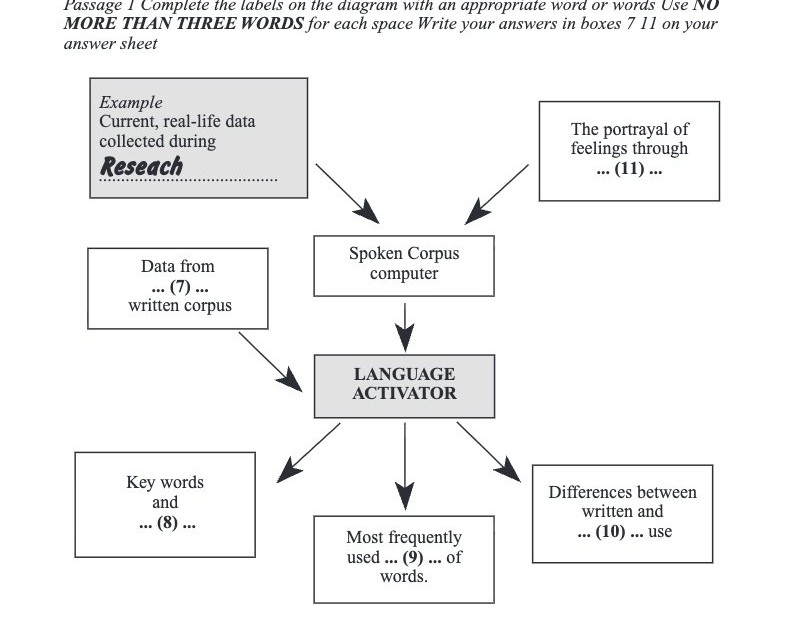
C This has been the basis - along with an existing written corpus - for the Language Activator dictionary, described by lexicographer Professor Randolph Quirk as “the book the world has been waiting for”. It shows advanced foreign learners of English how the language is really used. In the dictionary, key words such as “eat” are followed by related phrases such as “wolf down” or “be a picky eater”, allowing the student to choose the appropriate phrase.
D “This kind of research would be impossible without computers,” said Delia Summers, a director of dictionaries. “It has transformed the way lexicographers work. If you look at the word “like”, you may intuitively think that the first and most frequent meaning is the verb, as in “I like swimming”. It is not. It is the preposition, as in: “she walked like a duck”. Just because a word or phrase is used doesn’t mean it ends up in a dictionary. The sifting out process is as vital as ever. But the database does allow lexicographers to search for a word and find out how frequently it is used - something that could only be guessed at intuitively before.
E Researchers have found that written English works in a very different way to spoken English. The phrase “say what you like” literally means “feel free to say anything you want”, but in reality it is used, evidence shows, by someone to prevent the other person voicing disagreement. The phrase “it”s a question of crops up on the database over and over again. It has nothing to do with enquiry, but it’s one of the most frequent English phrases which has never been in a language learner’s dictionary before: it is now.
F The Spoken Corpus computer shows how inventive and humorous people are when they are using language by twisting familiar phrases for effect. It also reveals the power of the pauses and noises we use to play for time, convey emotion, doubt and irony.
G For the moment, those benefiting most from the Spoken Corpus are foreign learners. “Computers allow lexicographers to search quickly through more examples of real English,” said Professor Geoffrey Leech of Lancaster University. “They allow dictionaries to be more accurate and give a feel for how language is being used.” The Spoken Corpus is part of the larger British National Corpus, an initiative carried out by several groups involved in the production of language learning materials: publishers, universities and the British Library.
Questions
Questions 1–6 Matching Headings
Reading Passage 1 has seven paragraphs (A-G). Choose the most suitable heading for each paragraph from the list of headings below. Write the appropriate numbers (i-xi).
NB There are more headings than paragraphs so you will not use all of them. You may use any heading more than once.
i. Grammar is corrected
ii. New method of research
iii. Technology learns from dictionaries
iv. Non-verbal content
v. The first study of spoken language
vi. Traditional lexicographical methods
vii. Written English tells the truth
viii. New phrases enter dictionary
ix. A cooperative research project
x. Accurate word frequency counts
xi. Alternative expressions provided
Questions 7–11 Diagram Labeling
The diagram below illustrates the information provided in paragraphs B-F of Reading Passage 1 Complete the labels on the diagram with an appropriate word or words Use NO MORE THAN THREE WORDS for each space Write your answers
Questions 12–12 One Choice
Choose the appropriate letter A-D and write it
Answers & Explanations Summary
| # | Answer | Evidence | Explanation |
|---|---|---|---|
| Q1 | vi | The compiling of dictionaries has been historically the provenance of studious professorial types - usually bespectacled - who love to pore over weighty tomes and make pronouncements on the finer nuances of meaning | Excerpt/Passage Explanation: The passage explains that in the past, making dictionaries was the job of smart professors who spent their time studying many big, heavy books to decide exactly what different words meant. Answer Explanation: The answer vi means 'Traditional lexicographical methods', referring to the old-fashioned ways researchers used to create dictionaries. Reason For Correctness: The correct answer is vi because Paragraph A describes the history of dictionary writing. It explains how 'studious professorial types' used to 'pore over' (read very carefully) large books ('weighty tomes') to determine word meanings. These old habits and systems represent 'traditional lexicographical methods' as opposed to the new technology mentioned at the end of the paragraph. |
| Q2 | ii | For the first time, dictionary publishers are incorporating real, spoken English into their data In one project, 150 volunteers each agreed to discreetly tie a Walkman recorder to their waist and leave it running for anything up to two weeks |
Excerpt/Passage Explanation: The passage states that dictionary makers are now doing something new by using real speech as information. It then describes a specific experiment where many people used recording machines for two weeks to help collect these real-world words. Answer Explanation: The answer 'ii' means the paragraph explains a way of gathering information that has not been used before. Reason For Correctness: The correct answer is 'ii' because Paragraph B describes a shift in how dictionary creators collect their data. It highlights a change from only using written texts to 'incorporating real, spoken English' for the 'first time'. This 'new method' is detailed through a specific 'project' where volunteers recorded their daily lives using 'Walkman' devices, creating a 'database' of language that had 'never really been studied before'. This process of data collection defines a modern research approach. |
| Q3 | x | But the database does allow lexicographers to search for a word and find out how frequently it is used - something that could only be guessed at intuitively before | Excerpt/Passage Explanation: The passage says that computer databases let the people who write dictionaries count exactly how often words are used, which is much better than just guessing. Answer Explanation: The answer means Paragraph D talks about using technology to find out exactly how often certain words are used in real life. Reason For Correctness: The correct answer is x because Paragraph D explains how computer databases have changed dictionary making by allowing researchers to see the frequency of words. Before this, writers had to guess or use their feelings (intuitively), but now they have hard data. The paragraph uses the word 'like' as an example to show that what people think is common might not be the most frequent usage. |
| Q4 | viii | The phrase “it”s a question of crops up on the database over and over again. It has nothing to do with enquiry, but it’s one of the most frequent English phrases which has never been in a language learner’s dictionary before: it is now | Excerpt/Passage Explanation: The passage states that certain very common English phrases, like "it’s a question of," were missing from dictionaries for people learning the language, but they are included in dictionaries today. Answer Explanation: The answer viii means that Paragraph E discusses how expressions that were previously missing from dictionaries are now being included. Reason For Correctness: The correct answer is viii because the paragraph explains that researchers found common spoken phrases that were never included in books for language learners in the past. It gives the example of the phrase “it’s a question of,” noting that while it is used very often, it was never in a learner's dictionary until now. This shows that the research is helping "new phrases" (phrases not previously recorded) "enter the dictionary." |
| Q5 | iv | It also reveals the power of the pauses and noises we use to play for time, convey emotion, doubt and irony | Excerpt/Passage Explanation: The passage explains that the computer study shows how important silences (pauses) and other sounds (noises) are when people talk. These things help people express feelings like doubt or humor without using words. Answer Explanation: The answer is 'Non-verbal content', which refers to information that is expressed without using actual words. Reason For Correctness: The correct answer is 'iv' because Paragraph F discusses elements of communication that are not words, such as silence and sounds. The text mentions 'pauses and noises,' which are classic examples of non-verbal communication used to show feelings or give the speaker more time to think. While the rest of the passage focuses on words and phrases, this specific paragraph highlights the importance of these non-word elements found in the Spoken Corpus. |
| Q6 | ix | The Spoken Corpus is part of the larger British National Corpus, an initiative carried out by several groups involved in the production of language learning materials: publishers, universities and the British Library | Excerpt/Passage Explanation: The passage explains that this large language project was created by many different groups working together, such as school researchers and book makers. Answer Explanation: The answer 'ix' refers to 'A cooperative research project,' which means a study or program where different people or organizations work together toward a common goal. Reason For Correctness: The correct answer is 'ix' because Paragraph G mentions that the British National Corpus is an initiative involving multiple parties. It specifies that the project is carried out by several different groups, including publishers, universities, and the British Library. The word 'cooperative' in the heading matches the phrase 'carried out by several groups' in the text, highlighting that it is a shared effort. |
| Q7 | existing | This has been the basis - along with an existing written corpus - for the Language Activator dictionary | Excerpt/Passage Explanation: The passage says that the Language Activator dictionary was created using the new spoken information and a written collection of words that was already there. Answer Explanation: The answer "existing" refers to the written collection of words that already belonged to the researchers before the new recordings were added. Reason For Correctness: The correct answer is supported by the text which explains how the new spoken data was combined with a written database. Paragraph C notes that the new information from recorded tapes was used alongside an "existing" written corpus to make the Language Activator dictionary. The word "existing" shows that this written part of the database was already available for use. |
| Q8 | related phrases / phrases | In the dictionary, key words such as “eat” are followed by related phrases such as “wolf down” or “be a picky eater”, allowing the student to choose the appropriate phrase | Excerpt/Passage Explanation: The passage explains that in this special dictionary, important words are listed with extra sets of words that belong together, helping learners pick the best one for their needs. Answer Explanation: The answer refers to groups of words that are linked to a specific main word to show how it is used in real conversation. Reason For Correctness: The correct answer is found in Paragraph C, which describes the structure of the Language Activator dictionary. It explains that instead of just giving a definition, the dictionary lists "related phrases" after a main "key word." This helps students understand the different ways a word like 'eat' can be used in natural speech, such as 'wolf down.' |
| Q9 | meaning | If you look at the word “like”, you may intuitively think that the first and most frequent meaning is the verb, as in “I like swimming”. It is not. It is the preposition, as in: “she walked like a duck” | Excerpt/Passage Explanation: The passage explains that people often guess how a word is most commonly used. For the word 'like,' people might think the most common use is as an action (a verb), but real data shows it is used more often to compare things (a preposition). Answer Explanation: The answer 'meaning' refers to what a word explains or represents in a conversation. Reason For Correctness: The correct answer is 'meaning' because paragraph D explains how technology helps dictionary writers find the most 'frequent' or common ways a word is used. Before computers, people could only guess which sense or definition of a word was the most popular. The example of the word 'like' shows that what we think is the first 'meaning' is often not the one people use most in real life. The database allows researchers to see the truth about how words are understood. |
| Q10 | real / spoken / real spoken / real,spoken | For the first time, dictionary publishers are incorporating real, spoken English into their data | Excerpt/Passage Explanation: The passage states that people who make dictionaries are now including the actual English that people use when they speak in their collection of information. Answer Explanation: The answer refers to the specific type of English language (the kind people use when talking) that is now being added to dictionaries. Reason For Correctness: The correct answer is derived from Paragraph B, which explains the new method of gathering language data. It mentions that for the first time, publishers are using "real, spoken English" in their work. This involves recording actual conversations from volunteers to capture how people truly talk. Keywords for a learner to note are "spoken", "real", and "incorporating" (which means including or adding). |
| Q11 | pauses and noises / pauses / noises / pauses noises / pauses,noises | It also reveals the power of the pauses and noises we use to play for time, convey emotion, doubt and irony | Excerpt/Passage Explanation: The passage explains that the computer database shows how we use short stops in speaking and extra sounds to show our emotions or to give ourselves a moment to think. Answer Explanation: The answer refers to the sounds we make or the short breaks we take when we are talking. Reason For Correctness: The correct answer is based on Paragraph F, which explains what the Spoken Corpus (a database of real speech) shows researchers. Beyond showing how people are creative or funny with words, the system also reveals the importance of the breaks and sounds people use during a conversation. These 'pauses' and 'noises' help speakers show their feelings or give them more time to think about what to say next. |
| Q12 | B | For the first time, dictionary publishers are incorporating real, spoken English into their data. It gives lexicographers (people who write dictionaries) access to a more vibrant, up-to-date vernacular language which has never really been studied before | Excerpt/Passage Explanation: The passage explains that people who make dictionaries are now using real-life speech in their work for the very first time. This gives the writers access to fresh, everyday language that they have never been able to study this way in the past. Answer Explanation: The answer means the article was written to tell readers about a fresh and modern way that experts are now using to create dictionaries. Reason For Correctness: The correct answer is B because the entire text focuses on a major change in how dictionaries are written. It explains that new technology is 'revolutionising' the process. By using recordings of real-life conversations for the 'first time,' dictionary writers have started a 'new approach' to gathering information, which is the main point of the article. |