
The Development Of The Modern Hot Air Balloon - IELTS Reading Answers & Explanations
From IELTS Simulation Tests Academic Reading Test 07 · Part 1 · Questions 1–13
Reading Passage
You should spend about 20 minutes on Questions 1–13, which are based on Reading Passage 1 below.
The Development of the Modern Hot Air Balloon
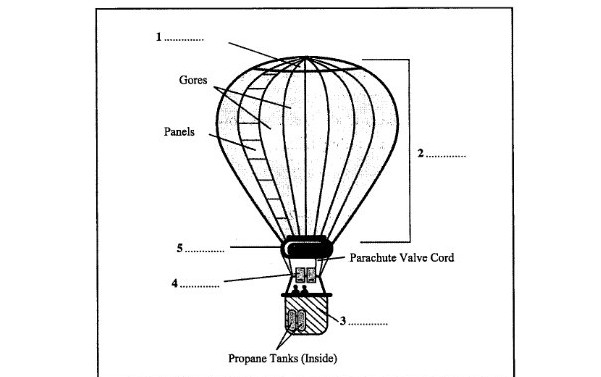
The modern hot air balloon is constructed by suspending a wicker basket underneath a large bag of nylon fabric, known as an envelope. The wicker basket carries the balloon's pilot, any other passengers, and the propane tanks that provide the balloon with a source of fuel. The propane tanks are connected by hose to a pair of burners, which are located between the basket and the envelope. When the burners ignite, their heat passes through the balloon's skirt—a circular sheath of fire-resistant material at the mouth of the envelope—and finally into the envelope itself. Located at the top of the envelope is a parachute vent, a mechanism that allows the pilot to release hot air and increase the balloon's rate of descent when required. This is controlled by a parachute valve cord that extends through the balloon, and into the basket.
The use of hot air balloons can be traced back to the Three Kingdoms era of Chinese history (220-280 AD). Zhuge Liang used these early incarnations, known as Kongming lanterns, as military signals. The first manned flight on record took place in France on October 15th, 1783. In a balloon constructed by Jacques-Etienne Montgolfier, a Frenchman named Pilatre de Rozier was elevated eighty feet off the ground. Modern hot air balloons, with their capacity to ascend or descend and occasionally 'steer' at the pilot's will, were first developed by Ed Yost in the 1950s. The Bristol Belle is generally regarded as the first modern hot air balloon, and had its inaugural flight in 1967. Since then, balloon technology has become extremely sophisticated. Some hot air balloons have reached altitudes of 21,000 metres, travelled over 7,500 kilometres, and reached speeds of up to 400 kilometres per hour.
Hot-air ballooning is generally a safe activity, and serious accidents are rare. In the event that something does go wrong, several items of safety gear are useful to have on board. In case the pilot light and the auxiliary piezo ignition fail, it is a good idea to have a welding torch flint sparker available for the pilot's use. Given the propane combustion used to propel the hot air balloon, a fire extinguisher is an absolute necessity. Flame-resistant gauntlets made out of either leather or nomex are required for the pilot so that a gas valve can be disabled even if an open flame is present. While nomex is a specially-manufactured synthetic form of fire-retardant material, synthetic clothing is generally a hindrance to fire safety, and clothing made of natural fibre is a superior option for pilots. Finally, a handling line—a long rope that can be thrown overboard—is a vital precautionary measure that allows people on the ground to steer the balloon away from trouble.
To ensure balloon longevity and safety in operation, it is vital that hot air balloons be maintained and repaired while not in use. Keeping the envelope clean and dehumidified is an important step that prevents mould from forming on the fabric. This is especially important if the balloon has landed in a wet or muddy environment. The burner and fuel system also requires regular maintenance. This can involve the replacement or repair of damaged hoses and any sticking or leaky valves. The wicker basket has skids on its bottom to help it gain traction upon landing; over time these are worn down, and will need to be replaced. International regulations stipulate that balloons must be given a full inspection every one hundred flight hours, or twelve months. This ensures that any problems can be rectified before they become hazardous.
Questions
Questions 1–5 Diagram Labeling
Complete the diagram below.
Choose NO MORE THAN TWO WORDS from Reading Passage 1 for each answer.
Questions 6–6 One Choice
Choose the correct letter, A, B, C or D.
Questions 7–9 Three Choices
Choose THREE letters, A–G.
Questions 10–13 Sentence Completion
Complete the sentences below with words taken from Reading Passage 1.
Use NO MORE THAN TWO WORDS for each answer.
- A dry envelope helps to stop the growth of 10 on the material.
- Frequent 11 is important: fixing or changing faulty parts of the propulsion system when necessary.
- 12 help the basket grip the ground when it sets down.
- Balloons must be checked annually according to 13 .
Answers & Explanations Summary
| # | Answer | Evidence | Explanation |
|---|---|---|---|
| Q1 | parachute vent / parachute valve | Located at the top of the envelope is a parachute vent, a mechanism that allows the pilot to release hot air and increase the balloon's rate of descent when required | Excerpt/Passage Explanation: The passage explains that there is a parachute vent at the very top of the balloon's main bag (envelope) that helps the pilot release hot air to bring the balloon down. Answer Explanation: The answer refers to the "parachute vent" (or "parachute valve"), which is the opening located at the very top of the balloon used to let hot air escape. Reason For Correctness: The correct answer is supported by the first paragraph, which explains the parts of a hot air balloon. The passage states that a "parachute vent" is located at the top of the envelope to let out hot air so the balloon can descend. |
| Q2 | an envelope / envelope | The modern hot air balloon is constructed by suspending a wicker basket underneath a large bag of nylon fabric, known as an envelope | Excerpt/Passage Explanation: The passage explains that a hot air balloon is made by hanging a basket under a big bag made of nylon, which is called an envelope. Answer Explanation: The answer "envelope" means the large cloth bag part of a hot air balloon that holds the air. Reason For Correctness: The correct answer is "envelope" because the passage explicitly defines the large nylon bag of the hot air balloon as an "envelope". Keywords to notice include "large bag of nylon fabric" and "known as an envelope". |
| Q3 | wicker basket / basket / a basket | The modern hot air balloon is constructed by suspending a wicker basket underneath a large bag of nylon fabric, known as an envelope | Excerpt/Passage Explanation: The passage explains that a hot air balloon is built by hanging a woven basket under the large bag made of nylon material. Answer Explanation: The answer refers to the "wicker basket" (or simply "basket"), which is the container hanging at the bottom of the balloon where people and fuel tanks stay. Reason For Correctness: The correct answer is "(wicker) basket" because the passage states that the modern hot air balloon is made by hanging a "wicker basket" beneath the large fabric bag (the envelope). This basket holds the pilot, passengers, and propane tanks. |
| Q4 | burners | The propane tanks are connected by hose to a pair of burners, which are located between the basket and the envelope | Excerpt/Passage Explanation: The passage states that fuel from propane tanks goes through a hose to two burners positioned between the basket at the bottom and the large balloon fabric at the top. Answer Explanation: The answer "burners" refers to the heating devices positioned between the basket and the balloon bag that produce fire to heat the air. Reason For Correctness: The correct answer is "burners" because the passage explains the anatomy of a modern hot air balloon. It notes that the propane tanks connect via a hose to a pair of "burners" located directly in the space between the wicker basket and the envelope. Important keywords include "connected by hose to a pair of burners" and "located between the basket and the envelope". |
| Q5 | skirt / balloon's skirt | When the burners ignite, their heat passes through the balloon's skirt—a circular sheath of fire-resistant material at the mouth of the envelope—and finally into the envelope itself | Excerpt/Passage Explanation: The passage explains that when the burners start burning, their heat travels through the balloon's skirt—a fire-proof ring of material at the opening of the envelope—and goes directly into the balloon. Answer Explanation: The answer "skirt" refers to the ring-shaped, fire-safe piece of fabric located at the bottom opening (mouth) of the hot air balloon's envelope. Reason For Correctness: The correct answer is "skirt" because the passage identifies this part of the balloon when detailing how heat enters the balloon. Specifically, it describes the "skirt" as a circular layer of fire-resistant material positioned right at the mouth of the envelope. |
| Q6 | C | The first manned flight on record took place in France on October 15th, 1783. In a balloon constructed by Jacques-Etienne Montgolfier, a Frenchman named Pilatre de Rozier was elevated eighty feet off the ground | Excerpt/Passage Explanation: The passage explains that during the first recorded flight with a person in France in 1783, Pilatre de Rozier went up 80 feet into the air inside a balloon made by Jacques-Etienne Montgolfier. Answer Explanation: The answer means that Pilatre de Rozier (Choice C) was the very first human being to go up into the air in a hot air balloon. Reason For Correctness: The correct answer is C because paragraph 2 talks about the very first flight carrying a person ('first manned flight'). It says that while Jacques-Etienne Montgolfier built the balloon, a man named Pilatre de Rozier was the person who actually lifted up ('was elevated eighty feet off the ground'). Here, 'elevated' is a synonym for 'ascend'. |
| Q7 | — | — | |
| Q8 | — | — | |
| Q9 | A / E / F | In case the pilot light and the auxiliary piezo ignition fail, it is a good idea to have a welding torch flint sparker available for the pilot's use. Given the propane combustion used to propel the hot air balloon, a fire extinguisher is an absolute necessity. Flame-resistant gauntlets made out of either leather or nomex are required for the pilot so that a gas valve can be disabled even if an open flame is present. While nomex is a specially-manufactured synthetic form of fire-retardant material, synthetic clothing is generally a hindrance to fire safety, and clothing made of natural fibre is a superior option for pilots. Finally, a handling line—a long rope that can be thrown overboard—is a vital precautionary measure that allows people on the ground to steer the balloon away from trouble | Excerpt/Passage Explanation: The passage explains that pilots should carry a flint sparker tool to start a fire if the main ignition fails, wear fire-resistant gloves (gauntlets) to protect their hands, and have a rope (handling line) that can be dropped to people on the ground to guide the balloon safely. Answer Explanation: The answer choices A, E, and F mean that a drop line (a long rope thrown down to the ground), fire-proof gloves, and a flint spark lighter are three safety items recommended for hot air balloons. Reason For Correctness: The correct answer includes A, E, and F because the third paragraph specifically lists these safety items: 1. A "welding torch flint sparker" (Flint spark lighter, F) is suggested in case the normal ignition fails. 2. "Flame-resistant gauntlets" (Fire-proof gloves, E) are required to protect the pilot's hands when turning off gas valves near flames. 3. A "handling line" (Drop line, A), described as a rope thrown overboard, is recommended to help people on the ground guide the balloon. The other options are incorrect: "piezo ignition" is the standard ignition part that might fail (not extra safety gear), "synthetic clothing" is described as dangerous rather than recommended, and "gas valve" and "propane combustion" are parts of the normal burner system, not safety equipment. |
| Q10 | mould / mold | Keeping the envelope clean and dehumidified is an important step that prevents mould from forming on the fabric | Excerpt/Passage Explanation: The passage means that making sure the balloon bag stays clean and dry stops mould from growing on the cloth. Answer Explanation: The answer "mould" refers to a type of fungus that grows on wet surfaces and materials. Reason For Correctness: The correct answer is "mould" because the passage explains that keeping the envelope clean and dry (dehumidified) stops mould from growing on the balloon's cloth. In the sentence, "dry envelope" matches "dehumidified", "helps to stop the growth of" matches "prevents ... from forming", and "material" matches "fabric". |
| Q11 | maintenance | The burner and fuel system also requires regular maintenance. This can involve the replacement or repair of damaged hoses and any sticking or leaky valves | Excerpt/Passage Explanation: The passage explains that the parts that produce heat and fuel must be checked and cared for regularly, which includes repairing or replacing damaged pieces. Answer Explanation: The answer "maintenance" means the regular work done to keep machines, equipment, or parts in good working condition. Reason For Correctness: The correct answer is "maintenance" because the passage states that the burner and fuel system needs regular care. In the sentence, "Frequent" matches the passage's "regular", and "fixing or changing faulty parts" matches "the replacement or repair of damaged hoses and any sticking or leaky valves". Therefore, the word that fills the blank is "maintenance". |
| Q12 | Skids | The wicker basket has skids on its bottom to help it gain traction upon landing; over time these are worn down, and will need to be replaced | Excerpt/Passage Explanation: The passage explains that the bottom of the basket has skids so it can better grip the ground during landing, but they wear out and must be replaced over time. Answer Explanation: The answer "Skids" refers to pieces or strips attached to the bottom of the basket. Reason For Correctness: The correct answer is supported by the fourth paragraph, which discusses the parts of the basket. The text explains that skids on the bottom help the basket gain traction (grip the ground) when it lands (sets down). Therefore, "skids" correctly completes the sentence. |
| Q13 | international regulations | International regulations stipulate that balloons must be given a full inspection every one hundred flight hours, or twelve months | Excerpt/Passage Explanation: The passage says that global rules require balloons to be completely checked every 100 hours of flying time or once every year (12 months). Answer Explanation: The answer refers to worldwide rules or laws that people across different countries must follow. Reason For Correctness: The correct answer is "international regulations" because the passage states that worldwide safety rules require hot air balloons to receive a full check-up every twelve months (which means "annually"). In the sentence, "according to" matches "stipulate that", and "checked annually" matches "given a full inspection every... twelve months". |