
The Wallaby - IELTS Reading Answers & Explanations
From IELTS Trainer 2 General Training Reading Test 3 · Part 3 · Questions 28–40
Reading Passage
You should spend about 20 minutes on Questions 28-40, which are based on Reading Passage 3.
The wallaby
Wallabies are small to medium-sized marsupials that inhabit the Australian continent and its surrounding islands. The word wallaby comes from the indigenous Australian language.
A
While the largest wallabies can measure 6 feet from head to tail, as big or bigger than some kangaroos, most species of wallaby are smaller than kangaroos. The smallest are around 12 inches when fully-grown. They have an upright posture supported by two disproportionately large hind legs and feet, small forelimbs and a large thick tail. Wallabies have strong hind legs that enable them to travel at speed; their sizeable Achilles tendons assist them in hopping. Besides hopping, the hind legs can also be used to deliver hard kicks to other wallabies. Their tails are not able to grip but are essential in that they provide balance when a wallaby is stationary or in motion.
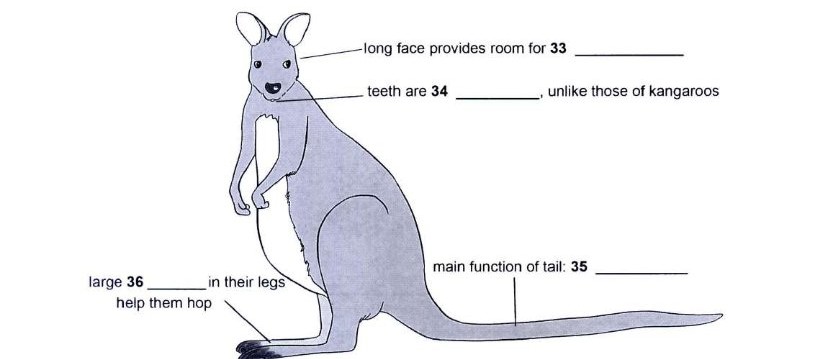
Because wallabies are herbivores, they have a large jaw to allow them to chew grass and plants. This accounts for their elongated faces. One distinction between a wallaby and a kangaroo is the teeth: wallabies have flat molars at the back, while kangaroos' back teeth are curved.
B
Wallabies generally prefer bushy or rugged areas in remote locations of Australia, rather than the open arid plains that kangaroos prefer. Some smaller wallabies, such as pademelons, live in the forest. Often wallabies are named for the type of area where they reside, e.g. shrub wallabies, brush wallabies and rock wallabies.
From 1858 until 1870, about 12 species of marsupial were taken from Australia and liberated in New Zealand, but only the brush-tailed opossum and the wallabies adapted successfully to the new land. Inadequate early accounts of which exact species were introduced and where they were initially taken from, mean that there is still confusion with regards to which species of wallaby are actually present in New Zealand today.
In 1896, the acclaimed Australian painter Frederick McCubbin painted On the wallaby track, showing a family in the bush without a home, the woman with a child on her lap and the man boiling water for tea. The painting's title derives from the Australian colloquial term 'on the wallaby track' describing the wandering rural workers who moved from place to place for work and alluding to the nomadic tendency of wallabies.
C
In terms of their young, like all marsupials, wallabies are born at an early stage of development. Young wallabies, like young kangaroos, are called a joey. As soon as they are born, they crawl into their mothers' pouches and stay there, generally for around two months. At first, the joey spends varying lengths of time out of the pouch, grazing and acquiring vital survival skills. When it needs to sleep or it feels it is in danger; however, the joey will return to the pouch. In some species, joeys stay in the pouch for up to a year or until the next joey is born. However, for most wallabies the young are thought to be independent by 9 months.
There is significant variation when it comes to the daily habits of wallabies. The larger wallaby species tend to be diurnal (mostly active throughout the day) and live in mobs, or groups, whereas smaller species are generally nocturnal (active at night) and solitary.
D
There are animals that are native to Australia that have always hunted the wallaby; these include dingoes, wedge-tailed eagles and Tasmanian devils. However, it is species that were brought to Australia by settlers that have posed more danger. Foxes, cats and dogs have all taken their toll on wallaby numbers, as have herbivores like rabbits, sheep, goats and cattle that compete with wallabies for food. However, it is human activity that has had the most impact; land clearing and burning of bushlands have left great numbers of wallabies effectively homeless and without a source of food.
E
Four species of wallaby have already gone extinct. There are others that are classified as vulnerable or endangered, which means that they face a high or very high risk of extinction in the wild. Measures are being taken to help particular species, including conserving their habitats and breeding them in captivity, so they may be reintroduced into the wild at a later point when conditions are favourable.
While wallabies are considered by some farmers to be a pest, efforts are being made by the Australian Society for Kangaroos to stop farmers culling kangaroos and wallabies. Instead they advocate that they should be captured and relocated.
Questions
Questions 28–32 Matching Headings
Reading Passage 3 has five sections A-E.
Choose the correct heading for each section, A-E, from the list of headings below.
NB you can use any letter more than once.
i. How do wallabies interact with other species?
ii. What is being done to protect wallabies?
iii. What are the threats to the wallaby population?
iv. How much contact do wallabies have with their offspring and with each other?
v. What are the distinctive features of wallabies?
vi. How do wallabies behave when in groups?
vii. Where can wallabies be found?
viii. What kinds of wallaby are suited to specific environments?
Questions 33–36 Diagram Labeling
Label the diagram below.
Choose ONE WORD ONLY from the Reading Passage for each answer.
Questions 37–40 One Choice
Write the correct letter, A, B, C or D.
Answers & Explanations Summary
| # | Answer | Evidence | Explanation |
|---|---|---|---|
| Q28 | v | They have an upright posture supported by two disproportionately large hind legs and feet, small forelimbs and a large thick tail One distinction between a wallaby and a kangaroo is the teeth: wallabies have flat molars at the back, while kangaroos' back teeth are curved |
Excerpt/Passage Explanation: The passage describes how the wallaby's body looks, including how it stands, the size of its legs and tail, and how its teeth are special compared to a kangaroo's teeth. Answer Explanation: The answer means that Section A is about the special physical parts and body characteristics that make wallabies unique. Reason For Correctness: The correct answer 'v' is suitable because Section A focuses entirely on the physical appearance and body structure of wallabies. It describes their size, their 'upright posture,' their powerful legs, and their tails. It also highlights a specific 'distinction' (a difference) between wallabies and kangaroos by looking at their teeth, which is a key distinctive feature. |
| Q29 | vii | Wallabies generally prefer bushy or rugged areas in remote locations of Australia, rather than the open arid plains that kangaroos prefer From 1858 until 1870, about 12 species of marsupial were taken from Australia and liberated in New Zealand, but only the brush-tailed opossum and the wallabies adapted successfully to the new land |
Excerpt/Passage Explanation: The passage explains that wallabies like to live in rough or bushy parts of Australia and that some were also brought to live in New Zealand. Answer Explanation: The answer means that Section B of the text provides information about the different geographic locations and habitats where wallabies live. Reason For Correctness: The correct answer is "vii" because Section B focuses on the places wallabies inhabit. It mentions they live in bushy, rugged areas, or forests in Australia, and it also describes how some species were moved to New Zealand. The section also mentions wallabies are named for the specific areas where they "reside," such as "shrub," "brush," or "rock" wallabies, which directly relates to where they can be found. |
| Q30 | iv | Young wallabies, like young kangaroos, are called a joey. As soon as they are born, they crawl into their mothers' pouches and stay there, generally for around two months The larger wallaby species tend to be diurnal (mostly active throughout the day) and live in mobs, or groups, whereas smaller species are generally nocturnal (active at night) and solitary |
Excerpt/Passage Explanation: The passage explains that baby wallabies (joeys) have a lot of contact with their mothers by living in their pouches. It also explains how adult wallabies live, either together in groups known as mobs or by themselves. Answer Explanation: The answer choice iv means that Section C focuses on how baby wallabies connect with their parents and how adult wallabies live together in groups or separately. Reason For Correctness: The correct answer is iv because Section C is divided into two main ideas that match the heading. First, it describes the relationship between the mother and her offspring (young wallabies called joeys), specifically how they stay inside the mother's pouch for protection and growth. Second, it describes how wallabies interact with each other in social settings, noting that some species live in groups called 'mobs' while others prefer to be 'solitary' (living alone). |
| Q31 | iii | Foxes, cats and dogs have all taken their toll on wallaby numbers, as have herbivores like rabbits, sheep, goats and cattle that compete with wallabies for food. However, it is human activity that has had the most impact; land clearing and burning of bushlands have left great numbers of wallabies effectively homeless and without a source of food | Excerpt/Passage Explanation: The passage explains that several things are causing wallaby numbers to go down: some animals kill them, some animals take their food, and humans destroy the places where they live. Answer Explanation: The answer identifies Section D as the part of the text that explains the different things causing danger to wallabies and reducing their numbers. Reason For Correctness: The correct answer is 'iii' because Section D is dedicated to the various 'threats' (dangers) facing the 'wallaby population' (the total number of wallabies). The text describes predators that 'hunted' them, introduced animals that 'posed more danger', and 'human activity' that causes wallabies to lose their homes and food. All these points explain why the amount of wallabies might decrease. |
| Q32 | ii | Measures are being taken to help particular species, including conserving their habitats and breeding them in captivity, so they may be reintroduced into the wild at a later point when conditions are favourable | Excerpt/Passage Explanation: The passage explains that people are taking action to help wallabies by protecting the areas where they live and taking care of them in safe environments so they can be released back into nature later. Answer Explanation: The answer 'ii' indicates that Section E focuses on the different ways people are trying to keep wallabies safe and stop them from disappearing forever. Reason For Correctness: The correct answer is 'ii' because Section E talks about protecting wallabies. It mentions that some species are at risk of extinction and describes efforts to help them, such as saving their land (habitats) and raising them in safe places (breeding in captivity). It also discusses how search groups are trying to stop farmers from killing them and instead moving them to new locations (relocated). |
| Q33 | jaw | Because wallabies are herbivores, they have a large jaw to allow them to chew grass and plants | Excerpt/Passage Explanation: The passage explains that since wallabies only eat plants (herbivores), they have a big mouth bone called a jaw to help them eat their food. Answer Explanation: The answer is a part of the mouth that wallabies use to eat. Reason For Correctness: The correct answer is found in the first section of the text. It explains that wallabies have a big jaw because they eat items like grass and plants. This part of their body is large and makes their faces look long. |
| Q34 | flat | One distinction between a wallaby and a kangaroo is the teeth: wallabies have flat molars at the back, while kangaroos' back teeth are curved | Excerpt/Passage Explanation: The passage explains that wallabies and kangaroos are different because wallabies have level or even teeth (molars) at the back, whereas kangaroos have curved ones. Answer Explanation: The answer identifies the shape of the wallaby's back teeth. Reason For Correctness: The correct answer is supported by Section A of the passage, where it discusses the physical differences between wallabies and kangaroos. It specifically mentions that one way to tell them apart is by looking at their teeth. While kangaroos have curved teeth at the back, wallabies have molars that are flat. |
| Q35 | balance | Their tails are not able to grip but are essential in that they provide balance when a wallaby is stationary or in motion | Excerpt/Passage Explanation: The passage explains that even though the wallaby cannot use its tail to grab things, the tail is necessary because it helps the animal keep its body steady and balanced. Answer Explanation: The answer identifies the main purpose of the wallaby's tail, which is to help the animal stay steady and not fall over. Reason For Correctness: The correct answer is found in Section A of the text, which describes the different body parts of the wallaby. It mentions that the wallaby's tail is very important because it provides balance. This means the tail helps the animal remain steady whether it is standing still (stationary) or jumping around (in motion). |
| Q36 | tendons | their sizeable Achilles tendons assist them in hopping | Excerpt/Passage Explanation: The passage explains that wallabies have large Achilles tendons that help them move by jumping. Answer Explanation: The answer refers to the physical parts in the wallaby's legs that help it jump. Reason For Correctness: The correct answer is 'tendons' because the text explains that wallabies have large 'Achilles tendons' that help them hop (jump). The passage states these parts are 'sizeable,' which means they are big, and they work with the animal's strong back legs to help it move quickly. |
| Q37 | D | Wallabies generally prefer bushy or rugged areas in remote locations of Australia, rather than the open arid plains that kangaroos prefer | Excerpt/Passage Explanation: The passage says that wallabies like rough, wild land in places that are far away from others, rather than the dry, open land that kangaroos enjoy. Answer Explanation: The answer explains that wallabies usually live in wild, rough places that are far from where people live. Reason For Correctness: The correct answer is found in the second section of the text. It states that wallabies like to live in 'bushy or rugged areas' which are described as 'remote'. In English, 'remote' means a place that is far away from cities or where people usually stay. The text also notes that they choose these spots instead of the dry, flat 'plains' that kangaroos like. |
| Q38 | B | Inadequate early accounts of which exact species were introduced and where they were initially taken from, mean that there is still confusion with regards to which species of wallaby are actually present in New Zealand today | Excerpt/Passage Explanation: The passage explains that since the old reports about which wallabies were brought to New Zealand were not very good or complete, people today are still not sure which types of wallabies actually live there. Answer Explanation: The answer choice says that people are unsure about which wallaby types are in New Zealand because the old records written when they were first brought there are not full or detailed enough. Reason For Correctness: The correct answer is derived from Paragraph B, which mentions that wallabies were taken to New Zealand between 1858 and 1870. The text states that there are 'inadequate early accounts' about the specific types of wallabies brought over. In this context, 'inadequate early accounts' is a synonym for 'incomplete records.' Because these records did not clearly say which species were included or where they came from, scientists today still feel 'confusion'—or have a 'debate'—about the exact species living in New Zealand now. |
| Q39 | A | In 1896, the acclaimed Australian painter Frederick McCubbin painted On the wallaby track, showing a family in the bush without a home, the woman with a child on her lap and the man boiling water for tea. The painting's title derives from the Australian colloquial term 'on the wallaby track' describing the wandering rural workers who moved from place to place for work and alluding to the nomadic tendency of wallabies | Excerpt/Passage Explanation: The passage states that the name comes from a painting of a family with no home and that local people used the phrase to describe workers who travel from one place to another for their jobs, just like animals that move around a lot. Answer Explanation: The answer means people who move from place to place for work and do not have a permanent house to live in. Reason For Correctness: The correct answer is A because the text explains that the phrase 'on the wallaby track' comes from a painting that shows people who have no home. The passage uses words like 'wandering' and 'nomadic' and says these people 'moved from place to place.' This perfectly matches the idea of traveling around without one fixed home. |
| Q40 | D | However, it is human activity that has had the most impact; land clearing and burning of bushlands have left great numbers of wallabies effectively homeless and without a source of food | Excerpt/Passage Explanation: The passage states that humans have the biggest effect on wallabies because they clear the land and burn the bush. This makes the wallabies lose their homes and their food. Answer Explanation: The answer means that destroying the natural areas where wallabies live is the biggest threat to their survival. Reason For Correctness: The correct answer is supported by the text in Section D, which lists several threats to wallabies. While it mentions predators like foxes and competition for food from animals like rabbits, it specifically states that human activity has had the most impact. This activity includes land clearing and burning, which are ways of destroying the wallabies' habitats (the places where they live). Therefore, human destruction is the greatest danger among the choices. |