
TWO WINGS AND A TOOLKIT - IELTS Reading Answers & Explanations
From Official IELTS Practice Materials Academic Reading Test 2 · Part 2 · Questions 14–26
Reading Passage
You should spend about 20 minutes on Questions 14-26, which are based on Reading Passage 2 on pages 6 and 7.
TWO WINGS AND A TOOLKIT
A research team at Oxford University discover the remarkable toolmaking skills of New Caledonian crows
Betty and her mate Abel are captive crows in the care of Alex Kacelnik, an expert in animal behaviour at Oxford University. They belong to a forest-dwelling species of bird (Corvus moneduloides) confined to two islands in the South Pacific. New Caledonian crows are tenacious predators, and the only birds that habitually use a wide selection of self-made tools to find food.
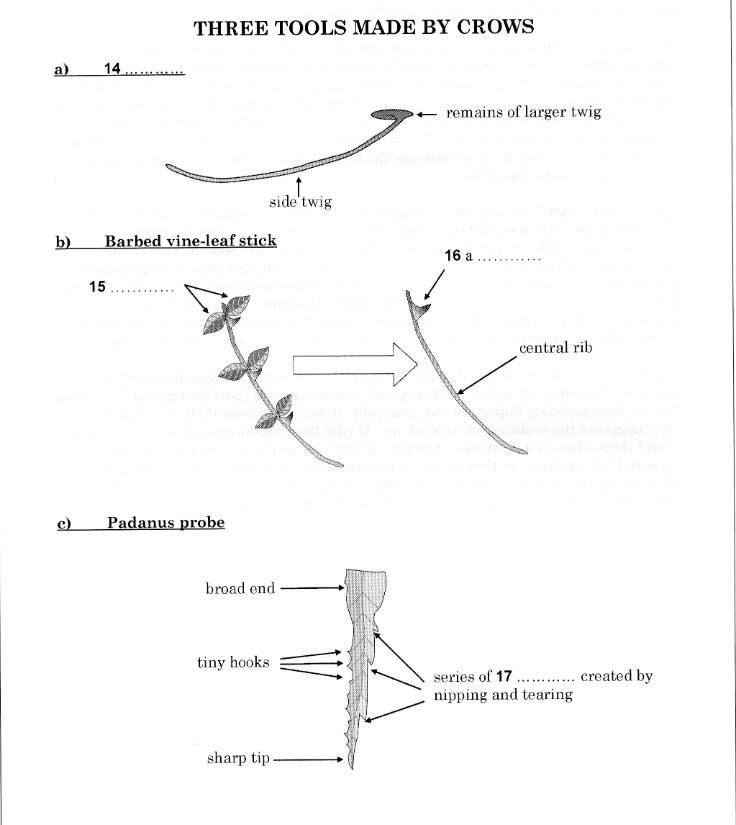
One of the wild crows' cleverest tools is the crochet hook, made by detaching a side twig from a larger one, leaving enough of the larger twig to shape into a hook. Equally cunning is a tool crafted from the barbed vine-leaf, which consists of a central rib with paired leaflets each with a rose-like thorn at its base. They strip out a piece of this rib, removing the leaflets and all but one thorn at the top, which remains as a ready-made hook to prise out insects from awkward cracks.
The crows also make an ingenious tool called a padanus probe from padanus tree leaves. The tool has a broad base, sharp tip, a row of tiny hooks along one edge, and a tapered shape created by the crow nipping and tearing to form a progression of three or four steps along the other edge of the leaf. What makes this tool special is that they manufacture it to a standard design, as if following a set of instructions. Although it is rare to catch a crow in the act of clipping out a padanus probe, we do have ample proof of their workmanship: the discarded leaves from which the tools are cut. The remarkable thing that these 'counterpart' leaves tell us is that crows consistently produce the same design every time, with no in-between or trial versions. It's left the researchers wondering whether, like people, they envisage the tool before they start and perform the actions they know are needed to make it. Research has revealed that genetics plays a part in the less sophisticated toolmaking skills of finches in the Galápagos islands. No one knows if that's also the case for New Caledonian crows, but it's highly unlikely that their toolmaking skills are hardwired into the brain. 'The picture so far points to a combination of cultural transmission - from parent birds to their young - and individual resourcefulness,' says Kacelnik.
In a test at Oxford, Kacelnik's team offered Betty and Abel an original challenge - food in a bucket at the bottom of a 'well'. The only way to get the food was to hook the bucket out by its handle. Given a choice of tools - a straight length of wire and one with a hooked end - the birds immediately picked the hook, showing that they did indeed understand the functional properties of the tool.
But do they also have the foresight and creativity to plan the construction of their tools? It appears they do. In one bucket-in-the-well test, Abel carried off the hook, leaving Betty with nothing but the straight wire. 'What happened next was absolutely amazing,' says Kacelnik. She wedged the tip of the wire into a crack in a plastic dish and pulled the other end to fashion her own hook. Wild crows don't have access to pliable, bendable material that retains its shape, and Betty's only similar experience was a brief encounter with some pipe cleaners a year earlier. In nine out of ten further tests, she again made hooks and retrieved the bucket.
The question of what's going on in a crow's mind will take time and a lot more experiments to answer, but there could be a lesson in it for understanding our own evolution. Maybe our ancestors, who suddenly began to create symmetrical tools with carefully worked edges some 1.5 million years ago, didn't actually have the sophisticated mental abilities with which we credit them. Closer scrutiny of the brains of New Caledonian crows might provide a few pointers to the special attributes they would have needed. 'If we're lucky we may find specific developments in the brain that set these animals apart,' says Kacelnik.
One of these might be a very strong degree of laterality - the specialisation of one side of the brain to perform specific tasks. In people, the left side of the brain controls the processing of complex sequential tasks, and also language and speech. One of the consequences of this is thought to be right-handedness. Interestingly, biologists have noticed that most padanus probes are cut from the left side of the leaf, meaning that the birds clip them with the right side of their beaks - the crow equivalent of right-handedness. The team thinks this reflects the fact that the left side of the crow's brain is specialised to handle the sequential processing required to make complex tools.
Under what conditions might this extraordinary talent have emerged in these two species? They are both social creatures, and wide-ranging in their feeding habits. These factors were probably important but, ironically, it may have been their shortcomings that triggered the evolution of toolmaking. Maybe the ancestors of crows and humans found themselves in a position where they couldn't make the physical adaptations required for survival - so they had to change their behaviour instead. The stage was then set for the evolution of those rare cognitive skills that produce sophisticated tools. New Caledonian crows may tell us what those crucial skills are.
Questions
Questions 14–17 Diagram Labeling
Label the diagrams below.
Choose NO MORE THAN TWO WORDS from the passage for each answer.
Questions 18–23 True / False / Not Given
Do the following statements agree with the information given in Reading Passage 2?
TRUE if the statement agrees with the information
FALSE if the statement contradicts the information
NOT GIVEN if there is no information on this
Questions 24–26 Three Choices
Choose THREE letters, A-G.
Answers & Explanations Summary
| # | Answer | Evidence | Explanation |
|---|---|---|---|
| Q14 | crochet hook | One of the wild crows' cleverest tools is the crochet hook, made by detaching a side twig from a larger one, leaving enough of the larger twig to shape into a hook | Excerpt/Passage Explanation: The passage explains that one of the smartest tools made by wild crows is called a crochet hook, which they create by removing a small stick from a bigger stick and forming a hook shape. Answer Explanation: The answer refers to the "crochet hook," a clever tool that wild crows make from sticks. Reason For Correctness: The correct answer is "crochet hook" because the text identifies this specific item as one of the smart tools created by wild crows. They make it by breaking off a smaller twig from a larger branch and shaping part of the branch into a curved hook. |
| Q15 | paired leaflets / leaflets / paired leaves / leaves | Equally cunning is a tool crafted from the barbed vine-leaf, which consists of a central rib with paired leaflets each with a rose-like thorn at its base | Excerpt/Passage Explanation: The passage explains that a tool made from a vine leaf has a main center line (rib) with pairs of small leaves (leaflets) attached to it. Answer Explanation: The answer refers to the smaller parts of the leaf, called leaflets or leaves, that grow in pairs along the main center part of the vine leaf. Reason For Correctness: The correct answer is 'leaflets' (or 'leaves') because the passage explains that the tool made from a vine leaf has a main stem (a 'central rib') with pairs of 'leaflets' growing along it. When crows make the tool, they remove these leaflets to leave behind a hook. |
| Q16 | thorn | They strip out a piece of this rib, removing the leaflets and all but one thorn at the top, which remains as a ready-made hook to prise out insects from awkward cracks | Excerpt/Passage Explanation: The passage explains that the birds take away the leaf parts but keep one thorn at the top, using it as a hook to get insects out of tight spots. Answer Explanation: The answer refers to a sharp, pointed part of a plant that the crows leave on their tool to act as a hook. Reason For Correctness: The correct answer is "thorn" because the passage describes how New Caledonian crows craft a tool from a vine-leaf. They strip off the extra leaves (leaflets) and leave just one thorn at the tip to serve as a ready-made hook for catching insects in small gaps. |
| Q17 | tapered steps / steps | The tool has a broad base, sharp tip, a row of tiny hooks along one edge, and a tapered shape created by the crow nipping and tearing to form a progression of three or four steps along the other edge of the leaf | Excerpt/Passage Explanation: The passage explains that the leaf tool has a wide bottom, a sharp point, small hooks on one side, and three or four steps on the other side that give it a narrow, angled shape. Answer Explanation: The answer means the narrow, stepped parts (or 'steps') that form the pointed, angled edge of the leaf tool made by the bird. Reason For Correctness: The correct answer is 'steps' (or 'tapered steps'). The passage describes the design of the padanus probe made by New Caledonian crows. It mentions that the bird cuts and tears the leaf edge to make a series or 'progression of three or four steps', which creates its 'tapered shape'. |
| Q18 | TRUE | What makes this tool special is that they manufacture it to a standard design, as if following a set of instructions | Excerpt/Passage Explanation: The passage explains that the crows always create this specific tool using a regular, set plan, as if they are following given directions. Answer Explanation: The answer is TRUE because the statement matches the information given in the text. Reason For Correctness: The correct answer is TRUE because the text says that New Caledonian crows make the padanus probe using a 'standard design', which means they always build it in the exact same way. The phrase 'fixed pattern' has the same meaning as a 'standard design' or following 'a set of instructions'. |
| Q19 | TRUE | Although it is rare to catch a crow in the act of clipping out a padanus probe, we do have ample proof of their workmanship: the discarded leaves from which the tools are cut | Excerpt/Passage Explanation: The passage explains that even though humans almost never see a crow making a padanus probe in real time, there is plenty of proof ('ample proof') of how they make them because researchers can examine the leaves left behind after the tools are cut out. Answer Explanation: The answer is TRUE because the statement correctly matches the facts given in the text. Reason For Correctness: The correct answer is TRUE because the passage explicitly mentions that researchers have 'ample proof' (a synonym for plenty of evidence) showing how the crows make the padanus probe, which comes from studying the leftover leaves ('discarded leaves') where the tools were cut out. |
| Q20 | FALSE | The remarkable thing that these 'counterpart' leaves tell us is that crows consistently produce the same design every time, with no in-between or trial versions | Excerpt/Passage Explanation: The passage explains that left-over parts of the leaves prove that crows always make the exact same tool shape every single time, without needing any practice attempts or test models. Answer Explanation: The answer choice FALSE means that the statement gives information that is opposite to what is written in the passage. Reason For Correctness: The correct answer is FALSE because the statement claims that crows practise many times before making a useful padanus probe, but the text states that they make the exact same tool design every time without any practice or test versions ("no in-between or trial versions"). Since the passage directly contradicts the statement, the answer is FALSE. |
| Q21 | TRUE | It's left the researchers wondering whether, like people, they envisage the tool before they start and perform the actions they know are needed to make it | Excerpt/Passage Explanation: The passage states that researchers are curious if crows, just like human beings, imagine what the tool looks like in their minds before they start making it. Answer Explanation: The answer means that scientists think the birds might picture the padanus probe in their minds before making it. Reason For Correctness: The correct answer is TRUE because the text explains that the exact and consistent way crows cut padanus leaf tools makes researchers wonder if the birds picture the tool in their minds first. In the passage, the word 'envisage' means to form a mental image, which matches the idea of having a 'mental image' in the statement. |
| Q22 | NOT GIVEN | Research has revealed that genetics plays a part in the less sophisticated toolmaking skills of finches in the Galápagos islands | Excerpt/Passage Explanation: The passage states that science knows about genetics in finches, but it does not say that padanus probe research helped explain how other birds make tools. Answer Explanation: The answer means that the passage does not provide enough information to know if studying the padanus probe helped explain the toolmaking abilities of other birds. Reason For Correctness: The correct answer is NOT GIVEN because the text never mentions whether studying the padanus probe explained how other bird species make tools. While the text mentions finches from the Galápagos islands as another bird species that uses tools, it does not link research on the padanus probe to understanding toolmaking in many other bird species. |
| Q23 | FALSE | No one knows if that's also the case for New Caledonian crows, but it's highly unlikely that their toolmaking skills are hardwired into the brain. 'The picture so far points to a combination of cultural transmission - from parent birds to their young - and individual resourcefulness,' says Kacelnik | Excerpt/Passage Explanation: The passage explains that it is very unlikely that the crows are born automatically knowing how to make tools (hardwired/genes). Instead, they learn the skills from older birds and use their own creative thinking. Answer Explanation: The answer FALSE means that the statement contradicts the information given in the text. Reason For Correctness: The correct answer is FALSE because the researchers do not believe that the crows' toolmaking ability is passed down through genes (genetics). Instead, the text states that it is 'highly unlikely' to be hardwired into their brains. The lead researcher, Kacelnik, explains that the ability comes from 'cultural transmission' (learning from parents) and 'individual resourcefulness' (their own problem-solving skills). |
| Q24 | — | — | |
| Q25 | — | — | |
| Q26 | C / D / F | In people, the left side of the brain controls the processing of complex sequential tasks, and also language and speech. One of the consequences of this is thought to be right-handedness. Interestingly, biologists have noticed that most padanus probes are cut from the left side of the leaf, meaning that the birds clip them with the right side of their beaks - the crow equivalent of right-handedness. The team thinks this reflects the fact that the left side of the crow's brain is specialised to handle the sequential processing required to make complex tools Under what conditions might this extraordinary talent have emerged in these two species? They are both social creatures, and wide-ranging in their feeding habits |
Excerpt/Passage Explanation: The passage shows that the left side of the brain in both humans and crows handles complex step-by-step actions. This brain feature makes humans right-handed and causes crows to clip tools using the right side of their beaks. The text also states that both species eat many different kinds of food. Answer Explanation: The answers mean that New Caledonian crows and humans share three features: preferring to use their right side when working (C), being able to organize and follow step-by-step actions (D), and eating many different types of food (F). Reason For Correctness: The correct answer choices are C, D, and F. The text points out several shared traits between humans and New Caledonian crows: - Choice C is correct because humans tend to be right-handed and crows tend to use the right side of their beaks, showing a bias to the right. - Choice D is correct because the left side of the brain in both species handles sequential processing, which means dealing with step-by-step actions. - Choice F is correct because both species are described as having 'wide-ranging in their feeding habits,' which means they eat a wide variety of foodstuffs. |