
What’s So Funny? - IELTS Reading Answers & Explanations
From Cambridge IELTS 05 Academic Reading Test 2 · Part 2 · Questions 14–27
Reading Passage
Read the text below and answer questions 14-27.
What's so funny?
John McCrone reviews recent research on humour
The joke comes over the headphones: 'Which side of a dog has the most hair? The left.' No, not funny. Try again. 'Which side of a dog has the most hair? The outside.' Hah! The punchline is silly yet fitting, tempting a smile, even a laugh. Laughter has always struck people as deeply mysterious, perhaps pointless. The writer Arthur Koestler dubbed it the luxury reflex: 'unique in that it serves no apparent biological purpose'.
Theories about humour have an ancient pedigree. Plato expressed the idea that humour is simply a delighted feeling of superiority over others. Kant and Freud felt that joke-telling relies on building up a psychic tension which is safely punctured by the ludicrousness of the punchline. But most modern humour theorists have settled on some version of Aristotle's belief that jokes are based on a reaction to or resolution of incongruity, when the punchline is either a nonsense or, though appearing silly, has a clever second meaning.
Graeme Ritchie, a computational linguist in Edinburgh, studies the linguistic structure of jokes in order to understand not only humour but language understanding and reasoning in machines. He says that while there is no single format for jokes, many revolve around a sudden and surprising conceptual shift. A comedian will present a situation followed by an unexpected interpretation that is also apt.
So even if a punchline sounds silly, the listener can see there is a clever semantic fit and that sudden mental 'Aha!' is the buzz that makes us laugh. Viewed from this angle, humour is just a form of creative insight, a sudden leap to a new perspective.
However, there is another type of laughter, the laughter of social appeasement and it is important to understand this too. Play is a crucial part of development in most young mammals. Rats produce ultrasonic squeaks to prevent their scuffles turning nasty. Chimpanzees have a 'play-face' — a gaping expression accompanied by a panting 'ah, ah' noise. In humans, these signals have mutated into smiles and laughs. Researchers believe social situations, rather than cognitive events such as jokes, trigger these instinctual markers of play or appeasement. People laugh on fairground rides or when tickled to flag a play situation, whether they feel amused or not.
Both social and cognitive types of laughter tap into the same expressive machinery in our brains, the emotion and motor circuits that produce smiles and excited vocalisations. However, if cognitive laughter is the product of more general thought processes, it should result from more expansive brain activity.
Psychologist Vinod Goel investigated humour using the new technique of 'single event' functional magnetic resonance imaging (fMRI). An MRI scanner uses magnetic fields and radio waves to track the changes in oxygenated blood that accompany mental activity. Until recently, MRI scanners needed several minutes of activity and so could not be used to track rapid thought processes such as comprehending a joke. New developments now allow half-second 'snapshots' of all sorts of reasoning and problem-solving activities.
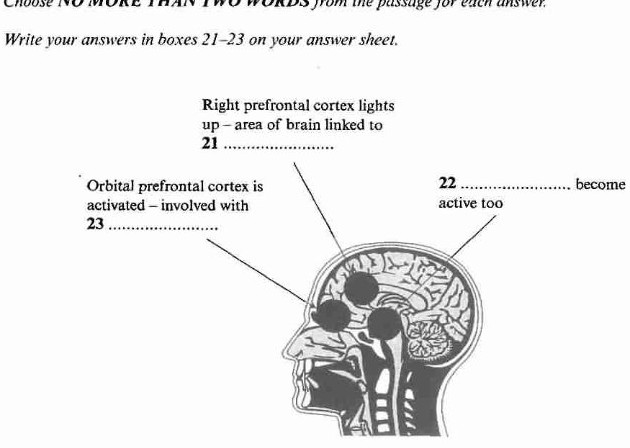
Although Goel felt being inside a brain scanner was hardly the ideal place for appreciating a joke, he found evidence that understanding a joke involves a widespread mental shift. His scans showed that at the beginning of a joke the listener's prefrontal cortex lit up, particularly the right prefrontal believed to be critical for problem solving. But there was also activity in the temporal lobes at the side of the head (consistent with attempts to rouse stored knowledge) and in many other brain areas. Then when the punchline arrived, a new area sprang to life — the orbital prefrontal cortex. This patch of brain tucked behind the orbits of the eyes is associated with evaluating information.
Making a rapid emotional assessment of the events of the moment is an extremely demanding job for the brain, animal or human. Energy and arousal levels may need to be retuned in the blink of an eye. These abrupt changes will produce either positive or negative feelings. The orbital cortex, the region that becomes active in Goel's experiment, seems the best candidate for the site that feeds such feelings into higher-level thought processes, with its close connections to the brain's sub-cortical arousal apparatus and centres of metabolic control.
All warm-blooded animals make constant tiny adjustments in arousal in response to external events, but humans, who have developed a much more complicated internal life as a result of language, respond emotionally not only to their surroundings, but to their own thoughts. Whenever a sought-for answer snaps into place, there is a shudder of pleased recognition. Creative discovery being pleasurable, humans have learned to find ways of milking this natural response. The fact that jokes tap into our general evaluative machinery explains why the line between funny and disgusting, or funny and frightening, can be so fine. Whether a joke gives pleasure or pain depends on a person's outlook.
Humour may be a luxury, but the mechanism behind it is no evolutionary accident. As Peter Derks, a psychologist at William and Mary College in Virginia, says: 'I like to think of humour as the distorted mirror of the mind. It's creative, perceptual, analytical and lingual. If we can figure out how the mind processes humour, then we'll have a pretty good handle on how it works in general.'
Questions
Questions 14–20 True / False / Not Given
Do the following statements agree with the information given in Reading Passage 2?
TRUE if the statement agrees with the information
FALSE if the statement contradicts the information
NOT GIVEN if there is no information on this
Questions 21–23 Diagram Labeling
The diagram below shows the areas of the brain activated by jokes.
Label the diagram.
Choose NO MORE THAN TWO WORDS from the passage for each answer.
Questions 24–27 Matching Sentence Endings
Complete each sentence with the correct ending A–G below.
A. react to their own thoughts.
B. helped create language in humans.
C. respond instantly to whatever is happening.
D. may provide valuable information about the operation of the brain.
E. cope with difficult situations.
F. relate to a person's subjective views.
G. led our ancestors to smile and then laugh.
Answers & Explanations Summary
| # | Answer | Evidence | Explanation |
|---|---|---|---|
| Q14 | FALSE | The writer Arthur Koestler dubbed it the luxury reflex: 'unique in that it serves no apparent biological purpose' | Excerpt/Passage Explanation: The passage explains that Arthur Koestler viewed laughter as a 'luxury' or extra thing, rather than something that helps the body survive or function in a necessary way. Answer Explanation: The answer means that the statement—that Arthur Koestler believed laughter was biologically useful—is incorrect based on the text. Reason For Correctness: The correct answer is FALSE because the passage states that Arthur Koestler called laughter the 'luxury reflex.' He specifically noted that it is unique because it 'serves no apparent biological purpose.' This directly contradicts the idea that he thought it was important in several biological ways. |
| Q15 | NOT GIVEN | Plato expressed the idea that humour is simply a delighted feeling of superiority over others | Excerpt/Passage Explanation: The passage says Plato believed humor is just a happy feeling of being better than other people. It does not mention using humor to show how smart or intelligent someone is. Answer Explanation: The answer means the text does not provide enough information to confirm or deny if Plato thought humor was a sign of high intelligence. Reason For Correctness: The correct answer is NOT GIVEN because while the text mentions Plato's view on humor, it focuses on the feeling of "superiority." Feeling superior means feeling better than others in general, which is not the same as having "above-average intelligence." The text never mentions Plato's thoughts on whether humor is related to how smart someone is, so we cannot tell if the statement is true or false. |
| Q16 | TRUE | Kant and Freud felt that joke-telling relies on building up a psychic tension which is safely punctured by the ludicrousness of the punchline | Excerpt/Passage Explanation: The passage explains that Kant believed a joke works by making a person feel a build-up of mental pressure, and then the funny ending of the joke lets that pressure pop safely. Answer Explanation: The answer means that Kant thought a joke works by letting out built-up mental energy in a safe and managed way. Reason For Correctness: The correct answer is TRUE because the passage states that Kant believed joke-telling is based on creating 'psychic tension.' In this context, 'psychic tension' is a synonym for 'nervous energy.' The passage also says this tension is 'safely punctured,' which means it is let out or released in a way that is not harmful, matching the idea of a 'controlled release.' |
| Q17 | FALSE | But most modern humour theorists have settled on some version of Aristotle's belief that jokes are based on a reaction to or resolution of incongruity, when the punchline is either a nonsense or, though appearing silly, has a clever second meaning | Excerpt/Passage Explanation: The passage states that most people who study humor today use a version of Aristotle's idea. This idea says that jokes work because they have a surprise ending or a hidden meaning. Answer Explanation: The answer is FALSE because the text actually says that most experts today agree with and use Aristotle's ideas about humor, rather than ignoring them. Reason For Correctness: The correct answer is FALSE because the passage explains that modern experts on humor have 'settled on' or agreed to use Aristotle's concepts. The statement claiming these ideas are 'ignored' is factually opposite to what is written in the text. Key words to notice are 'modern humour theorists', which refers to current thinking, and 'settled on some version of Aristotle's belief', which shows they are still using his work. |
| Q18 | TRUE | Graeme Ritchie, a computational linguist in Edinburgh, studies the linguistic structure of jokes in order to understand not only humour but language understanding and reasoning in machines | Excerpt/Passage Explanation: The passage explains that Graeme Ritchie looks at the way jokes are built to learn more about how machines can understand language and can think or solve problems. Answer Explanation: The answer is TRUE because the text mentions that Graeme Ritchie's research on jokes is connected to how machines (artificial intelligence) process information. Reason For Correctness: The correct answer is TRUE because the passage states that Graeme Ritchie studies the way jokes are made to help understand 'reasoning in machines'. The term 'reasoning in machines' refers to how computers or electronics can think and process data, which is the definition of artificial intelligence. Therefore, his work directly links jokes to the field of AI. |
| Q19 | NOT GIVEN | A comedian will present a situation followed by an unexpected interpretation that is also apt | Excerpt/Passage Explanation: The passage says that a comedian talks about a 'situation' and then gives a surprise meaning. However, it does not say if that situation is 'personal' (from their own life) or if 'most' comedians do this. Answer Explanation: The answer 'NOT GIVEN' means the text does not have enough information to tell us if the statement is true or false. Reason For Correctness: The correct answer is 'NOT GIVEN' because the passage never mentions the 'source' of a comedian's jokes. Although it explains that funny stories or 'situations' are used to surprise the listener, it does not say if these are 'personal situations' from the comedian's own life. Because this specific information is missing from the entire text, we cannot say it is true or false. |
| Q20 | TRUE | Chimpanzees have a 'play-face' — a gaping expression accompanied by a panting 'ah, ah' noise | Excerpt/Passage Explanation: The passage explains that when chimpanzees play, they show a certain facial expression and make a specific sound that goes 'ah, ah'. Answer Explanation: The answer means that the statement is correct: chimpanzees do make specific sounds while they are playing. Reason For Correctness: The correct answer is TRUE because the passage mentions specific signals used by young mammals during play. Specifically, it describes a 'play-face' used by chimpanzees and notes that this expression is paired with a specific 'ah, ah' noise, confirming they make particular sounds during play situations. |
| Q21 | problem solving | His scans showed that at the beginning of a joke the listener's prefrontal cortex lit up, particularly the right prefrontal believed to be critical for problem solving | Excerpt/Passage Explanation: The passage explains that when someone starts to hear a joke, a part of their brain called the right prefrontal cortex is used because it is the part that helps people solve problems. Answer Explanation: The answer refers to the mental task of finding solutions to questions or difficult situations. Reason For Correctness: The correct answer is based on the section of the text describing brain scans during a joke. It mentions that at the start of a joke, the right prefrontal cortex becomes active. The passage notes that scientists believe this specific area of the brain is very important for the process of problem solving. |
| Q22 | temporal lobes | But there was also activity in the temporal lobes at the side of the head (consistent with attempts to rouse stored knowledge) and in many other brain areas | Excerpt/Passage Explanation: The passage explains that when researchers scanned the brain, they saw activity in the temporal lobes. These are located on the side of the head and work to bring up facts or memories that are already saved in the brain. Answer Explanation: The answer is a specific area of the brain located on the sides of the head. Reason For Correctness: The correct answer identifies one of the brain regions that shows activity when someone starts to listen to a joke. According to the text, the 'temporal lobes' are activated because the brain is trying to find 'stored knowledge,' which means it is looking for information it already knows to help make sense of the joke. |
| Q23 | evaluating information | Then when the punchline arrived, a new area sprang to life — the orbital prefrontal cortex. This patch of brain tucked behind the orbits of the eyes is associated with evaluating information | Excerpt/Passage Explanation: The passage states that a part of the brain located behind the eyes, known as the orbital prefrontal cortex, starts working when the final part of a joke is told. This area of the brain is responsible for thinking about and judging the information it gets. Answer Explanation: The answer "evaluating information" refers to the mental process of looking at something and deciding what it means or how important it is. Reason For Correctness: The correct answer is "evaluating information" because the passage identifies the orbital prefrontal cortex as the specific part of the brain that becomes active when a joke's punchline is heard. The author explains that this part of the brain is linked to the task of judging or processing data. Key terms like "associated with" connect the specific brain region to this particular mental activity. |
| Q24 | C | Making a rapid emotional assessment of the events of the moment is an extremely demanding job for the brain, animal or human | Excerpt/Passage Explanation: The passage states that it is a very hard task for any brain to quickly judge the things that are happening right at this second. Answer Explanation: The answer means that one of the hardest things for the brain to do is to react immediately to things occurring right now. Reason For Correctness: The correct answer is chosen because the passage mentions that making a 'rapid emotional assessment' of 'events of the moment' is 'extremely demanding' for the brain. In this context, 'demanding job' is a synonym for 'difficult task', 'rapid' means 'instantly', and 'events of the moment' refers to 'whatever is happening'. Therefore, the text directly links the difficulty of the brain's work to the speed at which it must process current situations. |
| Q25 | A | but humans, who have developed a much more complicated internal life as a result of language, respond emotionally not only to their surroundings, but to their own thoughts | Excerpt/Passage Explanation: The passage explains that since humans have language, they have complex minds. This causes them to have feelings about what they think, not just about what is happening around them. Answer Explanation: The answer means that humans have feelings or reactions based on what they are thinking inside their minds. Reason For Correctness: The correct answer is A because the passage explains that because humans use language, they have a complex inner life. This allows them to have emotional responses not only to things happening around them but also to their own personal thoughts. The word 'respond' in the passage means the same thing as 'react' used in the answer choice. |
| Q26 | F | Whether a joke gives pleasure or pain depends on a person's outlook | Excerpt/Passage Explanation: The passage states that if a person enjoys a joke or finds it hurtful depends entirely on their own point of view or way of looking at the world. Answer Explanation: The answer means that how each person reacts to a joke depends on their own personal opinions and way of thinking. Reason For Correctness: The correct answer is F because the text explains that the way a person sees or evaluates something determines if a joke is funny, scary, or gross to them. It mentions that since we use our own brain machinery to judge things, the result (feeling happy or upset by a joke) depends on a person's 'outlook,' which is a synonym for their 'subjective views'. |
| Q27 | D | If we can figure out how the mind processes humour, then we'll have a pretty good handle on how it works in general.' | Excerpt/Passage Explanation: The passage says that if we understand the way our minds deal with funniness, we will have a very good understanding of how the mind does all its other tasks too. Answer Explanation: The answer means that Peter Derks believes that studying humor can help scientists understand how the human brain functions. Reason For Correctness: The correct answer is D because Peter Derks states that understanding how the mind handles humor can provide a 'good handle' on how it works overall. This suggests that humor is a tool to get valuable information about the operation of the brain, which is mentioned in option D. The phrase 'works in general' in the passage serves as a synonym for 'operation of the brain' in the answer choice. |