Our system will evaluate the answer based on this AI-generated description.
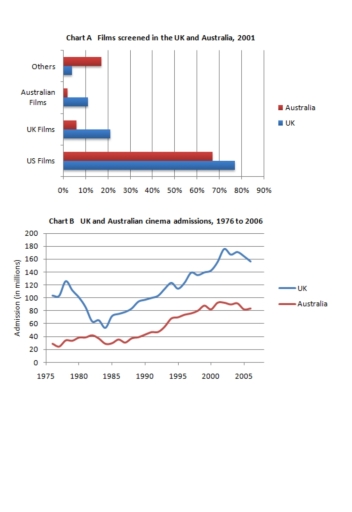
The image consists of two charts labeled Chart A and Chart B. Chart A, titled "Films screened in the UK and Australia, 2001," is a bar chart with percentage on the X-axis ranging from 0% to 90% and categories on the Y-axis labeled "US Films," "UK Films," "Australian Films," and "Others." Data points for Australia: US Films slightly above 80%, UK Films approximately 10%, Australian Films just below 10%, Others nearly 0%. Data points for the UK: US Films slightly under 70%, UK Films just above 20%, Australian Films around 5%, Others close to 5%. Chart B, titled "UK and Australian cinema admissions, 1976 to 2006," is a line graph with years on the X-axis ranging from 1975 to 2005 and "Admissions in millions" on the Y-axis from 0 to 200 in increments of 20. The UK line starts around 100 in 1975, dips to below 60 in the early '80s, rises to 120 in the early '90s, drops to 100 in the mid-90s, and then climbs steadily to just below 180 in 2006. The Australia line starts just above 20 in 1975, climbs to above 40 in the early '80s, hovers around 40 until the early '90s, then rises steadily to just above 80 in 2006.
Given the complexity of the image, the above description may not be entirely accurate.
Skyrocket your IELTS band score by 1-2 points in under a month with our premium plan!
Note: Both the topic and the answer were created by one of our users.
What are given in the supplied bar chart and line graph are the ratios of 4 people types of films which sell in 2001, as well as, the number of Australian and English people coming to watch these movies starting from 1975 to 2006.
Overall, the first thing to note is that the US films were the most bought by both nationalities, and in the cinema, people from Australia were less than the UK residents.
Now, turning to the details, it was American movies which stood out as having the highest percentages by the side of selling, but, the UK buyers were more by 9%, representing 76%, as well as, the statistic illustrated that English and Australian films were sold five times more for English people than American, showing 20% and 10%, respectively.
Moving on, in spite of declining the number of English viewers in the first decade, the number of films which were watched by American citizens, in the cinema, were less than 20 million people. Both rates depicted their own peaks after the second millennium with increasing by 70 million and 60 million from the first point, respectively.
Word Count: 190
