Our system will evaluate the answer based on this AI-generated description.
The image shows energy use in Australian homes in 2008 with heating & cooling at 38%, water heating at 25%, other appliances at 16%, lighting at 7%, fridges & freezers at 7%, cooking at 4%, and stand-by power at 3%; and gadgets bought by men and women in the UK in 2013 with programmable thermostats by men at approximately 38% and women at 15%, internet TV by men at about 50% and women at 17%, central heating controls by men at roughly 30% and women at 10%, online security cameras by men at about 62% and women at 18%, energy monitors by men at around 78% and women at 58%, wireless speakers by men at about 55% and women at 50%, people counters by men at roughly 20% and women at 10%, home cinema by men at 50% and women at around 16%, home movie projectors by men at approximately 62% and women at 21%, outdoor movie systems by men at about 85% and women at 65%, and streaming systems by men at about 58% and women at 57%.
Given the complexity of the image, the above description may not be entirely accurate.
Skyrocket your IELTS band score by 1-2 points in under a month with our premium plan!
Note: Both the topic and the answer were created by one of our users.
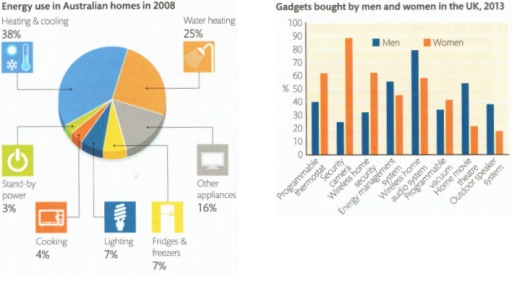
The pie chart shows the different sources for energy consumed by Australian citizens in 2008.
Overall, what stands out is that heating and cooling is the biggest segment of utilized energy-based products, followed by water heating. As for the less energy-consuming parts of the house that year, one can see that there was lighting, fridges and freezers, cooking, stand-by power and other appliances.
Looking at the details, the largest share of energy use taken by heating and cooling was at 38%, whereas it is clear from the visual that water heating was slightly less significant at 25%. Meanwhile, other appliances contributed over than a fifth, at 16%, which is notably lower than the top two categories but higher than lighting and fridges & freezers, each of which made up less than one tenth of a hundred, 7%. As regards the smallest segments, cooking and stand-by power, their shares were almost identical, at 4% and 3% respectively.
Word Count: 156
