Our system will evaluate the answer based on this AI-generated description.
The image displays a line graph detailing fuel production in a European country from 1981-2000 measured in million tonnes. Petroleum production: 100 (1981), 120 (1982), 100 (1983), 120 (1984), 120 (1985), 100 (1986), 100 (1987), 100 (1988), 100 (1989), 120 (1990), 100 (1991), 100 (1992), 120 (1993), 100 (1994), 100 (1995), 100 (1996), 120 (1997), 120 (1998), 100 (1999), 100 (2000). Coal production: 80 (1981), 80 (1982), 60 (1983), 40 (1984), 40 (1985), 60 (1986), 60 (1987), 40 (1988), 40 (1989), 60 (1990), 60 (1991), 60 (1992), 80 (1993), 80 (1994), 60 (1995), 60 (1996), 40 (1997), 20 (1998), 20 (1999), 40 (2000). Natural Gas production: 40 (1981), 40 (1982), 60 (1983), 60 (1984), 80 (1985), 80 (1986), 100 (1987), 100 (1988), 80 (1989), 60 (1990), 60 (1991), 40 (1992), 40 (1993), 60 (1994), 60 (1995), 60 (1996), 80 (1997), 100 (1998), 120 (1999), 120 (2000).
Given the complexity of the image, the above description may not be entirely accurate.
Skyrocket your IELTS band score by 1-2 points in under a month with our premium plan!
Note: Both the topic and the answer were created by one of our users.
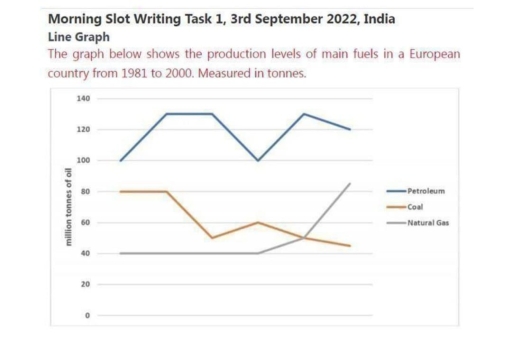
The line graph compares the amounts of three core fuels produced in a European country between 1981 and 2000, estimated in million tonnes.
Overall, the production levels of petroleum were the highest. Despite the initially increased production of coal, it was surpassed by natural gas at the end of the period.
The yield of petroleum fluctuated between 100 and around 130 million tonnes in the initial half of the period, with a plateau in between. In the next half of the period, it increased from 100 million tonnes to approximately 130 million tonnes before experiencing a slight decrease to 120 million tonnes in 2000.
The coal levels produced witnessed a sudden dip after being constant at 80 million tonnes and showed a slight increase by the end of 1990. From 1990 to 2000, this figure gradually decreased to around 42 million tonnes. The yield of natural gas was constant from 1980 to 1990 at 40 million tonnes. Thereafter, it increased significantly, reaching about 85 million tonnes in 2000, and among the three main fuels, petroleum was produced in large quantities.
Word Count: 180
