Our system will evaluate the answer based on this AI-generated description.
The image displays a line graph detailing fuel production in a European country from 1981-2000 measured in million tonnes. Petroleum production: 100 (1981), 120 (1982), 100 (1983), 120 (1984), 120 (1985), 100 (1986), 100 (1987), 100 (1988), 100 (1989), 120 (1990), 100 (1991), 100 (1992), 120 (1993), 100 (1994), 100 (1995), 100 (1996), 120 (1997), 120 (1998), 100 (1999), 100 (2000). Coal production: 80 (1981), 80 (1982), 60 (1983), 40 (1984), 40 (1985), 60 (1986), 60 (1987), 40 (1988), 40 (1989), 60 (1990), 60 (1991), 60 (1992), 80 (1993), 80 (1994), 60 (1995), 60 (1996), 40 (1997), 20 (1998), 20 (1999), 40 (2000). Natural Gas production: 40 (1981), 40 (1982), 60 (1983), 60 (1984), 80 (1985), 80 (1986), 100 (1987), 100 (1988), 80 (1989), 60 (1990), 60 (1991), 40 (1992), 40 (1993), 60 (1994), 60 (1995), 60 (1996), 80 (1997), 100 (1998), 120 (1999), 120 (2000).
Given the complexity of the image, the above description may not be entirely accurate.
Skyrocket your IELTS band score by 1-2 points in under a month with our premium plan!
Note: Both the topic and the answer were created by one of our users.
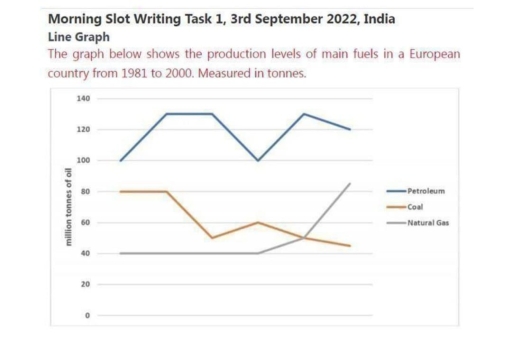
The line graph shows the production of main fuels in a European country between 1981 and 2000, measured in tonnes.
Overall, petroleum was the highest during all period. Coal generally decreased while natural gas increased in the end of the years.
In 1981 petroleum was about 100 million tonnes and it quickly rise to around 130 in 1985. After that it drop to 100 in 1990, then increase again to about 135 before finishing near 120 in 2000.
Coal started around 80 in 1981 and stayed same until 1985. Then it fell sharply to 50 in 1990. After small rise to 60 in 1995, it decreased again and ended about 45.
Natural gas was the lowest at first, around 40, and it almost did not change until 1990. However, after 1995 it increased fast and reached about 85 in 2000.
Word Count: 140
