Our system will evaluate the answer based on this AI-generated description.
The image depicts a line graph with a horizontal axis ranging from 2002 to 2010 and a vertical axis from 10 to 100 with increments of 10. Five lines, corresponding to different age groups, show an upward trend over time with varying slopes. The 19-24 group starts at approximately 10 in 2002, reaching just over 10 in 2003, around 15 in 2004, about 20 in 2005, nearly 30 in 2006, roughly 35 in 2007, approximately 45 in 2008, just under 55 in 2009, and around 65 in 2010. The 25-35 group commences at roughly 20 in 2002, increasing to around 30 in 2003, 40 in 2004, 50 in 2005, nearly 60 in 2006, just above 60 in 2007, about 70 in 2008, around 80 in 2009, and approximately 90 in 2010. The 36-45 group begins at just above 20 in 2002, growing to about 30 in 2003, nearly 40 in 2004, just over 50 in 2005, approximately 60 in 2006, about 70 in 2007, roughly 80 in 2008, close to 90 in 2009, and almost 100 in 2010. The 46-55 group starts at approximately 30 in 2002, increasing to around 40 in 2003, just under 50 in 2004, about 60 in 2005, over 70 in 2006, around 80 in 2007, nearly 90 in 2008, and just below 100 in 2009 and 2010. The 56-65 group initiates at nearly 40 in 2002, rising to almost 50 in 2003, just under 60 in 2004, about 70 in 2005, close to 80 in 2006, approaching 90 in 2007, and reaching 100 in 2008, remaining there in 2009 and 2010. Note: Due to the lack of precision in the graph, the values for each data point are estimated to the nearest increment based on their position on the graph
Given the complexity of the image, the above description may not be entirely accurate.
Skyrocket your IELTS band score by 1-2 points in under a month with our premium plan!
Note: Both the topic and the answer were created by one of our users.
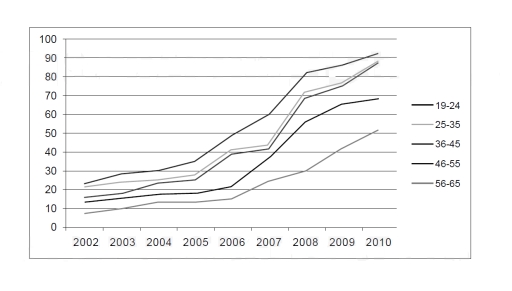
The line graph displays percentage of working adults in Australia using text messaging to interact in job related situations from 2002 to 2010
Overall, average percentages of adults using text messages in work-related scenarios showed steady surge among all age groups dating from 2002 to 2010. Younger generation generally recorded higher figures than older adults,although by the end of the period adults aged 19-24 recorded highest figure.
Looking first to younger age groups, around one quarter among 19-24 years of age used text messaging in the begining,and over time this number rose significantly reaching approximately 92 percent. Second best percentage of using text messaging was shown among adults 20-25 years of age, which was slightly lower than the precentages for the 19-24 age group in 2002 with a figure of roughly 22 percent, but it also sharply increased and ended up at 86 percent.As a result, the gap between figures widened slightly by the end of the period.
Turning to the older age groups, the figures were slightly lower for older age group. In 2002 percentage of seniors aged 36-45 was around 18 percent,while figures for 45-55 and 56-65 groups were slightly lower standing at 10 and 15 percent respectively. All three grops showed continuous increase in figures over time, with a particularysharp rise after 2007. By the end of the recording percentage of adults in 36-45 age group was little lower than in younger groups standing at 84 percent, while 46-55 and 56-65 aged groups showed greater margin in figures, with 67 and 52 percent.
Word Count: 256
