Our system will evaluate the answer based on this AI-generated description.
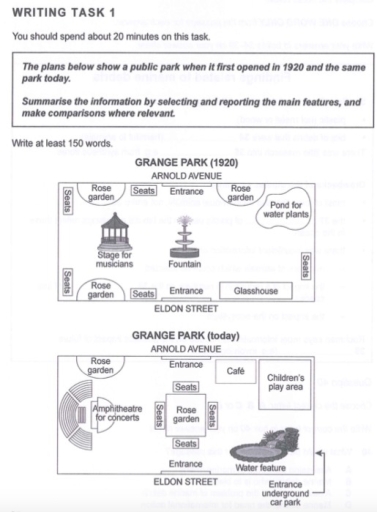
The image displays layout plans for Grange Park from 1920 and a contemporary version. In 1920, Arnold Avenue borders the north side, featuring a Rose Garden flanked by seats on both north-west and north-east sections. A centrally located fountain is depicted, with entrances at Arnold Avenue and Eldon Street, where another Rose Garden with southeast and southwest seating exists. A pond for water plants sits in the northeast quadrant adjacent to the northeastern Rose Garden, while a glasshouse occupies the east side, beside a stage for musicians on the west. In the modern layout, Arnold Avenue remains the northern boundary with the northwest Rose Garden shifted slightly westward, continuing flanked seating. The previously central fountain is replaced with seating while the glasshouse and pond areas have been transformed; the east now houses a cafe and the southeast a children's play area. An amphitheater for concerts has replaced the musician's stage, with a new introduction of a water feature, and car park access is located at the southern entrance.
Given the complexity of the image, the above description may not be entirely accurate.
Skyrocket your IELTS band score by 1-2 points in under a month with our premium plan!
Note: Both the topic and the answer were created by one of our users.
The plans compare the layout of Grange Park when it first opened in 1920 with its present-day design.
Overall, the park has undergone significant redevelopment. While the basic rectangular shape and the main entrances from Arnold Avenue and Eldon Street have remained the same, most facilities have been modernised or replaced, with a shift towards entertainment and leisure use.
In 1920, Grange Park was mainly decorative. It contained several rose gardens on both sides, a central fountain, and a stage for musicians located on the left side. There were also seats near the entrances, a pond for water plants in the north-east corner, and a glasshouse in the south-east area.
Today, the park has a more functional and family-oriented layout. The former stage has been replaced by an amphitheatre for concerts, while the pond and glasshouse have been removed. In their place, a large water feature now occupies the south-east corner, alongside an entrance to underground parking. Additionally, a café and a children’s play area have been added in the north-east section. Although rose gardens and seating areas still exist, they have been rearranged, and the central fountain has been removed entirely.
Word Count: 192
