Our system will evaluate the answer based on this AI-generated description.
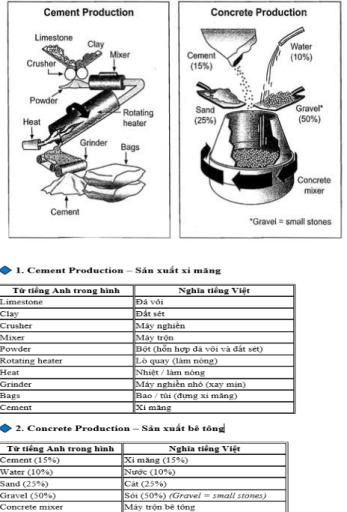
The image contains two diagrams depicting cement and concrete production, plus two tables with related terminology: Cement Production diagram includes limestone, clay, mixer, crusher, powder, rotating heater, heat, grinder, bags, cement; Concrete Production diagram shows cement (15%), water (10%), sand (25%), gravel (50%), concrete mixer, gravel defined as small stones; Table 1 - Cement Production - includes English to Vietnamese translations: Limestone translated to Đá vôi, clay đất sét, crusher máy nghiền, mixer máy trộn, powder bột (hỗn hợp đá vôi và đất sét), rotating heater lò quay (làm nóng), heat nhiệt/làm nóng, grinder máy nghiền (ép nhỏ), bags bao/túi (đựng xi măng), cement xi măng; Table 2 - Concrete Production - lists English to Vietnamese translations: Cement translated to xi măng (15%), water nước (10%), sand cát (25%), gravel sỏi (50%), note states gravel = small stones; both tables title sections 1. Cement Production (Sản xuất xi măng) and 2. Concrete Production (Sản xuất bê tông).
Given the complexity of the image, the above description may not be entirely accurate.
Skyrocket your IELTS band score by 1-2 points in under a month with our premium plan!
Note: Both the topic and the answer were created by one of our users.
The first diagram demonstrates the main stages which take place in the production of cement, while the second one depicts how concrete is manufactured.
As can be seen from the process, there are six primary stages, starting from collecting raw ingredients, ending with the completed cement packages. Additionally, the process of making concrete involves two main steps, namely batching the raw materials in proportion and feeding them into concrete mixer machine.
To begin with, the process starts with collecting raw materials, which are limestone, and clay. After that, the substances goes through a crusher to become powder, and this powder is then transferred to a mixer. Then, the dry mix flows down a pipe to the rotating heater and heated extensively. Subsequently, the mixture is put into a grinder and crushed one more time. As a result, cement is formed and packed into bags.
Turning to the diagram in more detail, the second procedure shows that raw components is batched in proportion, specifically 15% of cement, 10% of water, 25% of sand, and 50% of gravel. At the final phases, these materials are loaded into a concrete mixer, in which they are blended thoroughly.
Word Count: 194
