Our system will evaluate the answer based on this AI-generated description.
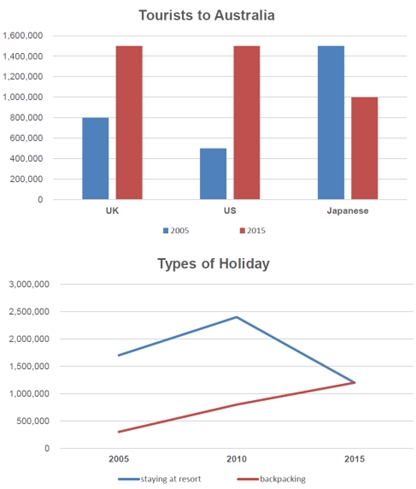
The image consists of two sections depicting two different graphs. The upper graph titled "Tourists to Australia" showcases the number of tourists from the UK, US, and Japan in two distinct years, 2005 and 2015. It shows UK tourists: approximately 1,200,000 in 2005 and about 1,100,000 in 2015; US tourists: roughly 600,000 in 2005 and nearly 1,400,000 in 2015; Japanese tourists: around 800,000 in 2005 and close to 600,000 in 2015. The lower graph titled "Types of Holiday" illustrates the number of tourists staying at a resort and those backpacking from 2005 to 2015. Resort stays reached their highest at approximately 2,500,000 in 2010, with the values around 1,750,000 in 2005 and close to 1,500,000 in 2015. Backpacking numbers started at about 2,000,000 in 2005, peaked at approximately 1,500,000 in 2010, and fell to around 1,000,000 in 2015.
Given the complexity of the image, the above description may not be entirely accurate.
Skyrocket your IELTS band score by 1-2 points in under a month with our premium plan!
Note: Both the topic and the answer were created by one of our users.
The charts show the number of tourists to Australia from the UK, the US, and Japan in 1995 and 2005, and the types of travel over the same period.
Overall, tourist numbers from the UK and the US increased, while those from Japan declined. In terms of travel type, backpacking was more popular until 2000 but dropped by 2005, whereas resort stays steadily rose.
In 1995, about 800,000 UK tourists visited Australia, rising to 1.5 million by 2005. US visitor numbers almost tripled, from around 500,000 to nearly 1.5 million. In contrast, Japanese tourists fell from roughly 1.5 million in 1995 to about 1 million in 2005.
Backpacking reached its highest point with 2.5 million travelers around 2000 before falling to 1.2 million in 2005. Meanwhile, resort grew continuously, starting at around 400,000 in 1995 and reaching over 1 million by 2005, equaling backpacking at the end of the period.
Word Count: 150
