Our system will evaluate the answer based on this AI-generated description.
The image displays two graphs; the first graph shows the total population of tigers in 11 tiger reserves in India for the years 1972, 1979, 1984, 1989, 1993, 1995, 1997, and 2002, with the respective populations at 268, 711, 1211, 1336, 1657, 1448, 1576, and 1576. The second graph depicts the number of tigers at five different tiger reserves over several years from 1972 to 2002. For Bandipur, the number of tigers increased from around 10 in 1972 to over 70 in 2002. In Corbett, the count began at about 45 in 1972 and rose to just under 160 in 2002. For Kanha, the initial count was around 25 in 1972, peaking at 100 in 1995 before falling to around 80 in 2002. Similipal's tiger population started at slightly above 0 and fluctuated, peaking around 115 in 1989 and ending close to 90 in 2002. Lastly, Buxa started with 0 tigers in 1972, reached a peak of around 20 in the 1980s, and concluded with 5 in 2002.
Given the complexity of the image, the above description may not be entirely accurate.
Skyrocket your IELTS band score by 1-2 points in under a month with our premium plan!
Note: Both the topic and the answer were created by one of our users.
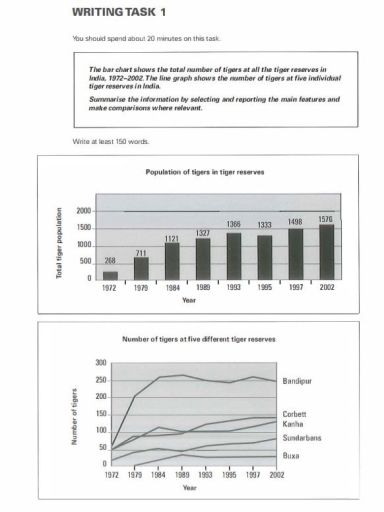
The graphs illustrate the statistics of tiger reserves in India over three decades spanning between 1972 and 2002. We are able to compare the total tiger population as well as the distribution of them amongst five different reserves.
The total population of tigers in these three decades has steadily risen, with the highest recorded in 2002 (1576), compared to the lowest in 1972 (268). Except for the year 1995, when there was a small decrease in population, the overall trend shows a growing number of tigers.
Reflecting the total population, the numbers in individual reserves have also increased over the years, with the highest rate of increase seen between 1972 to 1984, especially in Bandipur. The slowest rate is in Buxa. After 1984, the numbers have almost plateued. Bandipur gained roughly 200 tigers, which was five times more than Buxa, which only gained about 40 animals.
Overall, the graphs illustrate the growing trend in the population of tigers in India, with the highest growth seen in the Bandipur reserve. Although the growth is positive in all 5 reserves that were analysed, the growth rate varies between them.
Word Count: 187
