🔥 Today Only: Save 30% on Premium — Offer Ends Soon! - Upgrade Now!
Bar Chart

Band 6+: The bar graph illustrates the proportion of English and Welsh house owners and tenants from 1918 to 2011.

Image for topic: The bar graph illustrates the proportion of English and Welsh house owners and tenants from 1918 to 2011.
Our system will evaluate the answer based on this AI-generated description.
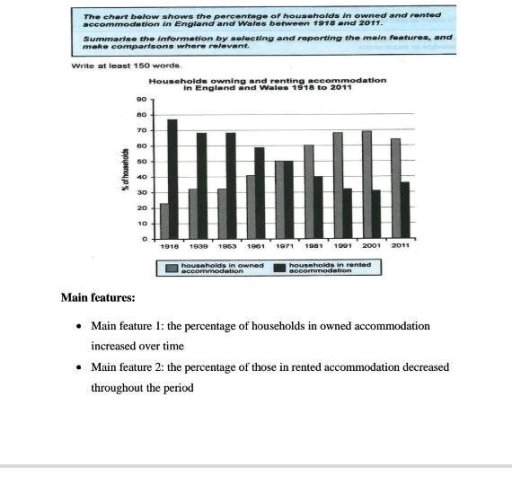
The image shows a bar graph with two types of data - households in owned accommodation and households in rented accommodation in England and Wales from the years 1918 to 2011. Households in owned accommodation in 1918 have a percentage of approximately 23, which increases to approximately 31 in 1939, approximately 32 in 1953, approximately 42 in 1961, approximately 51 in 1971, approximately 57 in 1981, approximately 68 in 1991, approximately 69 in 2001, and approximately 64 in 2011. Households in rented accommodation in 1918 have a percentage of approximately 77, which decreases to approximately 69 in 1939, approximately 68 in 1953, approximately 58 in 1961, approximately 49 in 1971, approximately 43 in 1981, approximately 32 in 1991, approximately 31 in 2001, and approximately 36 in 2011. The bar graph demonstrates two main features: 1) an increase in the percentage of households in owned accommodation and 2) a decrease in the percentage of households in rented accommodation over the period from 1918 to 2011.
Given the complexity of the image, the above description may not be entirely accurate.
Note: Both the topic and the answer were created by one of our users.

The given chart illustrates the compares informations about huseholds in owned and rented accomodation in England and Wales over the period from 1918 to 2011.

Overall, it is clear that the proportion of households living in owned accomodation increased steadily over the period,whereas the percentage of those renting declined significantly.

In households owned accomodation, the highest percentage was recorded in 2001,at around 70%,while the lowest figure was seen in 1918, at approximately 20%.

A distinct pattern can be observed in households in rented accomodation, where percentages rates from just over 70% in 1918 to nearly 30% in 2001.

Between 1918 and 1971, renting remained the dominant form of housing. However, it decreased over time. During the same period, the proportion of households owning their homes declined an equal level with renting . After that, home ownership became more common and continued to increase until it peaked in 2001. Also there was a slight decline in owned accomodation in 2011.

Word Count: 159

Answers On The Same Topic:

The bar graph illustrates the proportion of English and Welsh house owners and tenants from 1918 to 2011.

The chart shows the percentage of households owned and rented accommodation in England and Wales between 1918 and 2011. The pie chart shows the households in owned accommodation in again measured from 1918 to 2011. Both households that in rented accommodation decreased from 1918 to 2011. The highest households in owned accommodation is in the […]

The bar graph illustrates the proportion of English and Welsh house owners and tenants from 1918 to 2011.

The given bar chart provides information about the percentages of households in owned and rented accommodation in England and Wales from 1918 to 2011. Overall, it can be seen that households in rented accommodation had the largest proportion, while households in owned accommodation had the smallest proportion during the period. To start with, in 1918, […]

The bar graph illustrates the proportion of English and Welsh house owners and tenants from 1918 to 2011.

the graph below shows the percentage of English and Welsh property owners and renters starting from 1918 to 2011. Overall, the number of house owners kept increasing untill 2011, while the number of tenants oppositely fell. The highest percentage of rented households was in 1918 (about 78%), the nuber remained almost the same during 1939 […]

The bar graph illustrates the proportion of English and Welsh house owners and tenants from 1918 to 2011.

The bar chart illustrates the proportion of households owning and renting accommodation in England and Wales over a period from 1918 to 2011. In 1918, the majority of households were in rented accommodation, with the figure standing at around 77%, while only about 23% of households owned their accommodation. Over the next few decades, the […]

The bar graph illustrates the proportion of English and Welsh house owners and tenants from 1918 to 2011.

The bar chart illustrates the percentage of households that either owned or rented accommodation in England and Wales between 1918 and 2011. Overall, the percentage of households renting accommodation decreased steadily over the period, while home ownership rose. By 1971, both ownership and renting were equal. and by 2001, ownership had overtaken renting significantly, though […]

See All

Other Topics:

The chart below gives information about the UK's ageing population in 1985 and makes predictions for 2035. Summarize the information by selecting and reporting the main features, and make comparisons where relevant.

The bar chart provides the information about UK’s ageing populace in the year of 1985 and makes prognostication for 2035. Overall, it is clear that the percentage of elderly population is expected to increase across all region by 2035. Wales expected to increase population as compared to other four regions. In 1985, Wales had the […]

The chart below shows the number of people employed in five types of work on one region of Australia in 2001 and 2008. Summarise the information by selecting and reporting the main features, and make comparisons where relevant.

The bar chart illustrates the numbers of employees in five types of works on one region of Australia between 2001 and 2008. Overall, it is clear that sales sector accounted for the majority of employees while farming took up the smallest share. In addition, while sales, computing and nursing experienced growth, accounting and farming witnessed […]

The charts below show the price of fuel in two states of the USA from 2005 to 2009.

The bar charts compare the cost of gasoline and petrol, measured in dollars per litre, in two different states of the USA between 2005 to 2009. Overall, both types of fuel experienced an increase until 2008, before ending up falling down in 2009. Additionally, citizens had to pay more money to buy gasoline than petrol […]

The graph compares the percentage of International and the percentage of UK students gaining second class degrees or better at a major UK university.

The graph illustrates the comparison of International and UK students improving in different major in university in 2009.The result of the survey will be showing in percentage form. Firsty,In subject of Information technology and Electrical engineering can clearly see that International students both reached high rates of 80 percent gaining more effective than UK students […]

The bar chart shows the treatment of waste in different countries.

The provided data illustrate how waste is treated in various countries. Overall, landfills make up a large portion of the graph, with three countries relying on that as the main method of disposing waste. Whereas being used as chemicals is shown to be consistently low among all four countries. According to the chart, Netherlands is […]

The bar charts below show the prevalence of obesity among boys and girls aged 12 to 19 years by ethnicity, in the United States for the years 2004 and 2014.

The bar charts compare the percentage of obese boys and girls aged 12 to 19 across three ethnic groups in the US in two different years: 2004 and 2014. Overall, obesity rates increased across all ethnic groups for both genders over the ten-year period. In addition, Hispanic boys and Non-Hispanic Black girls experienced the highest […]

See All
We have detected unusual activity on your device.
Please verify your identity to continue.
Note: This verification step won't sign you in. If you have a premium account, please log in to access the service as usual.
Google/Gmail Verification
Or verify using Email/Code
We've sent a verification code to:
youremail@gmail.com (Not your email?)
Enter it below to complete the verification process.
Ensure your email address is correct, your inbox is not full, and you check your spam folder. If no email arrives, consider using an alternative email.
You will need a Premium plan to perform your action!
Note: If you already have a premium account, please log in to access our services as usual.

Plans & Pricing

Our mission is to make quality education accessible for everyone.
However, to keep our hardworking team running and this service alive, we genuinely need your support!
By opting for a premium plan, not only do you sustain us in achieving the mission, but you also unlock advanced features to enrich your learning experience.

Free

For learners who aren't pressed for time

What's included on Free
100+ Cambridge IELTS Tests
Instant IELTS Writing Task 1 & 2 Evaluation (2 times/month)
Instant IELTS Speaking Part 1, 2, & 3 Evaluation (2 times/month)
Instant IELTS Writing Task 1 & 2 Essay Generator (2 times/month)
500+ Dictation & Shadowing Exercises
100+ Pronunciation Exercises
Flashcards
Other Advanced Tools

Premium

For those serious about advancing their English proficiency, and for IELTS candidates aspiring to boost their band score by 1-2 points (especially in writing & speaking) in just 30 days or less

What's included on Premium
Save Your IELTS Test Progress & Analyze Mistakes By Question Type
Save Your Own Flashcard Sets & Use Them On Any Device
Unlock All Courses, IELTS Tests, Section & Part Practice
Unlimited AI Conversations
Unlimited AI Writing Enhancement Exercises
Unlimited IELTS Writing Task 1 & 2 Evaluation
Unlimited IELTS Speaking Part 1, 2, & 3 Evaluation
Checked Answers Will Not Be Published
Unlimited IELTS Writing Task 1 & 2 Essay Generator
Unlimited IELTS Speaking Part 1, 2, & 3 Sample Generator
Unlimited Usage Of Advanced Tools & AI Features
Priority Support within 24h (12-month plan only)

Due to the nature of our service and the provided free trials, payments are non-refundable.