Our system will evaluate the answer based on this AI-generated description.
The image contains a pie chart and a line graph with two keys (ESC and NESC) explaining that ESC refers to workers born in English-speaking countries other than Australia and NESC refers to workers born in non-English-speaking countries. The pie chart shows the workforce in Australia by place of birth in 2003 with percentage values showing Born in Australia 76%, ESC 10%, and NESC 14%. The line graph shows the unemployment in Australia by place of birth from 1993-2003 with percentages on the y-axis ranging from 0 to 8 and years on the x-axis. The graph lines show the unemployment percentage of Australia with a dashed line, ESC with a green line, and NESC with a red line. The unemployment rate in 1993 was approximately 2% for ESC, 2% for Australia, and 6% for NESC. In 1995, ESC had around 3%, Australia had 4%, and NESC had 8%. In 1997, ESC decreased to 2%, Australia went slightly above 2%, and NESC decreased to 6%. In 1999, ESC maintained 2%, Australia increased to 4%, and NESC decreased below 6%. In 2001, all three had around 2%, with NESC showing a slight increase compared to ESC and Australia. In 2003, ESC had just over 2%, Australia had just under 2%, and NESC had around 4%.
Given the complexity of the image, the above description may not be entirely accurate.
Skyrocket your IELTS band score by 1-2 points in under a month with our premium plan!
Note: Both the topic and the answer were created by one of our users.
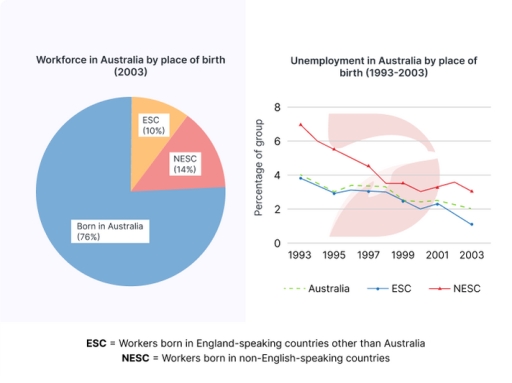
The diagrams illustrates the distribution of the Australian workforce by place of birth in 2003, and the unemployment trends from 1993 to 2003 among three groups: those born in Australia, in English-speaking countries (ESC), and in non English-speaking countries (NESC).
It is evident that most of the workforce in 2003 was made up of people born in Australia. Over the ten year period, unemployement declined across all groups, but NESC group consistently experienced the highest unployement rates.
In detail, the pie chart shows that in 2003, 76% of the workforce was Australian-born. Workers from non-English-speaking countries accounted for 14%, while from English-speaking countries, the figure was just 10%.
The line graph reveales that in 1993, unemployment was highest among NESC group, at around 7%, and after four years in 1997 it fell to apporximately 5%, while the ESC group had the lowest rate at 4% in 1993. By 2003, the rate for australians workers dropped to about 4%, the ESC group at 1.5%, and the NESC group at 3%.
Word Count: 169
