24 Hours Only: Get 39% OFF on Our Premium Plan - Check Out Now!
Multiple Graphs

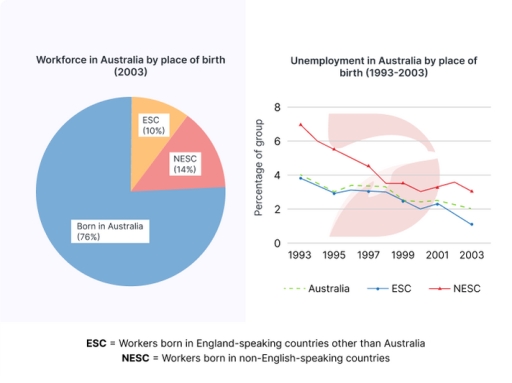
Band 5+: The chart and graph below give information about three categories of workers in Australia and the unemployment levels within those categories

Image for topic: The chart and graph below give information about three categories of workers in Australia and the unemployment levels within those categories
Our system will evaluate the answer based on this AI-generated description.
The image contains a pie chart and a line graph with two keys (ESC and NESC) explaining that ESC refers to workers born in English-speaking countries other than Australia and NESC refers to workers born in non-English-speaking countries. The pie chart shows the workforce in Australia by place of birth in 2003 with percentage values showing Born in Australia 76%, ESC 10%, and NESC 14%. The line graph shows the unemployment in Australia by place of birth from 1993-2003 with percentages on the y-axis ranging from 0 to 8 and years on the x-axis. The graph lines show the unemployment percentage of Australia with a dashed line, ESC with a green line, and NESC with a red line. The unemployment rate in 1993 was approximately 2% for ESC, 2% for Australia, and 6% for NESC. In 1995, ESC had around 3%, Australia had 4%, and NESC had 8%. In 1997, ESC decreased to 2%, Australia went slightly above 2%, and NESC decreased to 6%. In 1999, ESC maintained 2%, Australia increased to 4%, and NESC decreased below 6%. In 2001, all three had around 2%, with NESC showing a slight increase compared to ESC and Australia. In 2003, ESC had just over 2%, Australia had just under 2%, and NESC had around 4%.
Given the complexity of the image, the above description may not be entirely accurate.
Note: Both the topic and the answer were created by one of our users.

The given bar chart delinates different kinds of worker in Austrlia in 2003. Meanwhile, the line graph depicts information about the porportion of unemployment in three groups by birthplace.

Overall, the percentage of native Australian workers took the lion’s share in both categorys. Furthermore, unemployment level experienced a downward trend. However, english-speaking countries still remained the highest.

It can be seen from the workforce in Australia that the ratio of people who born in Australia took up two-third. Moreover, people from english and non-english-speaking countries shared the same quantity, at 10% and 14%, respectively.

In terms of unemployment rate, it is obvious that there was a drastic decrease in three groups over the period of 10 years. In ESC, it started at roughly 7% and drop dramatically to about 3% in the final year. With respect to Australia, this number started at approximately 4% and fall to roungly 2% in 2003. With regard to NESC, it stood at about 4% in 1993, after 10 years, it declined gradually at roughly 1%.

Word Count: 171

Answers On The Same Topic:

The chart and graph below give information about three categories of workers in Australia and the unemployment levels within those categories

The given chart illustrates the percentage of three sectors of workers in Australia in 2003: ESC, NESC, and those born in Australia while the graph depicts the unemployment rates within these groups over a decade from 1993. Overall, it can be seen that a number of workers born in Australia were dominant in the Australia’s […]

The chart and graph below give information about three categories of workers in Australia and the unemployment levels within those categories

The diagrams illustrates the distribution of the Australian workforce by place of birth in 2003, and the unemployment trends from 1993 to 2003 among three groups: those born in Australia, in English-speaking countries (ESC), and in non English-speaking countries (NESC). It is evident that most of the workforce in 2003 was made up of people […]

The chart and graph below give information about three categories of workers in Australia and the unemployment levels within those categories

The pie chart illustrates the percentage of workers in terms of place of birth in the year of 2003 while the line chart compares the proportion of the jobless in the 10-year period, starting at 1993 in Australia Overall, it is apparent that the Australian workers took up the majority . Moreover, despite experiencing a […]

The chart and graph below give information about three categories of workers in Australia and the unemployment levels within those categories

The pie-chart and line-graph give information about three types of workers in Australia in 2003 and the unemployment rate within those groups in a period from 1993 to 2003. Overall, workers who were born in Australia dominate the workforce in Australia. The unemployment percentage experienced a downward trend throughout the period, non-English speaking country had […]

See All

Other Topics:

The bar charts display the results from a 2009 survey regarding people's automobile in a European country. Summarise the information by selecting and reporting the main features, and make comparisons where relevant.

The bar charts illustrate the results from a 2009 survey about two key aspects of car ownership in a European nation: the frequency of changing cars and the type of vehicles purchased. In general, most car ownerships in this country tended to keep their automobiles for a long time instead of replacing them regularly. In […]

The charts below show the percentage of male and female students of different age groups who studied in Australia for full-time and part time education in 2006

The bar charts illustrate the percentages of male and female students in different age groups who were enrolled in part-time and full-time education in Australia in 2006. Overall, part-time study was more common than full-time study across most age groups, particularly among those aged 20-24. In addition, the highest proportions of students were observed in […]

The charts below show the percentage of male and female students of different age groups who studied in Australia for full-time and part time education in 2006

The bar charts illustrate the proportion of part-time and full-time students of both genders in different age groups, studying in Australia during 2006. Overall, the percentages of part-time students were consistently higher than those enrolled in full-time, particularly in the age group of 20-24. In addition, the proportion of female students were higher than the […]

The charts below show the results of a survey conducted by a university library to find out the opinions of full-time and part-time students about its service.

The pie charts illustrate the opinions of full-time and part-time students regarding IT support and opening hours at a university library. Overall, full-time students were significantly more satisfied with the IT support than part-time students, with the latter showing notably higher dissatisfaction. In contrast, both groups expressed high levels of satisfaction with the library’s opening […]

The Pie chart below give information about the composition of households rubbish in the United States in two different years

The pie chart provides information about the domestic waste in different categories in 1990 and 2007 in the United States. Overall, it can be seen that paper and organic waste were the main types of household litter in 1990. In additon, over the next 17 years, organic waste increased almost twofold. Taking a closer look […]

Diagrams show the layout of the library from 1974 to the present day

The diagram illustrates how a library has been changed from 1975 to the present. Overall, the library experienced several developments throughout the period. Some facilities remained unchanged, namely the library desk, the children’s book shelf, and the toilet. In contrast, other facilities were replaced, while the shared areas were redeveloped. In the present, the books […]

See All
We have detected unusual activity on your device.
Please verify your identity to continue.
Note: This verification step won't sign you in. If you have a premium account, please log in to access the service as usual.
Google/Gmail Verification
Or verify using Email/Code
We've sent a verification code to:
youremail@gmail.com (Not your email?)
Enter it below to complete the verification process.
Ensure your email address is correct, your inbox is not full, and you check your spam folder. If no email arrives, consider using an alternative email.
You will need a Premium plan to perform your action!
Note: If you already have a premium account, please log in to access our services as usual.

Plans & Pricing

Our mission is to make quality education accessible and free for everyone.
However, to keep our hardworking team running and this service alive, we genuinely need your support!
By opting for a premium plan, not only do you sustain us in achieving the mission, but you also unlock advanced features to enrich your learning experience.

Free

For learners who aren't pressed for time

What's included on Free
1000+ IELTS Tests & Samples
Instant IELTS Writing Task 1 & 2 Evaluation (2 times/month)
Instant IELTS Speaking Part 1, 2, & 3 Evaluation (5 times/month)
Instant IELTS Writing Task 1 & 2 Essay Generator (2 times/month)
500+ Dictation & Shadowing Exercises
100+ Pronunciation Exercises
Flashcards
Other Advanced Tools

Premium

For those serious about advancing their English proficiency, and for IELTS candidates aspiring to boost their band score by 1-2 points (especially in writing & speaking) in just 30 days or less

What's included on Premium
Save Your IELTS Test Progress
Unlock All Courses & Content
Unlimited AI Conversations
Unlimited AI Writing Enhancement Exercises
Unlimited IELTS Writing Task 1 & 2 Evaluation
Unlimited IELTS Speaking Part 1, 2, & 3 Evaluation
Checked Answers Will Not Be Published
Unlimited IELTS Writing Task 1 & 2 Essay Generator
Unlimited IELTS Speaking Part 1, 2, & 3 Sample Generator
Unlimited Usage Of Advanced Tools

Due to the nature of our service and the provided free trials, payments are non-refundable.
Nếu bạn là người Việt Nam và không có hoặc không muốn trả bằng credit/debit cards, bạn có thể thanh toán bằng phương thức chuyển khoản:


Chọn gói:
279,000₫ 157,000 ₫ cho gói 1 tháng (chỉ 5,233₫/ngày)
819,000₫ 397,000 ₫ cho gói 3 tháng (chỉ 4,411₫/ngày)
1,649,000₫ 667,000 ₫ cho gói 6 tháng (chỉ 3,706₫/ngày)
3,299,000₫ 857,000 ₫ cho gói 12 tháng (chỉ 2,381₫/ngày)


Sau khi chuyển khoản, vui lòng đợi trình duyệt tự động điều hướng bạn trở lại Engnovate và bạn sẽ ngay lập tức nhận được mã kích hoạt tài khoản premium.
Nếu có lỗi xảy ra, bạn có thể liên hệ với team thông qua một trong các phương thức: email đến helloengnovate@gmail.com hoặc nhắn tin qua facebook.com/engnovate.
Vì toàn bộ công cụ trên website đều có thể sử dụng thử miễn phí, Engnovate không hỗ trợ hoàn tiền.