Our system will evaluate the answer based on this AI-generated description.
The image contains a line graph labeled "Figure 2.1.10a: UK citrus fruit imports seasonal variation" with two lines representing "EU" and "Non EU" citrus fruit imports by the UK in 2022. The horizontal axis indicates months from January to December, and the vertical axis shows thousand tonnes from 0 to 20 in increments of 5. The "EU" line starts at approximately 15 thousand tonnes in January, dips to around 12 in February, rises to a peak near 18 in March, drops back to around 12 in April, falls gradually to just above 5 by August, then rises sharply to nearly 20 in September, before dropping back down to around 10 in December. The "Non EU" line begins at about 5 thousand tonnes in January, rises to 10 by February, maintains near 10 through May, peaks around 15 in June, decreases to 10 in July, drops sharply to nearly 0 in August, rises slightly to about 5 in September, and then fluctuates between 5 and 10 for the remaining months, ending around 5 in December.
Given the complexity of the image, the above description may not be entirely accurate.
Skyrocket your IELTS band score by 1-2 points in under a month with our premium plan!
Note: Both the topic and the answer were created by one of our users.
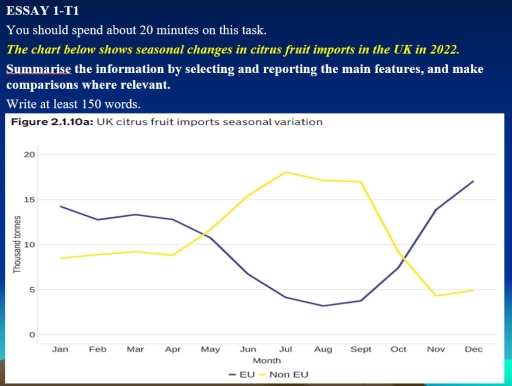
Overall, imports from the EU show a downward trend during the first half of the year, followed by a recovery in the final months, whereas non-EU imports follow the opposite pattern, peaking in summer and decreasing toward the end of the year. Both sources exhibit noticeable variation throughout the 12-month period.
In terms of the first three quarters, EU imports started at around 15,000 tonnes and remained steady until May. However, they decreased rapidly to approximately 8,000 tonnes, reaching their lowest point of 4,000 tonnes in August. In contrast, non-EU imports stood at 8,000 tonnes at the beginning of the year, rose significantly in the middle months, and peaked at 18,000 tonnes in July, staying stable until the end of September.
Regarding the final quarter, EU imports increased sharply, reaching 17,000 tonnes in December—higher than the starting levels. Conversely, non-EU imports plummeted to below 5,000 tonnes in November, with a slight increase toward the year’s end.
Word Count: 156
