Our system will evaluate the answer based on this AI-generated description.
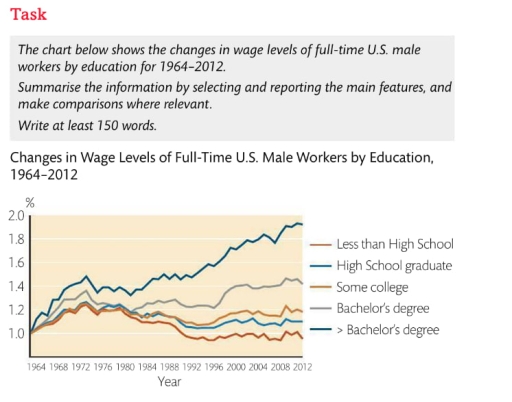
The image shows a line chart of wage levels for full-time U.S. male workers by education from 1964 to 2012. In 1964, less than high school was at 1.0, high school graduate at 1.0, some college at 1.0, bachelor's degree at approximately 1.54, and >bachelor's degree at approximately 1.68. By 1972, less than high school rose slightly above 1.0, high school graduate was at 1.2, some college at 1.25, bachelor's degree just under 1.8, and >bachelor's degree at approximately 1.9. In 1984, levels were as follows: less than high school at 1.1, high school graduate below 1.3, some college at approximately 1.4, bachelor's degree at 1.6, and >bachelor's degree peaking at 1.9. By 1996, less than high school dropped below 1.0, high school graduate near 1.1, some college about 1.2, bachelor's degree above 1.5, and >bachelor's degree at 1.8. In 2004, less than high school remained at 0.9, high school graduate just above 1.0, some college near 1.2, bachelor's degree around 1.6, >bachelor's degree at 1.9. Finally, in 2012, less than high school stayed at 0.8, high school graduate at 1.0, some college at 1.2, bachelor's at 1.6, with >bachelor's degree reaching 1.9.
Given the complexity of the image, the above description may not be entirely accurate.
Skyrocket your IELTS band score by 1-2 points in under a month with our premium plan!
Note: Both the topic and the answer were created by one of our users.
The line chart illustrates differences in the wage levels of U.S. male employees working full-time between 1964 and 2012, according to the type of their education.
Overall, it is clear from the chart that higher education provided workers with a good salary throughout the period. In contrast, men without a degree earned considerably less.
It can be seen that in 1964, all educational groups started from the same point, slightly above 1.0%. However, the income of those with more than a Bachelor’s degree experienced a significant rise, nearly doubling by 2012. In contrast, salary growth among Bachelor’s degree holders was less prominent, reaching around 1.4%.
Meanwhile, wages of those with a college or high school education fluctuated over the period. The highest percentage was slightly above 1.2% in 1972, whereas in 2008 it plummeted to almost 0.8%, making men with only a High School diploma the lowest-paid group.
In conclusion, the data suggests a strong correlation between educational level and wage growth among full-time U.S. male workers over the 48-year period.
Word Count: 171
